
Nur für die Forschung bestimmt
Dibenzazepine (YO-01027) γ-Sekretase-Inhibitor
Kat.-Nr.: S2711
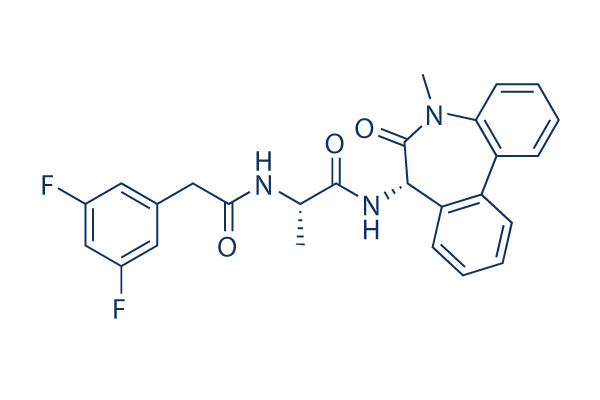
Chemische Struktur
Molekulargewicht: 463.48
Qualitätskontrolle (Quality Control)
| Verwandte Targets | HDAC Caspase Proteasome MMP HCV Protease Cysteine Protease Tyrosinase HIV Protease DPP Serine Protease |
|---|---|
| Andere Secretase Inhibitors | DAPT RO4929097 (RG-4733) LY411575 Nirogacestat (PF-03084014) MK-0752 Avagacestat (BMS-708163) Semagacestat (LY450139) MDL-28170 L-685,458 NGP 555 |
Zellkultur, Behandlung & Arbeitskonzentration
(Cell Culture, Treatment & Working Concentration)
| Zelllinien | Assay-Typ | Konzentration | Inkubationszeit | Formulierung | Aktivitätsbeschreibung | PMID |
|---|---|---|---|---|---|---|
| SupT1 | Function assay | 16 hrs | Inhibition of gamma secretase in human SupT1 cells assessed as reduction in amyloid beta 40 after 16 hrs by chemiluminescence assay, IC50=0.0026μM | 27045975 | ||
| SupT1 | Function assay | 16 hrs | Inhibition of gamma secretase mediated Notch signaling in human SupT1 cells after 16 hrs by chemiluminescence assay, IC50=0.0029μM | 27045975 | ||
| DAOY | qHTS assay | qHTS of pediatric cancer cell lines to identify multiple opportunities for drug repurposing: Primary screen for DAOY cells | 29435139 | |||
| A673 | qHTS assay | qHTS of pediatric cancer cell lines to identify multiple opportunities for drug repurposing: Primary screen for A673 cells | 29435139 | |||
| SK-N-MC | qHTS assay | qHTS of pediatric cancer cell lines to identify multiple opportunities for drug repurposing: Primary screen for SK-N-MC cells | 29435139 | |||
| SK-N-SH | qHTS assay | qHTS of pediatric cancer cell lines to identify multiple opportunities for drug repurposing: Primary screen for SK-N-SH cells | 29435139 | |||
| NB1643 | qHTS assay | qHTS of pediatric cancer cell lines to identify multiple opportunities for drug repurposing: Primary screen for NB1643 cells | 29435139 | |||
| RD | qHTS assay | qHTS of pediatric cancer cell lines to identify multiple opportunities for drug repurposing: Primary screen for RD cells | 29435139 | |||
| MG 63 (6-TG R) | qHTS assay | qHTS of pediatric cancer cell lines to identify multiple opportunities for drug repurposing: Primary screen for MG 63 (6-TG R) cells | 29435139 | |||
| Rh41 | qHTS assay | qHTS of pediatric cancer cell lines to identify multiple opportunities for drug repurposing: Primary screen for Rh41 cells | 29435139 | |||
| Klicken Sie hier, um weitere experimentelle Zellliniendaten anzuzeigen | ||||||
Chemische Informationen, Lagerung & Stabilität (Chemical Information, Storage & Stability)
| Molekulargewicht | 463.48 | Formel | C26H23F2N3O3 |
Lagerung (Ab Erhaltdatum) | |
|---|---|---|---|---|---|
| CAS-Nr. | 209984-56-5 | SDF herunterladen | Lagerung von Stammlösungen |
|
|
| Synonyme | YO-01027 | Smiles | CC(C(=O)NC1C2=CC=CC=C2C3=CC=CC=C3N(C1=O)C)NC(=O)CC4=CC(=CC(=C4)F)F | ||
Löslichkeit (Solubility)
|
In vitro |
DMSO
: 92 mg/mL
(198.49 mM)
Water : Insoluble Ethanol : Insoluble |
Molaritätsrechner
|
In vivo |
|||||
In-vivo-Formulierungsrechner (Klare Lösung)
Schritt 1: Geben Sie unten die Informationen ein (Empfohlen: Ein zusätzliches Tier einplanen, um Verluste während des Experiments auszugleichen)
Schritt 2: Geben Sie die In-vivo-Formulierung ein (Dies ist nur der Rechner, nicht die Formulierung. Bitte kontaktieren Sie uns zuerst, wenn im Abschnitt Löslichkeit keine In-vivo-Formulierung angegeben ist.)
Berechnungsergebnisse:
Arbeitskonzentration: mg/ml;
Methode zur Herstellung der DMSO-Stammflüssigkeit: mg Wirkstoff voraufgelöst in μL DMSO ( Konzentration der Stammflüssigkeit mg/mL, Bitte kontaktieren Sie uns zuerst, wenn die Konzentration die DMSO-Löslichkeit der jeweiligen Wirkstoffcharge überschreitet. )
Methode zur Herstellung der In-vivo-Formulierung: Nehmen Sie μL DMSO Stammflüssigkeit, fügen Sie als Nächstes hinzuμL PEG300, mischen und aufklären, fügen Sie als Nächstes hinzuμL Tween 80, mischen und aufklären, fügen Sie als Nächstes hinzu μL ddH2O, mischen und aufklären.
Methode zur Herstellung der In-vivo-Formulierung: Nehmen Sie μL DMSO Stammflüssigkeit, fügen Sie als Nächstes hinzu μL Maisöl, mischen und aufklären.
Hinweis: 1. Bitte stellen Sie sicher, dass die Flüssigkeit klar ist, bevor Sie das nächste Lösungsmittel hinzufügen.
2. Achten Sie darauf, die Lösungsmittel in der richtigen Reihenfolge hinzuzufügen. Sie müssen sicherstellen, dass die im vorherigen Schritt erhaltene Lösung klar ist, bevor Sie das nächste Lösungsmittel hinzufügen. Physikalische Methoden wie Vortexen, Ultraschall oder ein warmes Wasserbad können zur Unterstützung des Lösungsvorgangs verwendet werden.
Wirkungsmechanismus (Mechanism of Action)
| Targets/IC50/Ki |
γ secretase
(Cell-free assay) 2.6 nM
Notch
(Cell-free assay) 2.9 nM
|
|---|---|
| In vitro |
YO-01027 interacts directly with theγ-secretase complex and targets the N-terminal Presenilin fragment. Increasing concentrations of YO-01027 administered to APPL- or Notch-expressing cells leads to the progressive accumulation of APPL CTF fragments and a decrease in NICD production in a strictly dose-dependent manner. 10 μM of YO-01027 reduces breast cancer stem cells (BCSC) number and activity. A recent research indicates YO-01027 impairs mucin protein MUC16 biosynthesis in a concentration-dependent manner in undifferentiated cells at both preconfluent and confluent stages through Notch inhibition, but not in postmitotic stratified cells.
|
| Kinase-Assay |
Pharmakologische Hemmung der γ-secretase-Aktivität
|
|
Für YO-01027 werden Pilotexperimente mit verschiedenen Arzneimittelkonzentrationen im Bereich von 0,1 nM bis 250 nM durchgeführt, um den effektiven linearen Bereich und die maximale Hemmdosis für YO-01027 zu bestimmen. YO-01027 wird in den erforderlichen Konzentrationen dem S2-Zellmedium bei Induktion der Notch- oder APPL-Expression 6 Stunden vor der Proteinentnahme zugesetzt. Für jede Probe wird YO-01027 auch in der entsprechenden Konzentration in den Lysepuffer zur Proteinextraktion und Immunoblot-Analyse eingeschlossen.
|
|
| In vivo |
YO-01027, which is delivered 1 mg/mL by i.p. injection on the day of cell injection and every subsequent 3 days, YO-01027 significantly, decreases MCF7 but not MDA-MB-231 tumors and increases latency compared with control mice (18-28 days). YO-01027-treated MCF7 tumors that did form had significantly reduced tumor volumes. Treatment of YO-01027 into C57BL/6 mice inhibits epithelial cell proliferation and induces goblet cell differentiation in intestinal adenomas in a dose-dependent manner.
|
Referenzen |
|
Informationen zu klinischen Studien (Clinical Trial Information)
(Daten von https://clinicaltrials.gov, aktualisiert am 2025-05-21)
| NCT-Nummer | Rekrutierung | Bedingungen | Sponsor/Kollaboratoren | Startdatum | Phases |
|---|---|---|---|---|---|
| NCT06982703 | ENROLLING_BY_INVITATION | Antibiotic-associated Diarrhea |
University of Padova |
2024-06-15 |
Häufig gestellte Fragen (FAQ) (Frequently Asked Questions)
Frage 1:
How to dissolve it for in vivo applications?
Antwort:
For S2711, we suggest to use 0.5% hydroxyethyl cellulose in vivo study for it.

Die Produkte sind nur für Forschungszwecke bestimmt. Nicht zur Anwendung am Menschen. Kein Verkauf an Patienten.
©Copyright 2013 Selleck Chemicals. Alle Rechte vorbehalten.