
Nur für die Forschung bestimmt
TAK-733 MEK Inhibitor
Kat.-Nr.: S2617
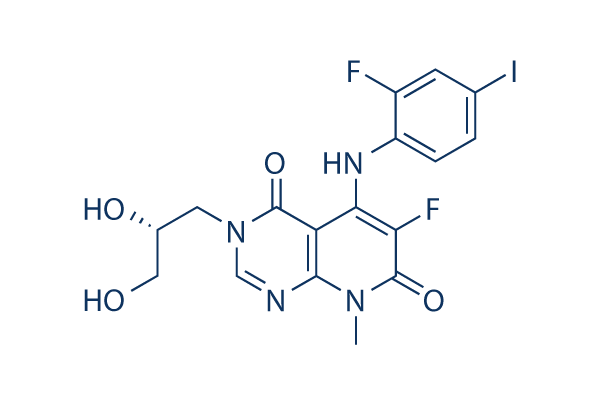
Chemische Struktur
Molekulargewicht: 504.23
Qualitätskontrolle (Quality Control)
| Verwandte Targets | ERK p38 MAPK Raf JNK Ras KRas S6 Kinase MAP4K TAK1 Mixed Lineage Kinase |
|---|---|
| Andere MEK Inhibitors | PD0325901 (Mirdametinib) U0126-EtOH PD 98059 CI-1040 (PD184352) (E/Z)-BIX02189 Pimasertib (AS-703026) Refametinib (RDEA119) AZD8330 GDC-0623 SL-327 |
Zellkultur, Behandlung & Arbeitskonzentration
(Cell Culture, Treatment & Working Concentration)
| Zelllinien | Assay-Typ | Konzentration | Inkubationszeit | Formulierung | Aktivitätsbeschreibung | PMID |
|---|---|---|---|---|---|---|
| COLO205 | Cytotoxicity assay | 72 hrs | Cytotoxicity against human COLO205 cells after 72 hrs by MTS assay, EC50=0.0021μM. | 21310613 | ||
| A375 | Cytotoxicity assay | 72 hrs | Cytotoxicity against human A375 cells after 72 hrs by MTS assay, EC50=0.0031μM. | 21310613 | ||
| COLO205 | Function assay | Inhibition of MEK1 in human COLO205 cells, IC50=0.00692μM. | 24755426 | |||
| DAOY | qHTS assay | qHTS of pediatric cancer cell lines to identify multiple opportunities for drug repurposing: Primary screen for DAOY cells | 29435139 | |||
| U-2 OS | qHTS assay | qHTS of pediatric cancer cell lines to identify multiple opportunities for drug repurposing: Primary screen for U-2 OS cells | 29435139 | |||
| SK-N-SH | qHTS assay | qHTS of pediatric cancer cell lines to identify multiple opportunities for drug repurposing: Primary screen for SK-N-SH cells | 29435139 | |||
| Rh18 | qHTS assay | qHTS of pediatric cancer cell lines to identify multiple opportunities for drug repurposing: Primary screen for Rh18 cells | 29435139 | |||
| RD | qHTS assay | qHTS of pediatric cancer cell lines to identify multiple opportunities for drug repurposing: Primary screen for RD cells | 29435139 | |||
| Klicken Sie hier, um weitere experimentelle Zellliniendaten anzuzeigen | ||||||
Chemische Informationen, Lagerung & Stabilität (Chemical Information, Storage & Stability)
| Molekulargewicht | 504.23 | Formel | C17H15F2IN4O4 |
Lagerung (Ab Erhaltdatum) | |
|---|---|---|---|---|---|
| CAS-Nr. | 1035555-63-5 | SDF herunterladen | Lagerung von Stammlösungen |
|
|
| Synonyme | N/A | Smiles | CN1C2=C(C(=C(C1=O)F)NC3=C(C=C(C=C3)I)F)C(=O)N(C=N2)CC(CO)O | ||
Löslichkeit (Solubility)
|
In vitro |
DMSO
: 101 mg/mL
(200.3 mM)
Water : Insoluble Ethanol : Insoluble |
Molaritätsrechner
|
In vivo |
|||||
In-vivo-Formulierungsrechner (Klare Lösung)
Schritt 1: Geben Sie unten die Informationen ein (Empfohlen: Ein zusätzliches Tier einplanen, um Verluste während des Experiments auszugleichen)
Schritt 2: Geben Sie die In-vivo-Formulierung ein (Dies ist nur der Rechner, nicht die Formulierung. Bitte kontaktieren Sie uns zuerst, wenn im Abschnitt Löslichkeit keine In-vivo-Formulierung angegeben ist.)
Berechnungsergebnisse:
Arbeitskonzentration: mg/ml;
Methode zur Herstellung der DMSO-Stammflüssigkeit: mg Wirkstoff voraufgelöst in μL DMSO ( Konzentration der Stammflüssigkeit mg/mL, Bitte kontaktieren Sie uns zuerst, wenn die Konzentration die DMSO-Löslichkeit der jeweiligen Wirkstoffcharge überschreitet. )
Methode zur Herstellung der In-vivo-Formulierung: Nehmen Sie μL DMSO Stammflüssigkeit, fügen Sie als Nächstes hinzuμL PEG300, mischen und aufklären, fügen Sie als Nächstes hinzuμL Tween 80, mischen und aufklären, fügen Sie als Nächstes hinzu μL ddH2O, mischen und aufklären.
Methode zur Herstellung der In-vivo-Formulierung: Nehmen Sie μL DMSO Stammflüssigkeit, fügen Sie als Nächstes hinzu μL Maisöl, mischen und aufklären.
Hinweis: 1. Bitte stellen Sie sicher, dass die Flüssigkeit klar ist, bevor Sie das nächste Lösungsmittel hinzufügen.
2. Achten Sie darauf, die Lösungsmittel in der richtigen Reihenfolge hinzuzufügen. Sie müssen sicherstellen, dass die im vorherigen Schritt erhaltene Lösung klar ist, bevor Sie das nächste Lösungsmittel hinzufügen. Physikalische Methoden wie Vortexen, Ultraschall oder ein warmes Wasserbad können zur Unterstützung des Lösungsvorgangs verwendet werden.
Wirkungsmechanismus (Mechanism of Action)
| Targets/IC50/Ki |
MEK1
(Cell-free assay) 3.2 nM
|
|---|---|
| In vitro |
TAK-733 is highly potent and selective MEK allosteric site inhibitor with IC50 of 3.2 nM. This compound shows potent enzymatic and cell activity with an EC50 of 1.9 nM against ERK phosphorylation in cells.
|
| In vivo |
TAK-733 demonstrates broad antitumor activity in mouse xenograft models of human cancer including models of melanoma, colorectal, NSCLC, pancreatic and breast cancer. This compound is well tolerated with pharmacokinetics and pharmacodynamics that support once-daily oral dosing in humans. It shows maximally efficacious doses at once daily orally doses of 10 mg/kg.
|
Referenzen |
|
Anwendungen (Applications)
| Methoden | Biomarker | Bilder | PMID |
|---|---|---|---|
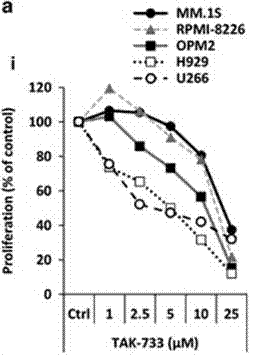
| Growth inhibition assay | Cell viability |
|
26918363 |
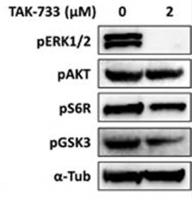
| Western blot | p-ERK / p-AKT / p-S6R / p-GSK3 pRb / Cyclin E |
|
26918363 |
Informationen zu klinischen Studien (Clinical Trial Information)
(Daten von https://clinicaltrials.gov, aktualisiert am 2013-11-01)
| NCT-Nummer | Rekrutierung | Bedingungen | Sponsor/Kollaboratoren | Startdatum | Phases |
|---|---|---|---|---|---|
| NCT01613261 | WITHDRAWN | Advanced Nonhematologic Malignancies |
Millennium Pharmaceuticals, Inc. |
2013-08 | PHASE1 |
| NCT01613261 | Withdrawn | Advanced Nonhematologic Malignancies |
Millennium Pharmaceuticals Inc. |
2013-08 | Phase 1 |
| NCT00948467 | COMPLETED | Advanced Non-hematologic Malignancies; Advanced Metastatic Melanoma |
Millennium Pharmaceuticals, Inc. |
2009-12 | PHASE1 |
| NCT00948467 | Completed | Advanced Non-hematologic Malignancies|Advanced Metastatic Melanoma |
Millennium Pharmaceuticals Inc. |
2009-12 | Phase 1 |

Die Produkte sind nur für Forschungszwecke bestimmt. Nicht zur Anwendung am Menschen. Kein Verkauf an Patienten.
©Copyright 2013 Selleck Chemicals. Alle Rechte vorbehalten.