
Nur für die Forschung bestimmt
SB-525334 ALK5-Inhibitor
Kat.-Nr.: S1476
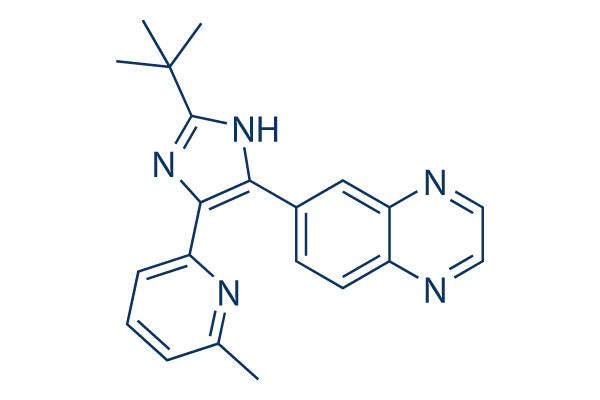
Chemische Struktur
Molekulargewicht: 343.42
Qualitätskontrolle (Quality Control)
| Verwandte Targets | PKC ROCK Bcr-Abl |
|---|---|
| Andere TGF-beta/Smad Inhibitors | SB431542 RepSox (E-616452) Vactosertib (TEW-7197) LDN-193189 A-83-01 LDN-193189 Dihydrochloride Galunisertib (LY2157299) SRI-011381 (C381) LY2109761 SIS3 Hydrochloride |
Zellkultur, Behandlung & Arbeitskonzentration
(Cell Culture, Treatment & Working Concentration)
| Zelllinien | Assay-Typ | Konzentration | Inkubationszeit | Formulierung | Aktivitätsbeschreibung | PMID |
|---|---|---|---|---|---|---|
| MiaPaCa2 | Cell Viability Assay | 0-10 μM | 72 h | efficiently reduces the viability with | 22399597 | |
| HUVECs | Function Assay | 10 μM | 72 h | reduces the phosphorylation of smad2 | 23968981 | |
| HUVECs | Function Assay | 10 μM | 72 h | blocks signaling | 23968981 | |
| HUVECs | Function Assay | 10 μM | 24/48/72 h | leads to a disruption of the HUVEC monolayer after 72 hr | 23968981 | |
| rhPOSTN | Apoptosis Assay | 0.5 μM | 48 h | significantly decreases the number of apoptotic cells | 24129188 | |
| AsPC1 | Cell Viability Assay | 0-10 μM | 72 h | efficiently reduces the viability with | 22399597 | |
| PASMCs | Function Assay | 1 μM | 15 min | inhibits TGF-β1-mediated proliferation of familial iPAH PASMCs at an IC50 of 295 nmol/L | 19116361 | |
| ELT-3 | Function Assay | 0.5/1.0/2.0 μM | 1 h | DMSO | inhibits TGF-β signaling in leiomyomas | 17505012 |
| Sf9 | Function assay | Inhibition of human recombinant GST-fused ALK5 expressed in Sf9 cells, IC50 = 0.162 μM. | 20472445 | |||
| TC32 | qHTS assay | qHTS of pediatric cancer cell lines to identify multiple opportunities for drug repurposing: Primary screen for TC32 cells | 29435139 | |||
| A673 | qHTS assay | qHTS of pediatric cancer cell lines to identify multiple opportunities for drug repurposing: Primary screen for A673 cells | 29435139 | |||
| Saos-2 | qHTS assay | qHTS of pediatric cancer cell lines to identify multiple opportunities for drug repurposing: Primary screen for Saos-2 cells | 29435139 | |||
| BT-37 | qHTS assay | qHTS of pediatric cancer cell lines to identify multiple opportunities for drug repurposing: Primary screen for BT-37 cells | 29435139 | |||
| BT-12 | qHTS assay | qHTS of pediatric cancer cell lines to identify multiple opportunities for drug repurposing: Primary screen for BT-12 cells | 29435139 | |||
| NB1643 | qHTS assay | qHTS of pediatric cancer cell lines to identify multiple opportunities for drug repurposing: Primary screen for NB1643 cells | 29435139 | |||
| OHS-50 | qHTS assay | qHTS of pediatric cancer cell lines to identify multiple opportunities for drug repurposing: Primary screen for OHS-50 cells | 29435139 | |||
| Rh41 | qHTS assay | qHTS of pediatric cancer cell lines to identify multiple opportunities for drug repurposing: Primary screen for Rh41 cells | 29435139 | |||
| SJ-GBM2 | qHTS assay | qHTS of pediatric cancer cell lines to identify multiple opportunities for drug repurposing: Primary screen for SJ-GBM2 cells | 29435139 | |||
| SK-N-MC | qHTS assay | qHTS of pediatric cancer cell lines to identify multiple opportunities for drug repurposing: Primary screen for SK-N-MC cells | 29435139 | |||
| Klicken Sie hier, um weitere experimentelle Zellliniendaten anzuzeigen | ||||||
Chemische Informationen, Lagerung & Stabilität (Chemical Information, Storage & Stability)
| Molekulargewicht | 343.42 | Formel | C21H21N5 |
Lagerung (Ab Erhaltdatum) | |
|---|---|---|---|---|---|
| CAS-Nr. | 356559-20-1 | SDF herunterladen | Lagerung von Stammlösungen |
|
|
| Synonyme | N/A | Smiles | CC1=NC(=CC=C1)C2=C(N=C(N2)C(C)(C)C)C3=CC4=NC=CN=C4C=C3 | ||
Löslichkeit (Solubility)
|
In vitro |
DMSO
: 69 mg/mL
(200.92 mM)
Ethanol : 69 mg/mL Water : Insoluble |
Molaritätsrechner
|
In vivo |
|||||
In-vivo-Formulierungsrechner (Klare Lösung)
Schritt 1: Geben Sie unten die Informationen ein (Empfohlen: Ein zusätzliches Tier einplanen, um Verluste während des Experiments auszugleichen)
Schritt 2: Geben Sie die In-vivo-Formulierung ein (Dies ist nur der Rechner, nicht die Formulierung. Bitte kontaktieren Sie uns zuerst, wenn im Abschnitt Löslichkeit keine In-vivo-Formulierung angegeben ist.)
Berechnungsergebnisse:
Arbeitskonzentration: mg/ml;
Methode zur Herstellung der DMSO-Stammflüssigkeit: mg Wirkstoff voraufgelöst in μL DMSO ( Konzentration der Stammflüssigkeit mg/mL, Bitte kontaktieren Sie uns zuerst, wenn die Konzentration die DMSO-Löslichkeit der jeweiligen Wirkstoffcharge überschreitet. )
Methode zur Herstellung der In-vivo-Formulierung: Nehmen Sie μL DMSO Stammflüssigkeit, fügen Sie als Nächstes hinzuμL PEG300, mischen und aufklären, fügen Sie als Nächstes hinzuμL Tween 80, mischen und aufklären, fügen Sie als Nächstes hinzu μL ddH2O, mischen und aufklären.
Methode zur Herstellung der In-vivo-Formulierung: Nehmen Sie μL DMSO Stammflüssigkeit, fügen Sie als Nächstes hinzu μL Maisöl, mischen und aufklären.
Hinweis: 1. Bitte stellen Sie sicher, dass die Flüssigkeit klar ist, bevor Sie das nächste Lösungsmittel hinzufügen.
2. Achten Sie darauf, die Lösungsmittel in der richtigen Reihenfolge hinzuzufügen. Sie müssen sicherstellen, dass die im vorherigen Schritt erhaltene Lösung klar ist, bevor Sie das nächste Lösungsmittel hinzufügen. Physikalische Methoden wie Vortexen, Ultraschall oder ein warmes Wasserbad können zur Unterstützung des Lösungsvorgangs verwendet werden.
Wirkungsmechanismus (Mechanism of Action)
| Targets/IC50/Ki |
TGFβR1(ALK5)
(Cell-free assay) 14.3 nM
|
|---|---|
| In vitro |
SB 525334 shows no inhibition in the enzymes ALK2, 3, and 6, with IC50 values > 10 μM. SB 525334 blocks phosphorylation induced by TGF-β1 and nuclear translocation of Smad2/3 in renal proximal tubule cells. SB 525334 also inhibits the increased mRNA expression levels of plasminogen activator inhibitor-1 (PAI-1) and procollagen α1(I) induced by TGF-β1 in A498 renal epithelial carcinoma cells at 1 μM). SB 525334 (1 μM) attenuates the heightened sensitivity to TGF-β1 exhibited by pulmonary artery smooth muscle cells (PASMCs) from patients with familial forms of idiopathic pulmonary arterial hypertension (PAH). |
| Kinase-Assay |
Kinase-Assay zur Bestimmung der Potenz und Selektivität von SB 525334
|
|
Um die Potenz von SB 525334 zu bestimmen, wird die gereinigte GST-markierte Kinasedomäne von ALK5 mit gereinigtem GST-markiertem Full-Length Smad3 in Anwesenheit von 33P-γATP und verschiedenen Konzentrationen von SB 525334 inkubiert. Der Messwert ist radioaktiv markiertes Smad3. Zur Bestimmung der Selektivität von SB 525334 werden gereinigte GST-markierte Kinasedomänen von ALK2 und ALK4 mit GST-markiertem Full-Length Smad1 bzw. Smad3 in Anwesenheit verschiedener Konzentrationen von SB 525334 inkubiert. IC50-Werte werden berechnet.
|
|
| In vivo |
SB 525334 (10 mg/kg/day) decreases the renal mRNA levels of PAI-1, procollagen α1(I), and procollagen α1(III) in a nephritis-induced renal fibrosis rat model. Furthermore, PAN-induced proteinuria is significantly inhibited by SB 525334 (10 mg/kg/day). SB 525334 may also be efficacious in mesenchymal tumors. SB 525334 (10 mg/kg/day) significantly decreases uterine mesenchymal tumor incidence, multiplicity, and size in Eker rats. SB 525334 significantly reverses pulmonary arterial pressure and inhibits right ventricular hypertrophy in a rat model of PAH. This is revealed by a significant reduction in pulmonary arteriole muscularization induced by monocrotaline (used to induce PAH) after treatment with SB 525334 (3 or 30 mg/kg). In a induced pulmonary fibrosis mice model, SB 525334 (10 mg/kg or 30 mg/kg) attenuates the histopathological alterations in the lung, and significantly decreased mRNA expression of Type I and III procollagen and fibronectin. SB 525334 also attenuates Smad2/3 nuclear translocation, myofibroblast proliferation, deposition of Type I collagen, and decreases CTGF-expressing cells. |
Referenzen |
|
Anwendungen (Applications)
| Methoden | Biomarker | Bilder | PMID |
|---|---|---|---|
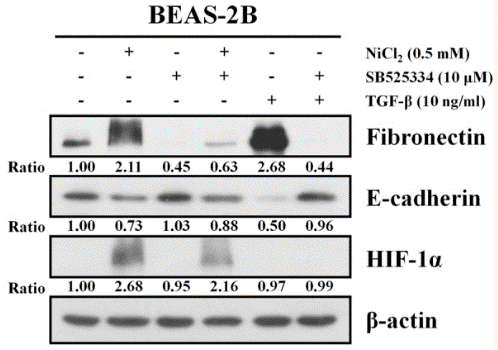
| Western blot | Fibronectin / E-cadherin / Hif-1α |
|
29127306 |
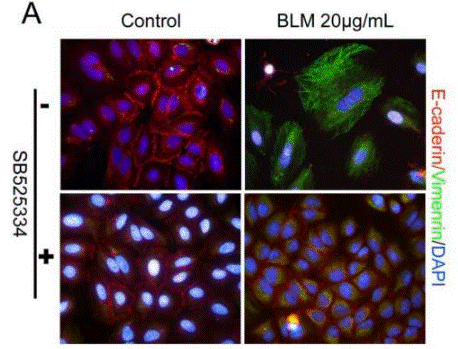
| Immunofluorescence | E-cadherin / Vimentin |
|
27471572 |
Häufig gestellte Fragen (FAQ) (Frequently Asked Questions)
Frage 1:
I want to know the feasibility of using it via oral gavage in rodents (dosing, frequency, formulation…)?
Antwort:
It can be used for oral gavage in rodents, and the vehicle we suggest is: 30% Propylene glycol, 5% Tween 80, 65% D5W (dextrose(5%)in water) at 20mg/ml maximum. Based on the following reference they administrated this compound at an estimated dose of 10 mg/kg/day in rat for 2 months: http://clincancerres.aacrjournals.org/content/13/10/3087.long

Die Produkte sind nur für Forschungszwecke bestimmt. Nicht zur Anwendung am Menschen. Kein Verkauf an Patienten.
©Copyright 2013 Selleck Chemicals. Alle Rechte vorbehalten.