
Nur für die Forschung bestimmt
SB505124 TGF-beta/Smad Inhibitor
Kat.-Nr.: S2186
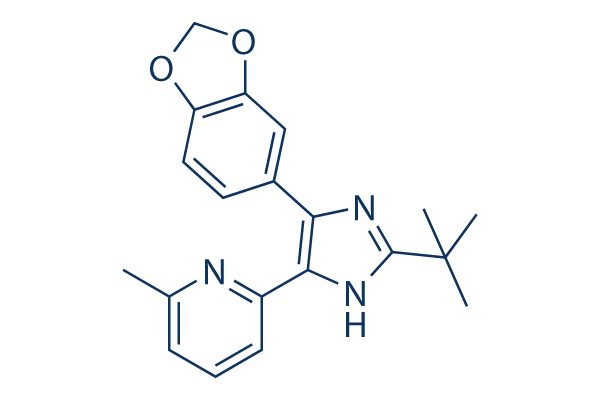
Chemische Struktur
Molekulargewicht: 335.4
Qualitätskontrolle (Quality Control)
| Verwandte Targets | PKC ROCK Bcr-Abl |
|---|---|
| Andere TGF-beta/Smad Inhibitors | SB431542 RepSox (E-616452) Vactosertib (TEW-7197) LDN-193189 A-83-01 LDN-193189 Dihydrochloride Galunisertib (LY2157299) SRI-011381 (C381) LY2109761 SIS3 Hydrochloride |
Zellkultur, Behandlung & Arbeitskonzentration
(Cell Culture, Treatment & Working Concentration)
| Zelllinien | Assay-Typ | Konzentration | Inkubationszeit | Formulierung | Aktivitätsbeschreibung | PMID |
|---|---|---|---|---|---|---|
| Sf9 | Function assay | Inhibition of human recombinant GST-fused ALK5 expressed in Sf9 insect cells using casein as substrate by proprietary radioisotopic protein kinase assay, IC50=0.0349μM | 26483198 | |||
| HaCaT | Function assay | 24 hrs | Inhibition of ALK5 in human HaCaT cells assessed as inhibition of TGFbeta1-induced luciferase activity after 24 hrs by luciferase reporter gene assay, IC50=0.0438μM | 24786585 | ||
| Sf9 | Function assay | Inhibition of human recombinant GST-fused ALK5 expressed in Sf9 cells, IC50=0.054μM | 21435890 | |||
| Sf9 | Function assay | Inhibition of GST-fused recombinant human ALK5 expressed in baculovirus-infected insect Sf9 cells using casein as substrate by radioisotope-based assay, IC50=0.054μM | 24704197 | |||
| Sf9 | Function assay | Inhibition of human recombinant ALK5 expressed in insect Sf9 cells using casein as substrate by radioisotopic assay, IC50=0.054μM | 24786585 | |||
| Sf9 | Function assay | Inhibition of human recombinant GST-fused ALK5 expressed in Sf9 cells using casein as a substrate by radioisotopic protein kinase assay, IC50=0.0544μM | 23047226 | |||
| 4T1 | Function assay | 24 hrs | Inhibition of ALK5 in mouse 4T1 cells assessed as inhibition of TGFbeta1-induced luciferase activity after 24 hrs by luciferase reporter gene assay, IC50=0.0766μM | 24786585 | ||
| Sf9 | Function assay | Inhibition of human recombinant GST-fused ALK5 expressed in Sf9 cells, IC50=0.169μM | 20472445 | |||
| NMuMG | Function assay | 0.1 to 0.5 uM | 1 hr | Inhibition of ALK5 activity in mouse NMuMG cells assessed as TGFbeta-induced phosphorylation of Smad2 at 0.1 to 0.5 uM after 1 hr by Western blot analysis | 23047226 | |
| TC32 | qHTS assay | qHTS of pediatric cancer cell lines to identify multiple opportunities for drug repurposing: Primary screen for TC32 cells | 29435139 | |||
| SJ-GBM2 | qHTS assay | qHTS of pediatric cancer cell lines to identify multiple opportunities for drug repurposing: Primary screen for SJ-GBM2 cells | 29435139 | |||
| A673 | qHTS assay | qHTS of pediatric cancer cell lines to identify multiple opportunities for drug repurposing: Primary screen for A673 cells | 29435139 | |||
| SK-N-MC | qHTS assay | qHTS of pediatric cancer cell lines to identify multiple opportunities for drug repurposing: Primary screen for SK-N-MC cells | 29435139 | |||
| BT-37 | qHTS assay | qHTS of pediatric cancer cell lines to identify multiple opportunities for drug repurposing: Primary screen for BT-37 cells | 29435139 | |||
| Saos-2 | qHTS assay | qHTS of pediatric cancer cell lines to identify multiple opportunities for drug repurposing: Primary screen for Saos-2 cells | 29435139 | |||
| SK-N-SH | qHTS assay | qHTS of pediatric cancer cell lines to identify multiple opportunities for drug repurposing: Primary screen for SK-N-SH cells | 29435139 | |||
| NB1643 | qHTS assay | qHTS of pediatric cancer cell lines to identify multiple opportunities for drug repurposing: Primary screen for NB1643 cells | 29435139 | |||
| LAN-5 | qHTS assay | qHTS of pediatric cancer cell lines to identify multiple opportunities for drug repurposing: Primary screen for LAN-5 cells | 29435139 | |||
| BT-12 | qHTS assay | qHTS of pediatric cancer cell lines to identify multiple opportunities for drug repurposing: Primary screen for BT-12 cells | 29435139 | |||
| OHS-50 | qHTS assay | qHTS of pediatric cancer cell lines to identify multiple opportunities for drug repurposing: Primary screen for OHS-50 cells | 29435139 | |||
| RD | qHTS assay | qHTS of pediatric cancer cell lines to identify multiple opportunities for drug repurposing: Primary screen for RD cells | 29435139 | |||
| Rh41 | qHTS assay | qHTS of pediatric cancer cell lines to identify multiple opportunities for drug repurposing: Primary screen for Rh41 cells | 29435139 | |||
| A673 | qHTS assay | qHTS of pediatric cancer cell lines to identify multiple opportunities for drug repurposing: Confirmatory screen for A673 cells) | 29435139 | |||
| SK-N-MC | qHTS assay | qHTS of pediatric cancer cell lines to identify multiple opportunities for drug repurposing: Confirmatory screen for SK-N-MC cells | 29435139 | |||
| BT-12 | qHTS assay | qHTS of pediatric cancer cell lines to identify multiple opportunities for drug repurposing: Confirmatory screen for BT-12 cells | 29435139 | |||
| LAN-5 | qHTS assay | qHTS of pediatric cancer cell lines to identify multiple opportunities for drug repurposing: Confirmatory screen for LAN-5 cells | 29435139 | |||
| BT-37 | qHTS assay | qHTS of pediatric cancer cell lines to identify multiple opportunities for drug repurposing: Confirmatory screen for BT-37 cells | 29435139 | |||
| TC32 | qHTS assay | qHTS of pediatric cancer cell lines to identify multiple opportunities for drug repurposing: Confirmatory screen for TC32 cells | 29435139 | |||
| fibroblast cells | qHTS assay | qHTS of pediatric cancer cell lines to identify multiple opportunities for drug repurposing: Confirmatory screen for control Hh wild type fibroblast cells | 29435139 | |||
| Klicken Sie hier, um weitere experimentelle Zellliniendaten anzuzeigen | ||||||
Chemische Informationen, Lagerung & Stabilität (Chemical Information, Storage & Stability)
| Molekulargewicht | 335.4 | Formel | C20H21N3O2 |
Lagerung (Ab Erhaltdatum) | |
|---|---|---|---|---|---|
| CAS-Nr. | 694433-59-5 | SDF herunterladen | Lagerung von Stammlösungen |
|
|
| Synonyme | N/A | Smiles | CC1=NC(=CC=C1)C2=C(N=C(N2)C(C)(C)C)C3=CC4=C(C=C3)OCO4 | ||
Löslichkeit (Solubility)
|
In vitro |
DMSO
: 67 mg/mL
(199.76 mM)
Ethanol : 67 mg/mL Water : Insoluble |
Molaritätsrechner
|
In vivo |
|||||
In-vivo-Formulierungsrechner (Klare Lösung)
Schritt 1: Geben Sie unten die Informationen ein (Empfohlen: Ein zusätzliches Tier einplanen, um Verluste während des Experiments auszugleichen)
Schritt 2: Geben Sie die In-vivo-Formulierung ein (Dies ist nur der Rechner, nicht die Formulierung. Bitte kontaktieren Sie uns zuerst, wenn im Abschnitt Löslichkeit keine In-vivo-Formulierung angegeben ist.)
Berechnungsergebnisse:
Arbeitskonzentration: mg/ml;
Methode zur Herstellung der DMSO-Stammflüssigkeit: mg Wirkstoff voraufgelöst in μL DMSO ( Konzentration der Stammflüssigkeit mg/mL, Bitte kontaktieren Sie uns zuerst, wenn die Konzentration die DMSO-Löslichkeit der jeweiligen Wirkstoffcharge überschreitet. )
Methode zur Herstellung der In-vivo-Formulierung: Nehmen Sie μL DMSO Stammflüssigkeit, fügen Sie als Nächstes hinzuμL PEG300, mischen und aufklären, fügen Sie als Nächstes hinzuμL Tween 80, mischen und aufklären, fügen Sie als Nächstes hinzu μL ddH2O, mischen und aufklären.
Methode zur Herstellung der In-vivo-Formulierung: Nehmen Sie μL DMSO Stammflüssigkeit, fügen Sie als Nächstes hinzu μL Maisöl, mischen und aufklären.
Hinweis: 1. Bitte stellen Sie sicher, dass die Flüssigkeit klar ist, bevor Sie das nächste Lösungsmittel hinzufügen.
2. Achten Sie darauf, die Lösungsmittel in der richtigen Reihenfolge hinzuzufügen. Sie müssen sicherstellen, dass die im vorherigen Schritt erhaltene Lösung klar ist, bevor Sie das nächste Lösungsmittel hinzufügen. Physikalische Methoden wie Vortexen, Ultraschall oder ein warmes Wasserbad können zur Unterstützung des Lösungsvorgangs verwendet werden.
Wirkungsmechanismus (Mechanism of Action)
| Targets/IC50/Ki |
ALK5
(Cell-free assay) 47 nM
ALK4
(Cell-free assay) 129 nM
|
|---|---|
| In vitro |
SB505124 is identified as a reversible ATP competitive and selective ALK inhibitor of ALK4 and ALK5. This compound shows no toxicity to renal epithelial A498 cells at concentrations up to 100 μM for 48 hours, and blocks TGF-β–induced apoptosis of FaO cells and NRP 154 cells in a concentration-dependent manner. In human umbilical vein endothelial cells (HUVEC), this chemical (500 nM) blocks the changes of TGF-β1 on F-actin assembly and prevents ROS production induced by TGF-β. By inhibiting TGF-beta1 signaling, it leads to decreased (DFO)-induced neurogenesis. A recent study shows that this inhibitor suppresses the migration and invasion of breast cancer MCF-7-M5 cells. |
| Kinase-Assay |
In-vitro-Proteinkinase-Assay
|
|
Kinase-Assays werden, wie von Laping et al., 2002 beschrieben, unter Verwendung der Kinasedomäne von ALK5 und des vollen N-terminal fusionierten GST-Smad3 durchgeführt. Kinase-Assays werden mit 65 nM GST-ALK5 und 184 nM GST-Smad3 in 50 mM HEPES, 5 mM MgCl2, 1 mM CaCl2, 1 mM Dithiothreitol und 3 μM ATP durchgeführt. Die Reaktionen werden 3 Stunden bei 30 °C mit 0,5 μCi [33P]γATP inkubiert. Phosphoryliertes Protein wird auf P-81-Papier eingefangen, mit 0,5 %iger Phosphorsäure gewaschen und durch Flüssigkeitsszintillation gezählt. Alternativ wird Smad3- oder Smad1-Protein auch auf FlashPlate Sterile Basic Microplates beschichtet. Kinase-Assays werden dann in FlashPlates mit denselben Assay-Bedingungen unter Verwendung entweder der Kinasedomäne von ALK5 mit Smad3 als Substrat oder der Kinasedomäne von ALK6 (BMP-Rezeptor) mit Smad1 als Substrat durchgeführt. Die Platten werden dreimal mit Phosphatpuffer gewaschen und mit TopCount gezählt.
|
|
| In vivo |
In a rabbit GFS model, SB505124 decreased the intraocular pressure (IOP) levels and reduces subconjunctival cell infiltration and scarring at the surgical site in the GFS. In (TAC)-treated mice and FK12EC KO mice, this compound prevents the activation of endothelial TGF-β receptors and induction of renal arteriolar hyalinosis. |
Referenzen |
|
Anwendungen (Applications)
| Methoden | Biomarker | Bilder | PMID |
|---|---|---|---|
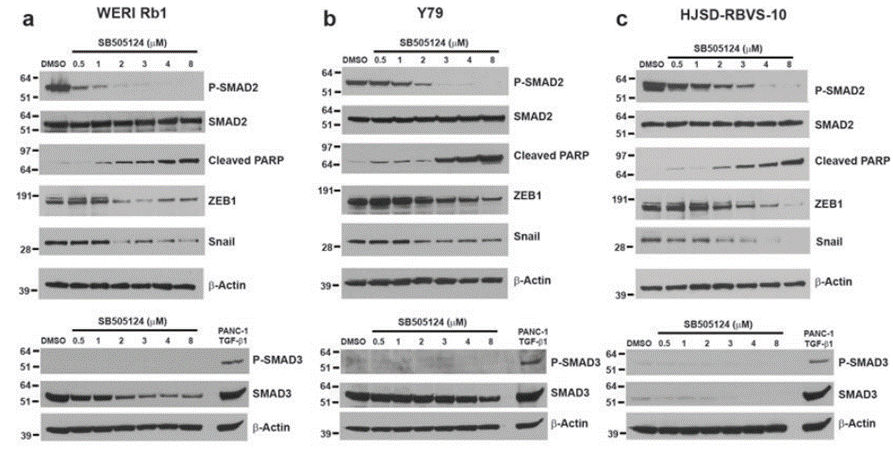
| Western blot | p-SMAD2 / SMAD2 / Cleaved PARP / ZEB1 / Snail |
|
30401983 |

Die Produkte sind nur für Forschungszwecke bestimmt. Nicht zur Anwendung am Menschen. Kein Verkauf an Patienten.
©Copyright 2013 Selleck Chemicals. Alle Rechte vorbehalten.