
Nur für die Forschung bestimmt
Procarbazine HCl DNA/RNA Synthesis Inhibitor
Kat.-Nr.: S1995
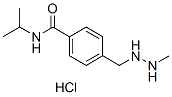
Chemische Struktur
Molekulargewicht: 257.76
Qualitätskontrolle (Quality Control)
| Verwandte Targets | HDAC PARP ATM/ATR DNA-PK WRN Topoisomerase PPAR Sirtuin Casein Kinase eIF |
|---|---|
| Andere DNA/RNA Synthesis Inhibitors | CX-5461 (Pidnarulex) SCR7 Favipiravir (T-705) RK-33 EED226 BMH-21 Carmofur Triapine (3-AP) YK-4-279 Halofuginone |
Chemische Informationen, Lagerung & Stabilität (Chemical Information, Storage & Stability)
| Molekulargewicht | 257.76 | Formel | C12H19N3O.HCl |
Lagerung (Ab Erhaltdatum) | |
|---|---|---|---|---|---|
| CAS-Nr. | 366-70-1 | SDF herunterladen | Lagerung von Stammlösungen |
|
|
| Synonyme | NSC-77213 HCl | Smiles | CC(C)NC(=O)C1=CC=C(C=C1)CNNC.Cl | ||
Löslichkeit (Solubility)
|
In vitro |
Water : 52 mg/mL Ethanol : 52 mg/mL
DMSO
: Insoluble
|
Molaritätsrechner
|
In vivo |
|||||
In-vivo-Formulierungsrechner (Klare Lösung)
Schritt 1: Geben Sie unten die Informationen ein (Empfohlen: Ein zusätzliches Tier einplanen, um Verluste während des Experiments auszugleichen)
Schritt 2: Geben Sie die In-vivo-Formulierung ein (Dies ist nur der Rechner, nicht die Formulierung. Bitte kontaktieren Sie uns zuerst, wenn im Abschnitt Löslichkeit keine In-vivo-Formulierung angegeben ist.)
Berechnungsergebnisse:
Arbeitskonzentration: mg/ml;
Methode zur Herstellung der DMSO-Stammflüssigkeit: mg Wirkstoff voraufgelöst in μL DMSO ( Konzentration der Stammflüssigkeit mg/mL, Bitte kontaktieren Sie uns zuerst, wenn die Konzentration die DMSO-Löslichkeit der jeweiligen Wirkstoffcharge überschreitet. )
Methode zur Herstellung der In-vivo-Formulierung: Nehmen Sie μL DMSO Stammflüssigkeit, fügen Sie als Nächstes hinzuμL PEG300, mischen und aufklären, fügen Sie als Nächstes hinzuμL Tween 80, mischen und aufklären, fügen Sie als Nächstes hinzu μL ddH2O, mischen und aufklären.
Methode zur Herstellung der In-vivo-Formulierung: Nehmen Sie μL DMSO Stammflüssigkeit, fügen Sie als Nächstes hinzu μL Maisöl, mischen und aufklären.
Hinweis: 1. Bitte stellen Sie sicher, dass die Flüssigkeit klar ist, bevor Sie das nächste Lösungsmittel hinzufügen.
2. Achten Sie darauf, die Lösungsmittel in der richtigen Reihenfolge hinzuzufügen. Sie müssen sicherstellen, dass die im vorherigen Schritt erhaltene Lösung klar ist, bevor Sie das nächste Lösungsmittel hinzufügen. Physikalische Methoden wie Vortexen, Ultraschall oder ein warmes Wasserbad können zur Unterstützung des Lösungsvorgangs verwendet werden.
Wirkungsmechanismus (Mechanism of Action)
| In vitro |
Procarbazine plus Cu(II) induce piperidine-labile and formamidopyrimidine-DNA glycosylase-sensitive lesions at the 5'-ACG-3' sequence, complementary to a hotspot of the p53 gene, and the 5'-TG-3' sequence. Procarbazine causes DNA damage through non-enzymatic formation of the Cu(I)-hydroperoxo complex and methyl radicals. Procarbazine has a strong clastogenic effect in hematopoietic cells and is mutagenic in a variety organs after high dose treatment. |
|---|---|
| In vivo |
Procarbazine causes significant decrease in testicular and epididymal weight and a drastic reduction in haploid cells and spermatogenic arrest, demonstrating variation among the test golden hamster. Procarbazine produces a dose-dependent potentiation of MAO A in brown adipose tissue, the elevation being more pronounced following monomethylhydrazine, with activity rising to 350% of that in control homogenates in rats. Procarbazine or monomethylhydrazine reduces metabolism of this amine by a similar degree as had been determined ex-vivo in blood vessel homogenates. Procarbazine is mutagenic, clastogenic and teratogenic in a wide range of test systems of varying complexity and a wide-spectrum carcinogen in rodents and monkeys, causing tumours of the haemopoietic system, the mammary gland, the lung and the nervous system. Procarbazine in vivo undergoes a complex series of metabolic changes that result in the generation of a number of chemically reactive species, including methylating agents and free radicals. |
Referenzen |
|
Informationen zu klinischen Studien (Clinical Trial Information)
(Daten von https://clinicaltrials.gov, aktualisiert am 2026-09-04)
| NCT-Nummer | Rekrutierung | Bedingungen | Sponsor/Kollaboratoren | Startdatum | Phases |
|---|---|---|---|---|---|
| NCT05675410 | RECRUITING | Lugano Classification Limited Stage Hodgkin Lymphoma AJCC v8 |
National Cancer Institute (NCI) |
2023-05-11 | PHASE3 |
| NCT00887146 | ACTIVE_NOT_RECRUITING | Brain and Central Nervous System Tumors |
Alliance for Clinical Trials in Oncology |
2009-09 | PHASE3 |
| NCT06830421 | RECRUITING | Primary Central Nervous System Lymphoma |
University Hospital Freiburg |
2023-08-09 | PHASE3 |
| NCT06541665 | ACTIVE_NOT_RECRUITING | Primary Central Nervous System Lymphoma |
Ono Pharmaceutical Co., Ltd. |
2024-05-17 | PHASE1 |
| NCT07015242 | RECRUITING | Lymphoma |
Juno Therapeutics, Inc., a Bristol-Myers Squibb Company |
2025-11-06 | PHASE2 |
| NCT02315326 | COMPLETED | Adult Patients With Newly Diagnosed or Relapsed or Refractory Primary Central Nervous System Lymphoma (PCNSL); Or Relapsed or Refractory Secondary Central Nervous System Lymphoma (SCNSL) |
Memorial Sloan Kettering Cancer Center |
2014-12-08 | PHASE1; PHASE2 |

Die Produkte sind nur für Forschungszwecke bestimmt. Nicht zur Anwendung am Menschen. Kein Verkauf an Patienten.
©Copyright 2013 Selleck Chemicals. Alle Rechte vorbehalten.