
Nur für die Forschung bestimmt
Dacomitinib (PF-299804) HER-Inhibitor
Kat.-Nr.: S2727
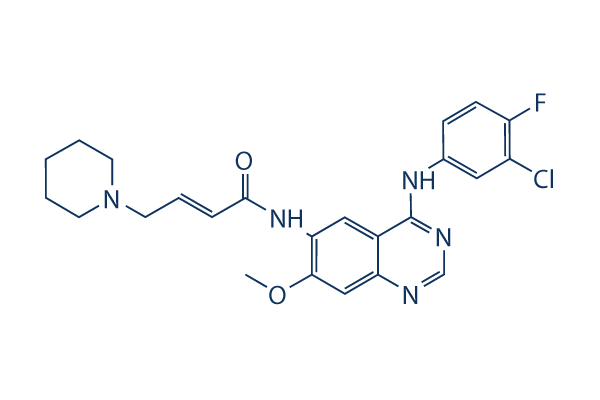
Chemische Struktur
Molekulargewicht: 469.94
Qualitätskontrolle (Quality Control)
| Verwandte Targets | VEGFR FGFR PDGFR c-Met Src MEK CSF-1R FLT3 HER2 c-Kit |
|---|---|
| Andere EGFR Inhibitors | Lazertinib (YH25448) Icotinib Hydrochloride Sunvozertinib AG-490 AG-1478 Canertinib (CI-1033) Genistein Rociletinib (CO-1686) Poziotinib (NOV120101, HM781-36B) WZ4002 |
Zellkultur, Behandlung & Arbeitskonzentration
(Cell Culture, Treatment & Working Concentration)
| Zelllinien | Assay-Typ | Konzentration | Inkubationszeit | Formulierung | Aktivitätsbeschreibung | PMID |
|---|---|---|---|---|---|---|
| PC9 cells | Function assay | 2 h | Inhibition of EGFR exon 19 deletion activating mutant phosphorylation in human PC9 cells after 2 hrs by fluorescence assay, IC50=0.63 nM | 23930994 | ||
| human LoVo cells | Function assay | 2 h | Inhibition of wild type EGFR phosphorylation in human LoVo cells after 2 hrs by fluorescence assay, IC50=0.011 μM | 23930994 | ||
| human NCI-H1975 cells | Function assay | 2 h | Inhibition of EGFR L858R/T970M double mutant phosphorylation in human NCI-H1975 cells after 2 hrs by fluorescence assay, IC50=0.042 μM | 23930994 | ||
| human NCI-H1975 cells | Proliferation assay | Antiproliferative activity against human NCI-H1975 cells assessed as growth inhibition, GI50=0.1233 μM | 26310890 | |||
| Sf9 | Function assay | 6 mins | Irreversible inhibition of GST-tagged ERBB1 (unknown origin) (Met-668 to Ala-1211 residues) expressed in baculovirus infected Sf9 insect cells assessed as reduction in Glu/Tyr copolymer phosphorylation after 6 mins by ELISA, IC50 = 0.006 μM. | 27491023 | ||
| NIH/3T3 | Function assay | 2 hrs | Irreversible inhibition of full length human ERBB1 autophosphorylation transfected in EGF-stimulated mouse NIH/3T3 cells incubated for 2 hrs followed by stimulation with EGF for 10 mins, IC50 = 0.006 μM. | 27491023 | ||
| Sf9 | Function assay | 6 mins | Irreversible inhibition of GST-tagged ERBB2 (unknown origin) (Ile-675 to Val-1256 residues) expressed in baculovirus infected Sf9 insect cells assessed as reduction in Glu/Tyr copolymer phosphorylation after 6 mins by ELISA, IC50 = 0.046 μM. | 27491023 | ||
| Sf9 | Function assay | 6 mins | Irreversible inhibition of GST-tagged ERBB4 (unknown origin) (Gly-259 to Gly-690 residues) expressed in baculovirus infected Sf9 insect cells assessed as reduction in Glu/Tyr copolymer phosphorylation after 6 mins by ELISA, IC50 = 0.074 μM. | 27491023 | ||
| Sf9 | Function assay | 30 mins | Irreversible inhibition of human recombinant GST-tagged JAK3 expressed in baculovirus infected Sf9 insect cells assessed as reduction in polyglutamic acid-tyrosine phosphorylation after 30 mins by ELISA, IC50 = 3.57 μM. | 27491023 | ||
| NIH/3T3 | Function assay | 30 mg/kg | 2 days | In vivo inhibition of full length human ERBB1 autophosphorylation transfected in NIH/3T3 cells implanted in mouse at 30 mg/kg, po qd for 2 days measured 24 hrs post last dose by Western blot analysis | 27491023 | |
| insect cells | Function assay | Inhibition of GST-tagged human EGFR catalytic domain expressed in insect cells, IC50 = 0.006 μM. | 28754471 | |||
| NCI-H1819 | Antiproliferative assay | 72 hrs | Antiproliferative activity against human NCI-H1819 cells expressing wild type HER2 incubated for 72 hrs by MTS assay, IC50 = 0.029 μM. | 28754471 | ||
| insect cells | Function assay | Inhibition of GST-tagged human HER2 catalytic domain expressed in insect cells, IC50 = 0.0457 μM. | 28754471 | |||
| NCI-H1975 | Antiproliferative assay | 72 hrs | Antiproliferative activity against human NCI-H1975 cells expressing EGFR T790M/L858R mutant incubated for 72 hrs by MTS assay, IC50 = 0.44 μM. | 28754471 | ||
| Klicken Sie hier, um weitere experimentelle Zellliniendaten anzuzeigen | ||||||
Chemische Informationen, Lagerung & Stabilität (Chemical Information, Storage & Stability)
| Molekulargewicht | 469.94 | Formel | C24H25ClFN5O2 |
Lagerung (Ab Erhaltdatum) | |
|---|---|---|---|---|---|
| CAS-Nr. | 1110813-31-4 | SDF herunterladen | Lagerung von Stammlösungen |
|
|
| Synonyme | PF299804,PF299 | Smiles | COC1=C(C=C2C(=C1)N=CN=C2NC3=CC(=C(C=C3)F)Cl)NC(=O)C=CCN4CCCCC4 | ||
Löslichkeit (Solubility)
|
In vitro |
DMSO
: 49 mg/mL
(104.26 mM)
Ethanol : 15 mg/mL Water : Insoluble |
Molaritätsrechner
|
In vivo |
|||||
In-vivo-Formulierungsrechner (Klare Lösung)
Schritt 1: Geben Sie unten die Informationen ein (Empfohlen: Ein zusätzliches Tier einplanen, um Verluste während des Experiments auszugleichen)
Schritt 2: Geben Sie die In-vivo-Formulierung ein (Dies ist nur der Rechner, nicht die Formulierung. Bitte kontaktieren Sie uns zuerst, wenn im Abschnitt Löslichkeit keine In-vivo-Formulierung angegeben ist.)
Berechnungsergebnisse:
Arbeitskonzentration: mg/ml;
Methode zur Herstellung der DMSO-Stammflüssigkeit: mg Wirkstoff voraufgelöst in μL DMSO ( Konzentration der Stammflüssigkeit mg/mL, Bitte kontaktieren Sie uns zuerst, wenn die Konzentration die DMSO-Löslichkeit der jeweiligen Wirkstoffcharge überschreitet. )
Methode zur Herstellung der In-vivo-Formulierung: Nehmen Sie μL DMSO Stammflüssigkeit, fügen Sie als Nächstes hinzuμL PEG300, mischen und aufklären, fügen Sie als Nächstes hinzuμL Tween 80, mischen und aufklären, fügen Sie als Nächstes hinzu μL ddH2O, mischen und aufklären.
Methode zur Herstellung der In-vivo-Formulierung: Nehmen Sie μL DMSO Stammflüssigkeit, fügen Sie als Nächstes hinzu μL Maisöl, mischen und aufklären.
Hinweis: 1. Bitte stellen Sie sicher, dass die Flüssigkeit klar ist, bevor Sie das nächste Lösungsmittel hinzufügen.
2. Achten Sie darauf, die Lösungsmittel in der richtigen Reihenfolge hinzuzufügen. Sie müssen sicherstellen, dass die im vorherigen Schritt erhaltene Lösung klar ist, bevor Sie das nächste Lösungsmittel hinzufügen. Physikalische Methoden wie Vortexen, Ultraschall oder ein warmes Wasserbad können zur Unterstützung des Lösungsvorgangs verwendet werden.
Wirkungsmechanismus (Mechanism of Action)
| Targets/IC50/Ki |
EGFR
(Cell-free assay) 6.0 nM
ErbB2
(Cell-free assay) 45.7 nM
ErbB4
(Cell-free assay) 73.7 nM
|
|---|---|
| In vitro |
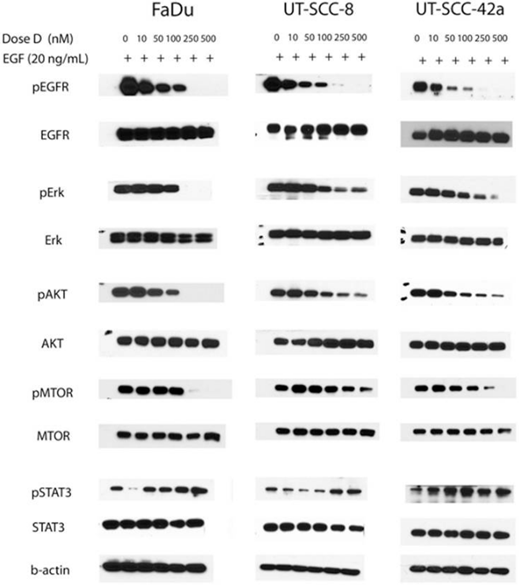
PF299804 is a specific inhibitor of the ERBB family of kinases. This compound inhibits EGFR signaling and induces apoptosis in the EGFR T790M-containing H3255 GR cell line. It is effective in -sensitive and NSCLC cell lines. This chemical inhibits the growth of H3255 and HCC827 cells engineered to express EGFR T790M. It inhibits EGFR phosphorylation in the presence of the T790M mutation. This agent is believed to irreversibly inhibit ERBB tyrosine kinase activity through binding at the ATP site and covalent modification of nucleophilic cysteine residues in the catalytic domains of ERBB family members. It shows significant growth-inhibitory effects in HER2-amplified gastric cancer cells (SNU216, N87), and it has lower 50% inhibitory concentration values compared with other EGFR tyrosine kinase inhibitors, including BIBW-2992, and CI-1033. This inhibitor induces apoptosis and G1 arrest and inhibits phosphorylation of receptors in the HER family and downstream signaling pathways including STAT3, AKT, and extracellular signal-regulated kinases (ERK) in HER2-amplified gastric cancer cells. It also blocks EGFR/HER2, HER2/HER3, and HER3/HER4 heterodimer formation as well as the association of HER3 with p85α in SNU216 cells. A recent research uses forty-seven human breast cancer and immortalized breast epithelial lines to evaluate the inhibition effects of this compound, the results indicate it preferentially inhibits growth of HER-2-amplified breast cancer cell lines than nonamplified lines (RR = 3.39, p < 0.0001). This chemical reduces the phosphorylation of HER2, EGFR, HER4, AKT, and ERK in the majority of sensitive lines. It exerts its anti-proliferative effect through a combined G0/G1 arrest and an induction of apoptosis. |
| Kinase-Assay |
ELISA-basierter ERBB-Kinase-Assay
|
|
Die zytoplasmatischen ERBB1-, ERBB 2- und ERBB4-Fusionsproteine werden durch Klonierung der ERBB1-Sequenz (Met-668 bis Ala-1211), der ERBB2-Sequenz (Ile-675 bis Val-1256) und der ERBB4-Sequenz (Gly-259 bis Gly-690) mittels PCR in den Baculovirus-Vektor pFastBac hergestellt. Die Proteine werden in mit Baculovirus infizierten Sf9-Insektenzellen als GST-Fusionsproteine exprimiert. Die Reinigung der Proteine erfolgt durch Affinitätschromatographie unter Verwendung von Glutathion-Sepharose-Beads. Die Hemmung der ERBB-Tyrosinkinase-Aktivität wird mittels eines ELISA-basierten Rezeptor-Tyrosinkinase-Assays bewertet. Kinase-Reaktionen (50 mM HEPES, pH 7,4, 125 mM NaCl, 10 mM MgCl2, 100 μM Natriumorthovanadat, 2 mM Dithiothreitol, 20 μM ATP, diese Verbindung oder Vehikelkontrolle und 1-5 nM GST-erbB pro 50 μL Reaktionsgemisch) werden in 96-Well-Platten durchgeführt, die mit 0,25 mg/mL Poly-Glu-Tyr beschichtet sind. Die Reaktionen werden für 6 Minuten bei Raumtemperatur unter Schütteln inkubiert. Die Kinase-Reaktionen werden durch Entfernung des Reaktionsgemisches gestoppt, anschließend werden die Wells mit Waschpuffer (0,1 % Tween 20 in PBS) gewaschen. Phosphorylierte Tyrosinreste werden durch Zugabe von 0,2 μg/mL Antiphosphotyrosin-Antikörper (Oncogene Ab-4; 50 μL/Well), gekoppelt an Meerrettichperoxidase (HRP), verdünnt in PBS mit 3 % BSA und 0,05 % Tween 20 für 25 Minuten unter Schütteln bei Raumtemperatur detektiert. Der Antikörper wird entfernt und die Platten werden in Waschpuffer gewaschen. HRP-Substrat (SureBlue3,3,5,5-Tetramethylbenzidin oder TMB) wird zugegeben (50 μL pro Well) und für 10-20 Minuten unter Schütteln bei Raumtemperatur inkubiert. Die TMB-Reaktion wird durch Zugabe von 50 μL Stopplösung (0,09 N H2SO4) gestoppt. Das Signal wird durch Messung der Extinktion bei 450 nm quantifiziert. Die IC50-Werte für diese Verbindung werden unter Verwendung der Median-Effekt-Methode bestimmt.
|
|
| In vivo |
Orally administered PF299804 effectively inhibits growth of HCC827 Del/T790M xenografts. Low oral administration of this compound (15mg/kg) causes significant antitumor activity, including marked tumor regressions in a variety of human tumor xenograft models that express and/ or overexpress ERBB family members or contain the double mutation (L858R/T790M) in ERBB1 (EGFR). |
Referenzen |
|
Anwendungen (Applications)
| Methoden | Biomarker | Bilder | PMID |
|---|---|---|---|
| Western blot | pEGFR / EGFR / pERK / ERK / pAKT / AKT / p-mTOR / mTOR / pSTAT3 / STAT3 |
|
24853121 |
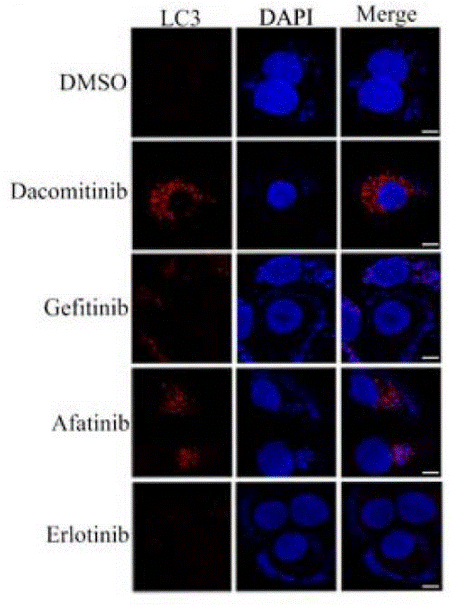
| Immunofluorescence | LC3 |
|
28366635 |
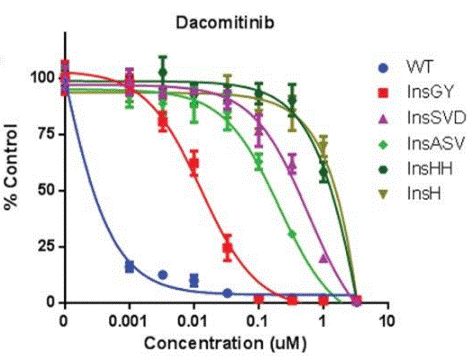
| Growth inhibition assay | Cell viability |
|
28363995 |
Informationen zu klinischen Studien (Clinical Trial Information)
(Daten von https://clinicaltrials.gov, aktualisiert am 2026-05-14)
| NCT-Nummer | Rekrutierung | Bedingungen | Sponsor/Kollaboratoren | Startdatum | Phases |
|---|---|---|---|---|---|
| NCT06486142 | RECRUITING | Non-Small Cell Lung Cancer |
Region Skane |
2022-09-21 | PHASE3 |
| NCT02925234 | RECRUITING | Cancer; Tumors; Neoplasm; Neoplasia |
The Netherlands Cancer Institute |
2016-08 | PHASE2 |
| NCT04946968 | ACTIVE_NOT_RECRUITING | Advanced Solid Tumours; Non-small Cell Lung Cancer; Head and Neck Squamous Cell Carcinoma |
National Cancer Centre, Singapore |
2021-08-24 | PHASE2 |
| NCT04423185 | RECRUITING | Rare Tumor |
Cancer Institute and Hospital, Chinese Academy of Medical Sciences |
2020-08-15 | PHASE2 |
| NCT04027647 | ACTIVE_NOT_RECRUITING | NSCLC Stage IIIB; NSCLC Stage IIIC; NSCLC Stage IV; Recurrent NSCLC; EGFR Positive Non-Small Cell Lung Cancer |
National Cancer Centre, Singapore |
2019-09-11 | PHASE2 |
| NCT03810807 | COMPLETED | Metastatic Non-small Cell Lung Cancer |
Memorial Sloan Kettering Cancer Center |
2019-01-17 | PHASE1 |
Häufig gestellte Fragen (FAQ) (Frequently Asked Questions)
Frage 1:
I would like to know whether the in vivo formulation you recommend for it is suitable for oral administration?
Antwort:
S2727 in 1% DMSO+30% polyethylene glycol+1% Tween 80 at 10mg/ml is a homogeneous suspension, and it was fine for oral gavage. When preparing the solution, please dissolve it in DMSO clearly first. If it dissolves not readily, please sonicate and warm it at about 45-50℃ for a while to help dissolving. Then add PEG 300 and Tween 80. After they mixed well, dilute with water. Then it will become a homogeneous suspension.

Die Produkte sind nur für Forschungszwecke bestimmt. Nicht zur Anwendung am Menschen. Kein Verkauf an Patienten.
©Copyright 2013 Selleck Chemicals. Alle Rechte vorbehalten.