
Nur für die Forschung bestimmt
Mifepristone (RU-486) Progesterone Receptor Antagonist
Kat.-Nr.: S2606
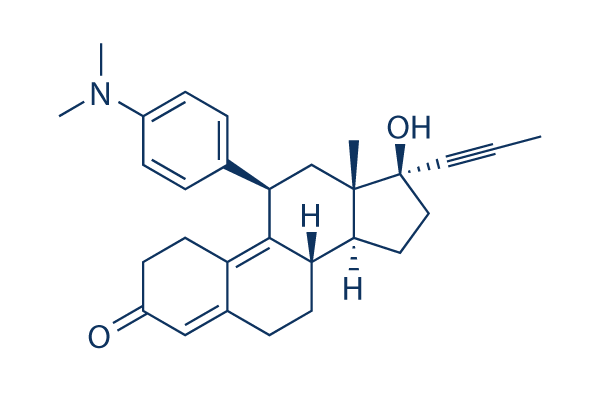
Chemische Struktur
Molekulargewicht: 429.59
Springen zu
Qualitätskontrolle (Quality Control)
Charge:
Reinheit:
100.00%
100.00
| Verwandte Targets | Adrenergic Receptor GPR Androgen Receptor Glucocorticoid Receptor ACE RAAS Progesterone Receptor Opioid Receptor THR PGES |
|---|---|
| Andere Estrogen/progestogen Receptor Inhibitors | Elacestrant (RAD1901) Dihydrochloride Vepdegestrant (ARV-471) MPP dihydrochloride Kaempferol Cholesterol PHTPP G15 Licochalcone A Endoxifen HCl Pregnenolone |
Zellkultur, Behandlung & Arbeitskonzentration
(Cell Culture, Treatment & Working Concentration)
| Zelllinien | Assay-Typ | Konzentration | Inkubationszeit | Formulierung | Aktivitätsbeschreibung | PMID |
|---|---|---|---|---|---|---|
| CHO-K1 cells | Function assay | Inhibition of CHO-K1 cells expressing glucocorticoid receptor, IC50=8e-06 μM | ||||
| T47D-C124 cells | Function assay | 24 h | Antagonist activity at progesterone receptor in human T47D-C124 cells transfected with luciferase gene linked to MMTV promoter assessed as inhibition of progesterone-induced luciferase transactivation activity after 24 hrs, IC50=2.1e-05 μM | |||
| neuroblastoma cells | Function assay | In vitro antagonist potency in transactivation assay in neuroblastoma cells expressing human PR-B progesterone receptor, IC50=2.5e-05 μM | ||||
| T47D cells | Function assay | 48 h | Antagonist activity at progesterone receptor in human T47D cells assessed as inhibition of progesterone-induced alkaline phosphatase activity after 48 hrs, IC50=4.5e-05 μM | |||
| CV-1 cells | Function assay | Antagonistic activity against human progesterone receptor B (hPR-B) in co-transfected CV-1 cells, IC50=0.00018 μM | ||||
| HEK293 cells | Function assay | Antagonist activity against glucocorticoid receptor (unknown origin) expressed in HEK293 cells by GRE-dependent luciferase reporter gene assay, IC50=0.000298 μM | ||||
| COS7 cells | Function assay | Antagonist activity at cloned glucocorticoid receptor-ligand binding domain expressed in african green monkey COS7 cells by GAL4 luciferase reporter assay, IC50=0.0006 μM | ||||
| SW1353 cells | Function assay | Binding affinity to glucocorticoid receptor in SW1353 cells by whole-cell binding assay, Ki=0.00082 μM | ||||
| A549 cells | Function assay | Antagonist activity at human glucocorticoid receptor assessed as inhibition of corticoid-induced transcription in human A549 cells by GRE-linked luciferase reporter gene assay, IC50=0.0016 μM | ||||
| A549 cells | Function assay | 16 h | Antagonist activity at glucocorticoid receptor in human A549 cells assessed as inhibition of corticoid-induced transcription after 16 hrs by glucocorticoid response element-driven luciferase reporter gene assay, IC50=0.0016 μM | |||
| rat H4-IIE cells | Function assay | 1 h | Antagonist activity against glucocorticoid receptor in rat H4-IIE cells assessed as inhibition of dexamethasone-induced receptor transactivation pre-incubated for 1 hr before dexamethasone addition and measured 24 hrs post dexamethasone stimulation by tyrosine aminotransferase enzyme assay, IC50=0.00194 μM | |||
| HeLa cells | Function assay | Effective concentration against inhibition of Dexamethasone induced glucocorticoid receptor transactivation of mouse mammary tumor virus luciferase gene in HeLa cells, EC50=0.002 μM | ||||
| NIH3T3 cells | Function assay | In vitro antagonist potency in transactivation assay in NIH3T3 cells expressing glucocorticoid receptor, IC50=0.0022 μM | ||||
| CHO cells | Function assay | Inhibition of Dexamethasone stimulated transcriptional activity in CHO cells expressing glucocorticoid receptor, IC50=0.005 μM | ||||
| hGRAF cells | Function assay | Inhibition of human GR expressed in hGRAF cells, Ki=0.005 μM | ||||
| COS-1 | Function assay | Binding affinity for human androgen receptor in transiently-transfected COS-1 cells, Ki=0.022 μM | ||||
| rat hepatocytes | Function assay | Inhibition of dexamethasone-induced GR-mediated tyrosine amino transferase activity in rat hepatocytes, IC50=0.27 μM | ||||
| human K562/R7 cells | Function assay | 72 h | Potentiation of doxorubicin-induced cytotoxicity against doxorubicin-resistant human K562/R7 cells assessed as doxorubicin IC50 at 1 uM after 72 hrs by MTT assay, IC50=0.9 μM | |||
| Klicken Sie hier, um weitere experimentelle Zellliniendaten anzuzeigen | ||||||
Chemische Informationen, Lagerung & Stabilität (Chemical Information, Storage & Stability)
| Molekulargewicht | 429.59 | Formel | C29H35NO2 |
Lagerung (Ab Erhaltdatum) | |
|---|---|---|---|---|---|
| CAS-Nr. | 84371-65-3 | SDF herunterladen | Lagerung von Stammlösungen |
|
|
| Synonyme | C-1073, RU 38486 | Smiles | CC#CC1(CCC2C1(CC(C3=C4CCC(=O)C=C4CCC23)C5=CC=C(C=C5)N(C)C)C)O | ||
Löslichkeit (Solubility)
|
In vitro |
DMSO
: 85 mg/mL
(197.86 mM)
Ethanol : 85 mg/mL Water : Insoluble |
Molaritätsrechner
Verdünnungsrechner
Molekulargewicht-Rechner
|
In vivo |
|||||
In-vivo-Formulierungsrechner (Klare Lösung)
Schritt 1: Geben Sie unten die Informationen ein (Empfohlen: Ein zusätzliches Tier einplanen, um Verluste während des Experiments auszugleichen)
mg/kg
g
μL
Schritt 2: Geben Sie die In-vivo-Formulierung ein (Dies ist nur der Rechner, nicht die Formulierung. Bitte kontaktieren Sie uns zuerst, wenn im Abschnitt Löslichkeit keine In-vivo-Formulierung angegeben ist.)
% DMSO
%
% Tween 80
% ddH2O
%DMSO
%
Berechnungsergebnisse:
Arbeitskonzentration: mg/ml;
Methode zur Herstellung der DMSO-Stammflüssigkeit: mg Wirkstoff voraufgelöst in μL DMSO ( Konzentration der Stammflüssigkeit mg/mL, Bitte kontaktieren Sie uns zuerst, wenn die Konzentration die DMSO-Löslichkeit der jeweiligen Wirkstoffcharge überschreitet. )
Methode zur Herstellung der In-vivo-Formulierung: Nehmen Sie μL DMSO Stammflüssigkeit, fügen Sie als Nächstes hinzuμL PEG300, mischen und aufklären, fügen Sie als Nächstes hinzuμL Tween 80, mischen und aufklären, fügen Sie als Nächstes hinzu μL ddH2O, mischen und aufklären.
Methode zur Herstellung der In-vivo-Formulierung: Nehmen Sie μL DMSO Stammflüssigkeit, fügen Sie als Nächstes hinzu μL Maisöl, mischen und aufklären.
Hinweis: 1. Bitte stellen Sie sicher, dass die Flüssigkeit klar ist, bevor Sie das nächste Lösungsmittel hinzufügen.
2. Achten Sie darauf, die Lösungsmittel in der richtigen Reihenfolge hinzuzufügen. Sie müssen sicherstellen, dass die im vorherigen Schritt erhaltene Lösung klar ist, bevor Sie das nächste Lösungsmittel hinzufügen. Physikalische Methoden wie Vortexen, Ultraschall oder ein warmes Wasserbad können zur Unterstützung des Lösungsvorgangs verwendet werden.
Wirkungsmechanismus (Mechanism of Action)
| Eigenschaften |
Mifepristone is the first approved medication for patients with endogenous cushing
|
|---|---|
| Targets/IC50/Ki |
Bcl-2
Progesterone receptor
(T47D cells) 0.2 nM
Glucocorticoid receptor
(A549 cells) 2.6 nM
|
| In vitro |
Mifepristone inhibit corticoid-induced transcription from a glucocorticoid response element (GRE)-linked luciferase reporter gene in the human lung carcinoma cell line A549. Moreover, this compound also blocks progesterone induction of alkaline phosphatase activity in the human breast cancer cell line T47D. It inhibits ovarian cancer cell growth of SK-OV-3 and OV2008 with IC50 of 6.25 μM and 6.91 μM, respectively. A recent study shows that this chemical induces caspase-1 over expression both in differentiated and undifferentiated caspase-1-embryonic stem cells. |
| Kinase-Assay |
Glucocorticoid receptor (GR) antagonist activity, Progesterone receptor (PR) antagonist activity
|
|
T47D-Alkalische-Phosphatase-Assay: T47D-Brustkrebszellen werden in 96-Well-Gewebekulturplatten mit 104 Zellen pro Well in Assay-Medium [RPMI-Medium ohne Phenolrot, das 5 % (v/v) Holzkohle-behandeltes FBS und 1 % (v/v) Penicillin-Streptomycin enthält] ausgesät. Zwei Tage später wird das Medium dekantiert und Mifepristone oder Kontrolle in einer Endkonzentration in frischem Assay-Medium hinzugefügt. Vierundzwanzig Stunden später wird ein Alkalischer-Phosphatase-Assay mit einem SEAP-Kit durchgeführt. Das Medium wird dekantiert und die Zellen werden 30 Minuten bei Raumtemperatur mit 5 % (v/v) Formalin fixiert. Die Zellen werden einmal bei Raumtemperatur mit Hanks gewaschen
|
|
| In vivo |
Mifepristone can impair the growth of SK-OV-3 tumors in immunosuppressed mice at 0.5 mg/day and 1 mg/day. This compound inhibits the prostate weight significantly in the highest doses in vivo, and inhibits growth of the prostate gland produced by dihydrotestosterone (DHT) to a greater extent than the induction of atrophy and cell death in rats. |
Referenzen |
|
Anwendungen (Applications)
| Methoden | Biomarker | Bilder | PMID |
|---|---|---|---|
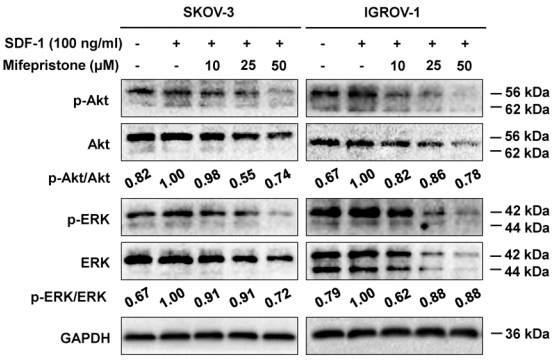
| Western blot | p-AKT / AKT / p-ERK / ERK MMP-2 / MMP-9 / COX-2 / VEGF |
|
28938623 |
Informationen zu klinischen Studien (Clinical Trial Information)
(Daten von https://clinicaltrials.gov, aktualisiert am 2026-04-01)
| NCT-Nummer | Rekrutierung | Bedingungen | Sponsor/Kollaboratoren | Startdatum | Phases |
|---|---|---|---|---|---|
| NCT07506512 | NOT_YET_RECRUITING | Early Pregnancy Loss |
University of Pennsylvania |
2026-07 | PHASE3 |
| NCT06733727 | NOT_YET_RECRUITING | Silent Miscarriage |
The University of Hong Kong |
2024-12-06 | |
| NCT06099769 | RECRUITING | Metastatic Breast Cancer |
Memorial Sloan Kettering Cancer Center |
2023-10-18 | PHASE2 |
| NCT06394999 | ACTIVE_NOT_RECRUITING | Female Contraception |
Leiden University Medical Center |
2025-05-02 | PHASE3 |
| NCT06502158 | RECRUITING | Cervical Preparation |
Montefiore Medical Center |
2024-10-31 | PHASE1 |
| NCT05177510 | RECRUITING | Labor, Induced |
Chelsea and Westminster NHS Foundation Trust |
2023-08-25 | PHASE2 |

Die Produkte sind nur für Forschungszwecke bestimmt. Nicht zur Anwendung am Menschen. Kein Verkauf an Patienten.
©Copyright 2013 Selleck Chemicals. Alle Rechte vorbehalten.