
Nur für die Forschung bestimmt
Idebenone ROS Chemisch
Kat.-Nr.: S2605
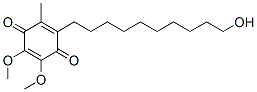
Chemische Struktur
Molekulargewicht: 338.44
Qualitätskontrolle (Quality Control)
Chemische Informationen, Lagerung & Stabilität (Chemical Information, Storage & Stability)
| Molekulargewicht | 338.44 | Formel | C19H30O5 |
Lagerung (Ab Erhaltdatum) | |
|---|---|---|---|---|---|
| CAS-Nr. | 58186-27-9 | SDF herunterladen | Lagerung von Stammlösungen |
|
|
| Synonyme | CV-2619 | Smiles | CC1=C(C(=O)C(=C(C1=O)OC)OC)CCCCCCCCCCO | ||
Löslichkeit (Solubility)
|
In vitro |
DMSO
: 68 mg/mL
(200.92 mM)
Ethanol : 68 mg/mL Water : Insoluble |
Molaritätsrechner
|
In vivo |
|||||
In-vivo-Formulierungsrechner (Klare Lösung)
Schritt 1: Geben Sie unten die Informationen ein (Empfohlen: Ein zusätzliches Tier einplanen, um Verluste während des Experiments auszugleichen)
Schritt 2: Geben Sie die In-vivo-Formulierung ein (Dies ist nur der Rechner, nicht die Formulierung. Bitte kontaktieren Sie uns zuerst, wenn im Abschnitt Löslichkeit keine In-vivo-Formulierung angegeben ist.)
Berechnungsergebnisse:
Arbeitskonzentration: mg/ml;
Methode zur Herstellung der DMSO-Stammflüssigkeit: mg Wirkstoff voraufgelöst in μL DMSO ( Konzentration der Stammflüssigkeit mg/mL, Bitte kontaktieren Sie uns zuerst, wenn die Konzentration die DMSO-Löslichkeit der jeweiligen Wirkstoffcharge überschreitet. )
Methode zur Herstellung der In-vivo-Formulierung: Nehmen Sie μL DMSO Stammflüssigkeit, fügen Sie als Nächstes hinzuμL PEG300, mischen und aufklären, fügen Sie als Nächstes hinzuμL Tween 80, mischen und aufklären, fügen Sie als Nächstes hinzu μL ddH2O, mischen und aufklären.
Methode zur Herstellung der In-vivo-Formulierung: Nehmen Sie μL DMSO Stammflüssigkeit, fügen Sie als Nächstes hinzu μL Maisöl, mischen und aufklären.
Hinweis: 1. Bitte stellen Sie sicher, dass die Flüssigkeit klar ist, bevor Sie das nächste Lösungsmittel hinzufügen.
2. Achten Sie darauf, die Lösungsmittel in der richtigen Reihenfolge hinzuzufügen. Sie müssen sicherstellen, dass die im vorherigen Schritt erhaltene Lösung klar ist, bevor Sie das nächste Lösungsmittel hinzufügen. Physikalische Methoden wie Vortexen, Ultraschall oder ein warmes Wasserbad können zur Unterstützung des Lösungsvorgangs verwendet werden.
Wirkungsmechanismus (Mechanism of Action)
| In vitro |
Idebenone effectively protects from retinal cell injury after oxidative stress or hypoglycemia, whereas the protection afforded after postincubation of both antioxidants is decreased. This compound attenuates delayed retinal cell damage, mediated by chemical ischemia. This chemical, a centrally active antioxidant used to treat multiinfarct dementia, protects cells from this form of glutamate-induced cytotoxicity in vitro. It provides significant protection against the neuronal degeneration induced by intrastriatal injection of kainic acid and quisqualic acid, but not the NMDA receptor agonist, quinolinic acid.
|
|---|---|
| In vivo |
Idebenone prevents the behavioural deficits in Y-maze and water maze, but not passive avoidance, tasks in A beta-(1-42)-infused rats when they are repeatedly administered by mouth once a day from 3 days before the start of A beta infusion to the end of behavioural experiments. This compound (100 and 300 mg/kg) is orally administered to rats for 3 days, it increases the state 3 respiration stimulated by ADP, slightly decreasez the state 4 respiration after the consumption of ADP and resultz in a significant increase of the respiratory control index (RCI) by 14-19% for glutamate oxidation and 10-17% for succinate oxidation, respectively. It significantly suppresses by about 10% the non-respiratory oxygen consumption, which closely associated with non-enzymatic reactions such as lipid peroxidation, membrane lysis and swelling of mitochondria.
|
Referenzen |
|
Informationen zu klinischen Studien (Clinical Trial Information)
(Daten von https://clinicaltrials.gov, aktualisiert am 2025-11-25)
| NCT-Nummer | Rekrutierung | Bedingungen | Sponsor/Kollaboratoren | Startdatum | Phases |
|---|---|---|---|---|---|
| NCT04534023 | ACTIVE_NOT_RECRUITING | Rapid Eye Movement Sleep Behavior Disorder; Synucleinopathy |
Ruijin Hospital |
2020-08-31 | PHASE2 |
| NCT05987397 | UNKNOWN | Post Stroke Epilepsy |
Xiangya Hospital of Central South University |
2023-07-05 | PHASE4 |
| NCT04151472 | RECRUITING | Migraine Disorders; Headache Disorders |
Second Affiliated Hospital, Zhejiang University, School of Medicine |
2021-12-08 | PHASE3 |
| NCT04071639 | UNKNOWN | Huntington Disease |
Second Affiliated Hospital, Zhejiang University, School of Medicine |
2020-03-12 | PHASE1 |
| NCT05411978 | UNKNOWN | Migraine |
Beijing Tiantan Hospital |
2022-05-09 | PHASE4 |
| NCT04669158 | COMPLETED | Non Alcoholic Steatohepatitis; Fibrosis |
Stanford University |
2021-07-30 | PHASE1; PHASE2 |

Die Produkte sind nur für Forschungszwecke bestimmt. Nicht zur Anwendung am Menschen. Kein Verkauf an Patienten.
©Copyright 2013 Selleck Chemicals. Alle Rechte vorbehalten.