
Nur für die Forschung bestimmt
Tranilast Immunology & Inflammation related Chemisch
Kat.-Nr.: S1439
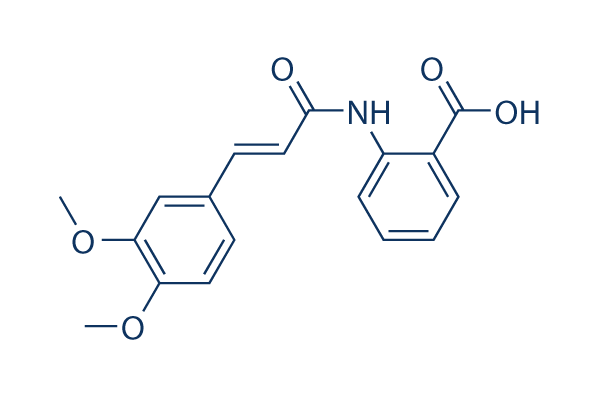
Chemische Struktur
Molekulargewicht: 327.33
Qualitätskontrolle (Quality Control)
| Verwandte Targets | PD-1/PD-L1 CXCR STING AhR CD markers Interleukins Anti-infection Antioxidant COX Histamine Receptor |
|---|---|
| Andere Immunology & Inflammation related Inhibitors | Cl-amidine Bestatin (Ubenimex) Bindarit (AF 2838) Tempol Sinomenine GI254023X (GI4023) Geniposidic acid CORM-3 Oxymatrine Germacrone |
Zellkultur, Behandlung & Arbeitskonzentration
(Cell Culture, Treatment & Working Concentration)
| Zelllinien | Assay-Typ | Konzentration | Inkubationszeit | Formulierung | Aktivitätsbeschreibung | PMID |
|---|---|---|---|---|---|---|
| ECs | Function assay | Evaluated for inhibition of proliferation of human coronary artery endothelial cells (ECs), induced by 5 % FBS., IC50 = 19.1 μM. | 11229768 | |||
| SMCs | Function assay | Inhibition of human coronary artery smooth muscle cells (SMC's) proliferation, induced by platelet-derived growth factor (PDGF-BB) 20 ng mL., IC50 = 24.5 μM. | 11229768 | |||
| Klicken Sie hier, um weitere experimentelle Zellliniendaten anzuzeigen | ||||||
Chemische Informationen, Lagerung & Stabilität (Chemical Information, Storage & Stability)
| Molekulargewicht | 327.33 | Formel | C18H17NO5 |
Lagerung (Ab Erhaltdatum) | |
|---|---|---|---|---|---|
| CAS-Nr. | 53902-12-8 | SDF herunterladen | Lagerung von Stammlösungen |
|
|
| Synonyme | SB 252218, MK-341 | Smiles | COC1=C(C=C(C=C1)C=CC(=O)NC2=CC=CC=C2C(=O)O)OC | ||
Löslichkeit (Solubility)
|
In vitro |
DMSO
: 65 mg/mL
(198.57 mM)
Water : Insoluble Ethanol : Insoluble |
Molaritätsrechner
|
In vivo |
|||||
In-vivo-Formulierungsrechner (Klare Lösung)
Schritt 1: Geben Sie unten die Informationen ein (Empfohlen: Ein zusätzliches Tier einplanen, um Verluste während des Experiments auszugleichen)
Schritt 2: Geben Sie die In-vivo-Formulierung ein (Dies ist nur der Rechner, nicht die Formulierung. Bitte kontaktieren Sie uns zuerst, wenn im Abschnitt Löslichkeit keine In-vivo-Formulierung angegeben ist.)
Berechnungsergebnisse:
Arbeitskonzentration: mg/ml;
Methode zur Herstellung der DMSO-Stammflüssigkeit: mg Wirkstoff voraufgelöst in μL DMSO ( Konzentration der Stammflüssigkeit mg/mL, Bitte kontaktieren Sie uns zuerst, wenn die Konzentration die DMSO-Löslichkeit der jeweiligen Wirkstoffcharge überschreitet. )
Methode zur Herstellung der In-vivo-Formulierung: Nehmen Sie μL DMSO Stammflüssigkeit, fügen Sie als Nächstes hinzuμL PEG300, mischen und aufklären, fügen Sie als Nächstes hinzuμL Tween 80, mischen und aufklären, fügen Sie als Nächstes hinzu μL ddH2O, mischen und aufklären.
Methode zur Herstellung der In-vivo-Formulierung: Nehmen Sie μL DMSO Stammflüssigkeit, fügen Sie als Nächstes hinzu μL Maisöl, mischen und aufklären.
Hinweis: 1. Bitte stellen Sie sicher, dass die Flüssigkeit klar ist, bevor Sie das nächste Lösungsmittel hinzufügen.
2. Achten Sie darauf, die Lösungsmittel in der richtigen Reihenfolge hinzuzufügen. Sie müssen sicherstellen, dass die im vorherigen Schritt erhaltene Lösung klar ist, bevor Sie das nächste Lösungsmittel hinzufügen. Physikalische Methoden wie Vortexen, Ultraschall oder ein warmes Wasserbad können zur Unterstützung des Lösungsvorgangs verwendet werden.
Wirkungsmechanismus (Mechanism of Action)
| In vitro |
Tranilast is an anti-allergic drug inhibiting the release of substances such as histamine and prostaglandins from mast cells, which suppresses collagen synthesis of fibroblasts derived from keloid tissues. This compound (3-300 mM) suppresses the collagen synthesis of fibroblasts from keloid and hypertrophic scar tissue but not healthy skin fibroblasts. It (30-300 mM) inhibits the release of transforming growth factor (TGF)-beta 1 from keloid fibroblasts, which enhances the collagen synthesis of keloid fibroblasts. This drug improves keloids and hypertrophic scars which originate from the abnormal proliferation and excessive collagen accumulation of fibroblasts. It inhibits the release of TGF-beta 1, IL-1 beta and PGE2 from the human monocytes-macrophages. This chemical inhibits the proliferation stimulated with fetal bovine serum (FBS), TGF-beta 1 and platelet-derived growth factor-BB (PDGF-BB) as well as PDGF-BB-induced migration. It exhibits inhibitory effects on spontaneous collagen synthesis and TGF-beta 1-induced collagen and glycosaminoglycan synthesis.
|
|---|---|
| In vivo |
Tranilast results in a 58% reduction in TGF-beta1-induced 3[H]-hydroxyproline incorporation in the diabetic heart of rats. This compound attenuates cardiac fibrosis by 37% in association with reduction in phospho-Smad2 in the diabetic heart of rats. It completely prevents the increase in chymaselike activity, reduces the chymase mRNA levels by 43%, and decreases the carotid intima/media ratio by 63% in the carotid artery of dogs.
|
Referenzen |
|
Informationen zu klinischen Studien (Clinical Trial Information)
(Daten von https://clinicaltrials.gov, aktualisiert am 2024-11-14)
| NCT-Nummer | Rekrutierung | Bedingungen | Sponsor/Kollaboratoren | Startdatum | Phases |
|---|---|---|---|---|---|
| NCT06643689 | NOT_YET_RECRUITING | Esophageal Stricture; Esophageal Neoplasms |
Second Affiliated Hospital, Zhejiang University, School of Medicine |
2025-01-01 | PHASE2 |
| NCT06689514 | RECRUITING | Prostatic Hypertrophy, Benign |
Yifeng Jing |
2025-01-20 | EARLY_PHASE1 |
| NCT05626829 | UNKNOWN | Nasopharyngeal Carcinoma; Recurrent Cancer |
Jian Guan |
2022-07-20 | PHASE2 |
| NCT06307288 | UNKNOWN | Rosacea |
Second Affiliated Hospital of Xi'an Jiaotong University |
2023-10-16 | PHASE4 |
| NCT03923140 | UNKNOWN | Cryopyrin-Associated Periodic Syndromes |
Peking Union Medical College Hospital |
2019-05-23 | PHASE2 |
| NCT05130892 | COMPLETED | NLRP3; hsCRP; Percutaneous Coronary Intervention |
Union Hospital, Tongji Medical College, Huazhong University of Science and Technology |
2021-11-15 | PHASE4 |

Die Produkte sind nur für Forschungszwecke bestimmt. Nicht zur Anwendung am Menschen. Kein Verkauf an Patienten.
©Copyright 2013 Selleck Chemicals. Alle Rechte vorbehalten.