
Nur für die Forschung bestimmt
Tigecycline Antineoplastic and Immunosuppressive Antibiotics Inhibitor
Kat.-Nr.: S1403
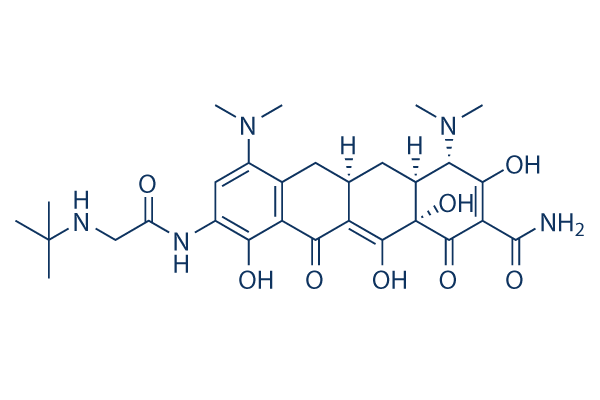
Chemische Struktur
Molekulargewicht: 585.65
Qualitätskontrolle (Quality Control)
| Verwandte Targets | Integrase Bacterial Antibiotics Anti-infection Fungal Antiviral COVID-19 Parasite Reverse Transcriptase HIV |
|---|---|
| Andere Antineoplastic and Immunosuppressive Antibiotics Inhibitors | Staurosporine (STS) Cyclosporin A Oligomycin A (MCH 32) Puromycin Dihydrochloride Nigericin sodium salt Geldanamycin (NSC 122750) Honokiol Streptozotocin (STZ) Sodium Monensin (NSC 343257) Hygromycin B |
Zellkultur, Behandlung & Arbeitskonzentration
(Cell Culture, Treatment & Working Concentration)
| Zelllinien | Assay-Typ | Konzentration | Inkubationszeit | Formulierung | Aktivitätsbeschreibung | PMID |
|---|---|---|---|---|---|---|
| THP-1 | Antibacterial assay | 24 hrs | Antibacterial activity against Staphylococcus aureus SCV isolated from cystic fibrosis patient infected in human THP-1 cells assessed as log reduction of intracellular CFU level after 24 hrs in presence of thymidine | 19188393 | ||
| Klicken Sie hier, um weitere experimentelle Zellliniendaten anzuzeigen | ||||||
Chemische Informationen, Lagerung & Stabilität (Chemical Information, Storage & Stability)
| Molekulargewicht | 585.65 | Formel | C29H39N5O8 |
Lagerung (Ab Erhaltdatum) | |
|---|---|---|---|---|---|
| CAS-Nr. | 220620-09-7 | SDF herunterladen | Lagerung von Stammlösungen |
|
|
| Synonyme | GAR-936, WAY-GAR-936, TBG-MINO | Smiles | CC(C)(C)NCC(=O)NC1=CC(=C2CC3CC4C(C(=O)C(=C(C4(C(=O)C3=C(C2=C1O)O)O)O)C(=O)N)N(C)C)N(C)C | ||
Löslichkeit (Solubility)
|
In vitro |
DMSO
: 100 mg/mL
(170.75 mM)
Water : 100 mg/mL Ethanol : Insoluble |
Molaritätsrechner
|
In vivo |
|||||
In-vivo-Formulierungsrechner (Klare Lösung)
Schritt 1: Geben Sie unten die Informationen ein (Empfohlen: Ein zusätzliches Tier einplanen, um Verluste während des Experiments auszugleichen)
Schritt 2: Geben Sie die In-vivo-Formulierung ein (Dies ist nur der Rechner, nicht die Formulierung. Bitte kontaktieren Sie uns zuerst, wenn im Abschnitt Löslichkeit keine In-vivo-Formulierung angegeben ist.)
Berechnungsergebnisse:
Arbeitskonzentration: mg/ml;
Methode zur Herstellung der DMSO-Stammflüssigkeit: mg Wirkstoff voraufgelöst in μL DMSO ( Konzentration der Stammflüssigkeit mg/mL, Bitte kontaktieren Sie uns zuerst, wenn die Konzentration die DMSO-Löslichkeit der jeweiligen Wirkstoffcharge überschreitet. )
Methode zur Herstellung der In-vivo-Formulierung: Nehmen Sie μL DMSO Stammflüssigkeit, fügen Sie als Nächstes hinzuμL PEG300, mischen und aufklären, fügen Sie als Nächstes hinzuμL Tween 80, mischen und aufklären, fügen Sie als Nächstes hinzu μL ddH2O, mischen und aufklären.
Methode zur Herstellung der In-vivo-Formulierung: Nehmen Sie μL DMSO Stammflüssigkeit, fügen Sie als Nächstes hinzu μL Maisöl, mischen und aufklären.
Hinweis: 1. Bitte stellen Sie sicher, dass die Flüssigkeit klar ist, bevor Sie das nächste Lösungsmittel hinzufügen.
2. Achten Sie darauf, die Lösungsmittel in der richtigen Reihenfolge hinzuzufügen. Sie müssen sicherstellen, dass die im vorherigen Schritt erhaltene Lösung klar ist, bevor Sie das nächste Lösungsmittel hinzufügen. Physikalische Methoden wie Vortexen, Ultraschall oder ein warmes Wasserbad können zur Unterstützung des Lösungsvorgangs verwendet werden.
Wirkungsmechanismus (Mechanism of Action)
| In vitro |
Tigecycline evades the Tet(A-E) efflux pumps, which account for most acquired resistance to tetracycline and minocycline in Enterobacteriaceae and Acinetobacter spp. This compound binds to bacterial ribosomes that have been modified by the Tet(M) protein, a mechanism that compromises all available tetracyclines, and which is frequent in Gram-positive cocci and Neisseria spp. It remains vulnerable to the chromosomally-encoded multidrug efflux pumps of Proteeae and Pseudomonas aeruginosa, and to Tet(X), a tetracycline-degrading mono-oxygenase found, albeit rarely, in Bacteroides spp. Its MICs for enterococci, staphylococci, and streptococci are mostly 0.06–0.25 mg/L, again with little or no skew to the distribution. This agent is prone to oxidation, and MIC values, particularly for the most susceptible isolates, may be raised if the drug is added to broth that has become oxygenated during storage, or if drug-containing media are stored before inoculation. It is a poor substrate for tetracycline-specific efflux pumps, and it still attaches to ribosomes that have been modified by the Tet(M) protein. This antibacterial has demonstrated activity against a wide variety of gram-positive and gram-negative pathogens, including multidrug-resistant strains. It is active against many gram-positive and -negative organisms, including methicillin-resistantStaphylococcus aureus, vancomycin-intermediate and -resistant enterococci, and extended-spectrum β-lactamase–producing Escherichia coli and Klebsiella pneumoniae. This compound exhibits antibacterial activity against a wide spectrum of aerobic and anaerobic bacteria. It is a broad-spectrum, protein-inhibiting, antibacterial agent possessing activity against strains resistant to other chemotherapeutic agents. This chemical demonstrates in vitro activities against the GISA and the methicillin-resistant and methicillin-susceptible staphylococcal strains tested (MICs at which 90% of isolates tested are inhibited [MIC90s], 0.5 to 1 μg/ml). It has MIC90s of 0.25 μg/ml for all of the S. pneumoniae strains and demonstrates similar activities against all of the S. pneumoniae strains tested. |
|---|---|
| In vivo |
Tigecycline is bactericidal against methicillin-susceptible S. aureus (MSSA) in the rabbit osteomyelitis model and exhibits good, but not excellent, activity in Legionellapneumophila pneumonia in guinea pigs. This compound at 50 mg/kg twice daily was not toxic to mice. It is effective in inhibiting NSCLC growth in vivo through decreasing proliferation and increasing apoptosis of tumor cells. |
Referenzen |
|
Anwendungen (Applications)
| Methoden | Biomarker | Bilder | PMID |
|---|---|---|---|
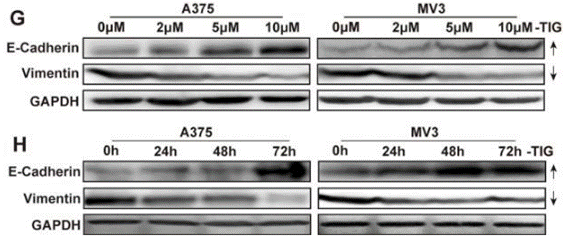
| Western blot | E-cadherin / Vimentin CDK2 / Cyclin E Cox-1 / Cox-2 / Cox-4 p-AMPKα / AMPKα / p-mTOR / mTOR / p-p70S6K / p70S6K / p-4E-BP-1 / 4E-BP1 p62 / LC3-I / LC3-II Cyclin D1 / CDK2 / p21 |
|
26621850 |
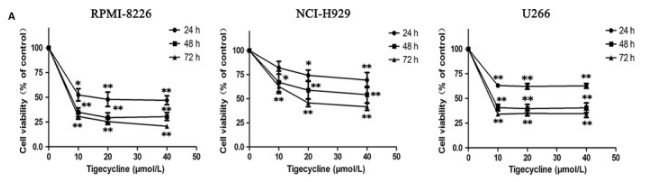
| Growth inhibition assay | Cell viability |
|
30247801 |
Informationen zu klinischen Studien (Clinical Trial Information)
(Daten von https://clinicaltrials.gov, aktualisiert am 2026-03-20)
| NCT-Nummer | Rekrutierung | Bedingungen | Sponsor/Kollaboratoren | Startdatum | Phases |
|---|---|---|---|---|---|
| NCT07485010 | NOT_YET_RECRUITING | Mycobacterium Abscessus Pulmonary Disease; Mycobacterium Abscessus Infection; Non-Tuberculous Mycobacterial (NTM) Infections; Non-Tuberculous Mycobacteria Pulmonary Disease |
The University of Queensland |
2027-04 | PHASE2 |
| NCT04310930 | RECRUITING | Pulmonary Disease Due to Mycobacteria (Diagnosis) |
The University of Queensland |
2020-03-02 | PHASE2; PHASE3 |
| NCT07759453 | NOT_YET_RECRUITING | Liver Transplant; Carbapenem-resistant Enterobacterales; CRE Colonization |
IRCCS Azienda Ospedaliero-Universitaria di Bologna |
2026-10-01 | PHASE3 |
| NCT07004049 | RECRUITING | Bloodstream Infection; Ventilator Associated Bacterial Pneumonia; Hospital Acquired Bacterial Pneumonia; Carbapenem Resistant Bacterial Infection; Multidrug Resistance |
National University of Singapore |
2025-04-21 | PHASE4 |
| NCT07495150 | NOT_YET_RECRUITING | Blood-Brain Barrier; Bacterial Meningitis |
yilong Wang |
2026-04-01 | |
| NCT07524920 | NOT_YET_RECRUITING | MDR Bacteria |
Ain Shams University |
2026-04-01 | PHASE2 |

Die Produkte sind nur für Forschungszwecke bestimmt. Nicht zur Anwendung am Menschen. Kein Verkauf an Patienten.
©Copyright 2013 Selleck Chemicals. Alle Rechte vorbehalten.