
Nur für die Forschung bestimmt
Thalidomide E3 ligase Ligand Chemical
Kat.-Nr.: S1193
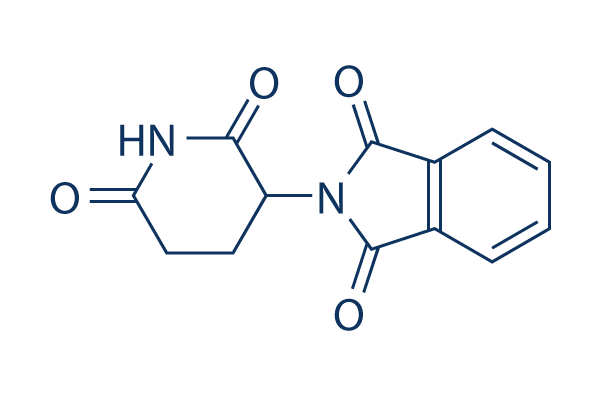
Chemische Struktur
Molekulargewicht: 258.23
Qualitätskontrolle (Quality Control)
| Verwandte Targets | Proteasome E1 Activating E3 Ligase DUB SUMO p97 E2 conjugating |
|---|---|
| Andere E3 ligase Ligand Inhibitors | CC-99282 |
Zellkultur, Behandlung & Arbeitskonzentration
(Cell Culture, Treatment & Working Concentration)
| Zelllinien | Assay-Typ | Konzentration | Inkubationszeit | Formulierung | Aktivitätsbeschreibung | PMID |
|---|---|---|---|---|---|---|
| HeLa | Function assay | Inhibition of IL-1-alpha-induced NF-kappaB activation in HeLa cells assessed as blocking of p50/p65 nuclear translocation, IC50=2.04μM | 17845850 | |||
| RAW264.7 | Antiinflammatory assay | 10 uM | 3 hrs | Antiinflammatory activity in mouse LPS-activated RAW264.7 cells assessed as ROS scavenging activity at 10 uM pretreated for 3 hrs before LPS challenge measured by decrease in fluorescent intensity by confocal microscopy | 18723357 | |
| RAW264.7 | Function assay | 1 uM | 3 hrs | Reduction in iNOS expression in LPS-activated mouse RAW264.7 cells at 1 uM pretreated for 3 hrs before LPS challenge assessed after 24 hrs by Western blot | 18723357 | |
| RAW264.7 | Function assay | 10 uM | 3 hrs | Reduction in iNOS expression in LPS-activated mouse RAW264.7 cells at 10 uM pretreated for 3 hrs before LPS challenge assessed after 24 hrs by Western blot | 18723357 | |
| RAW264.7 | Function assay | 10 uM | 3 hrs | Reduction in pERK1/2 expression in LPS-activated mouse RAW264.7 cells at 10 uM pretreated for 3 hrs before LPS challenge assessed after 24 hrs by Western blot | 18723357 | |
| Ehrlich ascites carcinoma cells | Toxicity assay | 1.25 mM/kg | 7 days | Toxicity in Swiss albino mouse bearing mouse Ehrlich ascites carcinoma cells assessed as focal degeneration of hepatocytes treated after 7 days post-tumor implantation at 1.25 mM/kg, sc for 5 days by histopathological analysis | 18951804 | |
| Ehrlich ascites carcinoma cells | Toxicity assay | 1.25 mM/kg | 7 days | Toxicity in Swiss albino mouse bearing mouse Ehrlich ascites carcinoma cells assessed as focal necrosis of hepatocytes treated after 7 days post-tumor implantation at 1.25 mM/kg, sc for 5 days by histopathological analysis | 18951804 | |
| BTI-TN-5B1-4 | Function assay | 30 mins | Binding affinity to human CRBN (1 to 442 residues)/N-terminal 6His-tagged human DDB1 (1 to 1140 residues) expressed in baculovirus infected BTI-TN-5B1-4 insect cells after 30 mins by cy5 probe based fluorescence polarization assay, Kd=0.25μM | 31117518 | ||
| Klicken Sie hier, um weitere experimentelle Zellliniendaten anzuzeigen | ||||||
Chemische Informationen, Lagerung & Stabilität (Chemical Information, Storage & Stability)
| Molekulargewicht | 258.23 | Formel | C13H10N2O4 |
Lagerung (Ab Erhaltdatum) | |
|---|---|---|---|---|---|
| CAS-Nr. | 50-35-1 | SDF herunterladen | Lagerung von Stammlösungen |
|
|
| Synonyme | K17 | Smiles | C1CC(=O)NC(=O)C1N2C(=O)C3=CC=CC=C3C2=O | ||
Löslichkeit (Solubility)
|
In vitro |
DMSO
: 150 mg/mL
(580.87 mM)
Im 60°C Wasserbad erwärmt;
Ultraschallbehandelt;
Water : Insoluble Ethanol : Insoluble |
Molaritätsrechner
|
In vivo |
|||||
In-vivo-Formulierungsrechner (Klare Lösung)
Schritt 1: Geben Sie unten die Informationen ein (Empfohlen: Ein zusätzliches Tier einplanen, um Verluste während des Experiments auszugleichen)
Schritt 2: Geben Sie die In-vivo-Formulierung ein (Dies ist nur der Rechner, nicht die Formulierung. Bitte kontaktieren Sie uns zuerst, wenn im Abschnitt Löslichkeit keine In-vivo-Formulierung angegeben ist.)
Berechnungsergebnisse:
Arbeitskonzentration: mg/ml;
Methode zur Herstellung der DMSO-Stammflüssigkeit: mg Wirkstoff voraufgelöst in μL DMSO ( Konzentration der Stammflüssigkeit mg/mL, Bitte kontaktieren Sie uns zuerst, wenn die Konzentration die DMSO-Löslichkeit der jeweiligen Wirkstoffcharge überschreitet. )
Methode zur Herstellung der In-vivo-Formulierung: Nehmen Sie μL DMSO Stammflüssigkeit, fügen Sie als Nächstes hinzuμL PEG300, mischen und aufklären, fügen Sie als Nächstes hinzuμL Tween 80, mischen und aufklären, fügen Sie als Nächstes hinzu μL ddH2O, mischen und aufklären.
Methode zur Herstellung der In-vivo-Formulierung: Nehmen Sie μL DMSO Stammflüssigkeit, fügen Sie als Nächstes hinzu μL Maisöl, mischen und aufklären.
Hinweis: 1. Bitte stellen Sie sicher, dass die Flüssigkeit klar ist, bevor Sie das nächste Lösungsmittel hinzufügen.
2. Achten Sie darauf, die Lösungsmittel in der richtigen Reihenfolge hinzuzufügen. Sie müssen sicherstellen, dass die im vorherigen Schritt erhaltene Lösung klar ist, bevor Sie das nächste Lösungsmittel hinzufügen. Physikalische Methoden wie Vortexen, Ultraschall oder ein warmes Wasserbad können zur Unterstützung des Lösungsvorgangs verwendet werden.
Wirkungsmechanismus (Mechanism of Action)
| Targets/IC50/Ki |
E3 Ligase
(Cell-free assay) TNF-alpha
(Cell-free assay) |
|---|---|
| In vitro |
Thalidomide must be metabolized by the liver to form an epoxide that may be the active teratogenic metabolite. This compound selectively inhibits the production of human monocyte tumor necrosis factor alpha (TNF-alpha) when human monocytes are triggered with lipopolysaccharide and other agonists in culture. It exerts its inhibitory action on tumor necrosis factor alpha by enhancing mRNA degradation. This chemical acts directly, by inducing apoptosis or G1 growth arrest, in MM cell lines and in patient MM cells that are resistant to melphalan, doxorubicin, and dexamethasone (Dex). It enhances the anti-MM activity of Dex and, conversely, are inhibited by interleukin 6. This agent is a potent costimulator of primary human T cells in vitro, synergizing with stimulation via the T cell receptor complex to increase interleukin 2-mediated T cell proliferation and interferon gamma production. It also increases the primary CD8+ cytotoxic T cell response induced by allogeneic dendritic cells in the absence of CD4+ T cells. |
| In vivo |
Thalidomide (200 mg/kg) results in an inhibition of the area of vascularized cornea of rabbits that ranged from 30% to 51% in three experiments with a median inhibition of 36%. |
Referenzen |
|
Anwendungen (Applications)
| Methoden | Biomarker | Bilder | PMID |
|---|---|---|---|
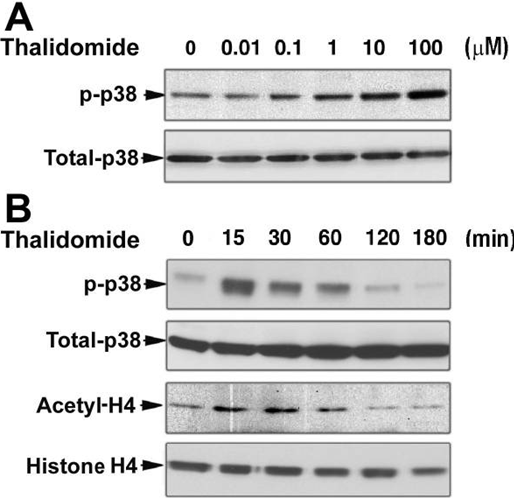
| Western blot | p-p38 / p38 / Acetyl-H4 |
|
17620452 |
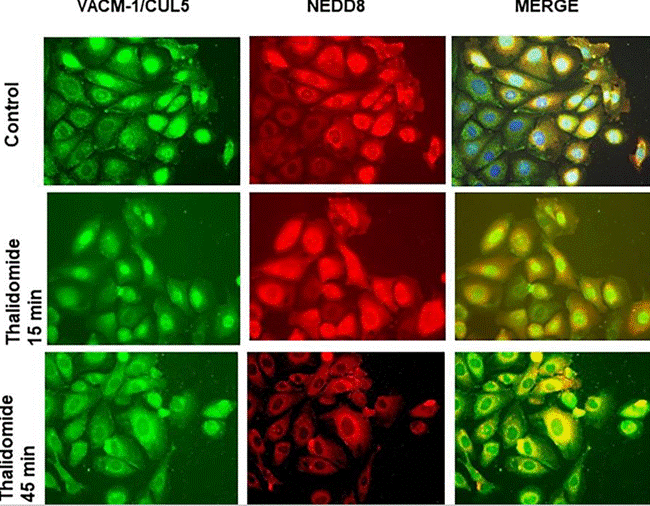
| Immunofluorescence | VCAM-1/CUL5 / NEDD8 bFGF |
|
29746508 |
Informationen zu klinischen Studien (Clinical Trial Information)
(Daten von https://clinicaltrials.gov, aktualisiert am 2025-12-30)
| NCT-Nummer | Rekrutierung | Bedingungen | Sponsor/Kollaboratoren | Startdatum | Phases |
|---|---|---|---|---|---|
| NCT07309419 | NOT_YET_RECRUITING | Hepatocellular Carcinoma |
Shanghai Zhongshan Hospital |
2025-12-22 | PHASE2; PHASE3 |
| NCT01356290 | RECRUITING | Medulloblastoma Recurrent; Ependymoma Recurrent; ATRT Recurrent; Rare CNS Tumor Recurrent |
Medical University of Vienna |
2014-04 | PHASE2 |
| NCT07671534 | RECRUITING | Solid Tumor Cancer |
Sarcoma Oncology Research Center, LLC |
2026-06 | PHASE2 |
| NCT06617182 | RECRUITING | Radiation Enteritis |
Yongquan Shi |
2024-09-30 | PHASE2 |
| NCT07746245 | NOT_YET_RECRUITING | Peripheral T-Cell Lymphoma |
The First Affiliated Hospital with Nanjing Medical University |
2026-08-01 | PHASE2 |
| NCT07195799 | RECRUITING | Non-Hodgkin Lymphoma |
The First Affiliated Hospital with Nanjing Medical University |
2024-12-31 | PHASE2 |

Die Produkte sind nur für Forschungszwecke bestimmt. Nicht zur Anwendung am Menschen. Kein Verkauf an Patienten.
©Copyright 2013 Selleck Chemicals. Alle Rechte vorbehalten.