
Nur für die Forschung bestimmt
Sodium butyrate HDAC Inhibitor
Kat.-Nr.: S1999
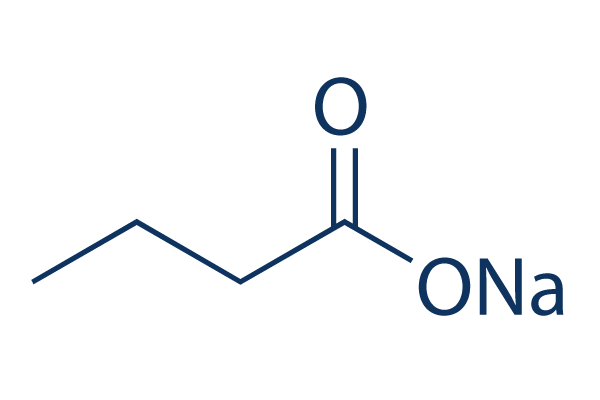
Chemische Struktur
Molekulargewicht: 110.09
Qualitätskontrolle (Quality Control)
Zellkultur, Behandlung & Arbeitskonzentration
(Cell Culture, Treatment & Working Concentration)
| Zelllinien | Assay-Typ | Konzentration | Inkubationszeit | Formulierung | Aktivitätsbeschreibung | PMID |
|---|---|---|---|---|---|---|
| human K562 cells | Proliferation assay | 1 mM | Antiproliferative activity against human K562 cells at 1 mM in presence of guanosine | |||
| human H1299 cells | Function assay | 7 days | Inhibition of human USP1/UAF1 in human H1299 cells assessed as reduction in colony formation after 7 days, EC50=3 μM | |||
| human JEG3 cells | Function assay | Inhibition of aromatase in human JEG3 cells by scintillation spectrometry, IC50=0.0015 μM | ||||
| Klicken Sie hier, um weitere experimentelle Zellliniendaten anzuzeigen | ||||||
Chemische Informationen, Lagerung & Stabilität (Chemical Information, Storage & Stability)
| Molekulargewicht | 110.09 | Formel | C4H7NaO2 |
Lagerung (Ab Erhaltdatum) | |
|---|---|---|---|---|---|
| CAS-Nr. | 156-54-7 | SDF herunterladen | Lagerung von Stammlösungen |
|
|
| Synonyme | NaB, Butanoic acid sodium salt | Smiles | CCCC(=O)[O-].[Na+] | ||
Löslichkeit (Solubility)
|
In vitro |
Water : 22 mg/mL Ethanol : 8 mg/mL
DMSO
: Insoluble
|
Molaritätsrechner
|
In vivo |
|||||
In-vivo-Formulierungsrechner (Klare Lösung)
Schritt 1: Geben Sie unten die Informationen ein (Empfohlen: Ein zusätzliches Tier einplanen, um Verluste während des Experiments auszugleichen)
Schritt 2: Geben Sie die In-vivo-Formulierung ein (Dies ist nur der Rechner, nicht die Formulierung. Bitte kontaktieren Sie uns zuerst, wenn im Abschnitt Löslichkeit keine In-vivo-Formulierung angegeben ist.)
Berechnungsergebnisse:
Arbeitskonzentration: mg/ml;
Methode zur Herstellung der DMSO-Stammflüssigkeit: mg Wirkstoff voraufgelöst in μL DMSO ( Konzentration der Stammflüssigkeit mg/mL, Bitte kontaktieren Sie uns zuerst, wenn die Konzentration die DMSO-Löslichkeit der jeweiligen Wirkstoffcharge überschreitet. )
Methode zur Herstellung der In-vivo-Formulierung: Nehmen Sie μL DMSO Stammflüssigkeit, fügen Sie als Nächstes hinzuμL PEG300, mischen und aufklären, fügen Sie als Nächstes hinzuμL Tween 80, mischen und aufklären, fügen Sie als Nächstes hinzu μL ddH2O, mischen und aufklären.
Methode zur Herstellung der In-vivo-Formulierung: Nehmen Sie μL DMSO Stammflüssigkeit, fügen Sie als Nächstes hinzu μL Maisöl, mischen und aufklären.
Hinweis: 1. Bitte stellen Sie sicher, dass die Flüssigkeit klar ist, bevor Sie das nächste Lösungsmittel hinzufügen.
2. Achten Sie darauf, die Lösungsmittel in der richtigen Reihenfolge hinzuzufügen. Sie müssen sicherstellen, dass die im vorherigen Schritt erhaltene Lösung klar ist, bevor Sie das nächste Lösungsmittel hinzufügen. Physikalische Methoden wie Vortexen, Ultraschall oder ein warmes Wasserbad können zur Unterstützung des Lösungsvorgangs verwendet werden.
Wirkungsmechanismus (Mechanism of Action)
| Targets/IC50/Ki |
Histone deacetylase
|
|---|---|
| In vitro |
Butyrate mediates growth inhibition of colonic cancer cells and thereby to elucidate the molecular link between a high-fiber diet and the arrest of colon carcinogenesis. This compound induces p21 mRNA expression in an immediate-early fashion, through transactivation of a promoter cis-element(s) located within 1.4 kb of the transcriptional start site, independent of p53 binding. Sodium butyrate, at physiological concentrations, induces apoptosis in 2 adenoma cell lines, RG/C2 and AA/Cl, and in the carcinoma cell line PC/JW/FI. It exerts potent effects on a variety of colonic mucosal functions such as inhibition of inflammation and carcinogenesis, reinforcing various components of the colonic defence barrier and decreasing oxidative stress. This chemical inhibits most HDAC except class III HDAC and class II HDAC6 and -10. It also is the most effective fatty acid in stimulating or repressing the expression of specific genes.
|
| In vivo |
Sodium butyrate significantly extends survival in a dose-dependent manner, improves body weight and motor performance, and delays the neuropathological sequelae in the R6/2 transgenic mouse model of Huntington's disease (HD). This compound also increases histone and specificity protein-1 acetylation and protects against 3-nitropropionic acid neurotoxicity.
|
Referenzen |
|
Anwendungen (Applications)
| Methoden | Biomarker | Bilder | PMID |
|---|---|---|---|
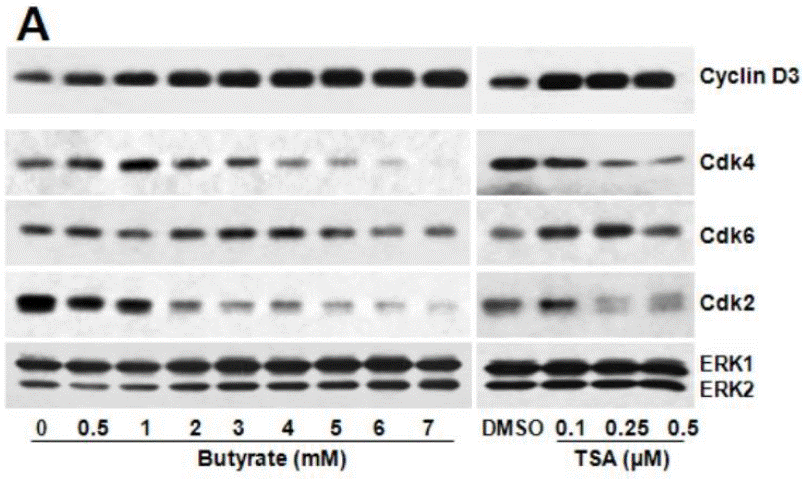
| Western blot | Cyclin D3 / CDK4 / CDK6 / CDK2 p15INK4b / p21Cip1 Phospho-H3 Ser10 / Acetyl-H3Lys9 / Acetyl-H3Lys14 / Dimethyl-H3 |
|
24280698 |
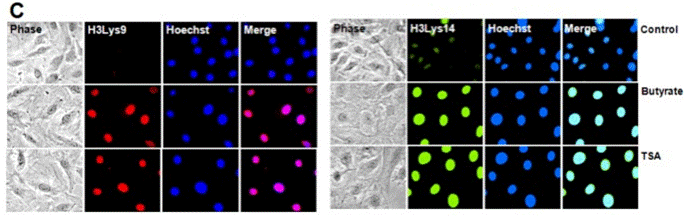
| Immunofluorescence | Acetyl-H3Lys9 |
|
24280698 |
Informationen zu klinischen Studien (Clinical Trial Information)
(Daten von https://clinicaltrials.gov, aktualisiert am 2026-05-28)
| NCT-Nummer | Rekrutierung | Bedingungen | Sponsor/Kollaboratoren | Startdatum | Phases |
|---|---|---|---|---|---|
| NCT07611370 | NOT_YET_RECRUITING | Graft Versus Host Disease; Hematopoietic and Lymphatic System Neoplasm; Malignant Solid Neoplasm |
City of Hope Medical Center |
2026-09-30 | PHASE1 |
| NCT07591012 | RECRUITING | Ulcerative Colitis (Disorder) |
University of Padova |
2026-05-01 | |
| NCT06653426 | RECRUITING | Menstrual Symptoms |
Magdy Milad, MD |
2024-10-01 | |
| NCT06514573 | RECRUITING | Autism Spectrum Disorder (ASD) |
Istituto Superiore di Sanità |
2025-05 | |
| NCT06851039 | COMPLETED | Healthy |
Wroclaw Medical University |
2025-03-06 | |
| NCT07252609 | COMPLETED | Obesity; Type 2 Diabetes |
Federico II University |
2024-11-13 |

Die Produkte sind nur für Forschungszwecke bestimmt. Nicht zur Anwendung am Menschen. Kein Verkauf an Patienten.
©Copyright 2013 Selleck Chemicals. Alle Rechte vorbehalten.