
Nur für die Forschung bestimmt
Fostamatinib (R788) Syk Inhibitor
Kat.-Nr.: S2625
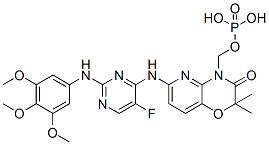
Chemische Struktur
Molekulargewicht: 580.46
Qualitätskontrolle (Quality Control)
| Verwandte Targets | EGFR VEGFR JAK FGFR PDGFR Src HIF FLT3 HER2 FLT |
|---|---|
| Andere Syk Inhibitors | R406 R406 (free base) PRT062607 (P505-15) HCl Entospletinib (GS-9973) Piceatannol BAY 61-3606 dihydrochloride PRT-060318 2HCl TAK-659 Hydrochloride Lanraplenib (GS-SYK) RO9021 |
Zellkultur, Behandlung & Arbeitskonzentration
(Cell Culture, Treatment & Working Concentration)
| Zelllinien | Assay-Typ | Konzentration | Inkubationszeit | Formulierung | Aktivitätsbeschreibung | PMID |
|---|---|---|---|---|---|---|
| human Ramos cells | Function assay | Inhibition of SYK in human Ramos cells, IC50=0.267 μM | ||||
| Klicken Sie hier, um weitere experimentelle Zellliniendaten anzuzeigen | ||||||
Chemische Informationen, Lagerung & Stabilität (Chemical Information, Storage & Stability)
| Molekulargewicht | 580.46 | Formel | C23H26FN6O9P |
Lagerung (Ab Erhaltdatum) | |
|---|---|---|---|---|---|
| CAS-Nr. | 901119-35-5 | SDF herunterladen | Lagerung von Stammlösungen |
|
|
| Synonyme | N/A | Smiles | CC1(C(=O)N(C2=C(O1)C=CC(=N2)NC3=NC(=NC=C3F)NC4=CC(=C(C(=C4)OC)OC)OC)COP(=O)(O)O)C | ||
Löslichkeit (Solubility)
|
In vitro |
DMSO
: 116 mg/mL
(199.84 mM)
Water : Insoluble Ethanol : Insoluble |
Molaritätsrechner
|
In vivo |
|||||
In-vivo-Formulierungsrechner (Klare Lösung)
Schritt 1: Geben Sie unten die Informationen ein (Empfohlen: Ein zusätzliches Tier einplanen, um Verluste während des Experiments auszugleichen)
Schritt 2: Geben Sie die In-vivo-Formulierung ein (Dies ist nur der Rechner, nicht die Formulierung. Bitte kontaktieren Sie uns zuerst, wenn im Abschnitt Löslichkeit keine In-vivo-Formulierung angegeben ist.)
Berechnungsergebnisse:
Arbeitskonzentration: mg/ml;
Methode zur Herstellung der DMSO-Stammflüssigkeit: mg Wirkstoff voraufgelöst in μL DMSO ( Konzentration der Stammflüssigkeit mg/mL, Bitte kontaktieren Sie uns zuerst, wenn die Konzentration die DMSO-Löslichkeit der jeweiligen Wirkstoffcharge überschreitet. )
Methode zur Herstellung der In-vivo-Formulierung: Nehmen Sie μL DMSO Stammflüssigkeit, fügen Sie als Nächstes hinzuμL PEG300, mischen und aufklären, fügen Sie als Nächstes hinzuμL Tween 80, mischen und aufklären, fügen Sie als Nächstes hinzu μL ddH2O, mischen und aufklären.
Methode zur Herstellung der In-vivo-Formulierung: Nehmen Sie μL DMSO Stammflüssigkeit, fügen Sie als Nächstes hinzu μL Maisöl, mischen und aufklären.
Hinweis: 1. Bitte stellen Sie sicher, dass die Flüssigkeit klar ist, bevor Sie das nächste Lösungsmittel hinzufügen.
2. Achten Sie darauf, die Lösungsmittel in der richtigen Reihenfolge hinzuzufügen. Sie müssen sicherstellen, dass die im vorherigen Schritt erhaltene Lösung klar ist, bevor Sie das nächste Lösungsmittel hinzufügen. Physikalische Methoden wie Vortexen, Ultraschall oder ein warmes Wasserbad können zur Unterstützung des Lösungsvorgangs verwendet werden.
Wirkungsmechanismus (Mechanism of Action)
| Eigenschaften |
Converted into its active metabolite R406 in vivo.
|
|---|---|
| Targets/IC50/Ki |
Syk
41 nM
Adenosine A3 receptor
81 nM
Adenosine transporter
1.84 μM
Monoamine transporter
2.74 μM
|
| In vitro |
Fostamatinib (R788) is a prodrug of the spleen tyrosine kinase (Syk) inhibitor R406. It is a competitive inhibitor for ATP binding with a Ki of 30 nM. This compound dose-dependently inhibits anti-IgE-mediated CHMC degranulation with an EC50 of 56 nM. It also inhibits the anti-IgE-induced production and release of LTC4 and cytokines and chemokines, including TNFα, IL-8, and GM-CSF. Inhibition of Syk by R788 results in inhibition of all phosphorylation events downstream of Syk signaling. Next to FcϵRI signaling in CHMC, it most potently inhibits the signaling of IL-4 and IL-2 receptors. It specifically inhibits FcγR signaling in human mast cells, macrophages, and neutrophils. R788 can inhibit local inflammatory injury mediated by immune complexes. It induces apoptosis of the majority of examined DLBCL cell lines. In R788-sensitive DLBCL cell lines, this compound specifically inhibits both tonic- and ligand-induced BCR signaling (autophosphorylation of SYK525/526 and SYK-dependent phosphorylation of the B-cell linker protein [BLNK]).
|
| Kinase-Assay |
Fluoreszenzpolarisations-Kinase-Assay und Ki-Bestimmung
|
|
Die Fluoreszenzpolarisationsreaktionen werden durchgeführt. Zur Ki-Bestimmung werden doppelte 200-μL-Reaktionen bei acht verschiedenen ATP-Konzentrationen von 200 μM (2-fache serielle Verdünnungen) in Gegenwart von entweder DMSO oder Fostamatinib (R788) bei 125, 62,5, 31,25, 15,5 oder 7,8 nM angesetzt. Zu verschiedenen Zeitpunkten werden 20 μL jeder Reaktion entnommen und gequencht, um die Reaktion zu stoppen. Für jede Konzentration dieser Verbindung wird die Reaktionsrate bei jeder ATP-Konzentration bestimmt und gegen die ATP-Konzentration aufgetragen, um den scheinbaren Km und Vmax (maximale Rate) zu bestimmen. Schließlich wird der scheinbare Km (oder scheinbare Ki/Vmax) gegen die Inhibitorkonzentration aufgetragen, um den Ki zu bestimmen.
|
|
| In vivo |
Oral administration of Fostamatinib (R788) to mice reduces immune complex-mediated inflammation in a reverse-passive Arthus reaction and two antibody-induced arthritis models. In another study, it effectively inhibits BCR signaling in vivo, resulting in reduced proliferation and survival of the malignant B cells and significantly prolongs survival of the treated animals. This compound also demonstrates a significant reduction in major inflammatory mediators such as TNFalpha, IL-1, IL-6 and IL-18, leading to reduced inflammation and bone degradation in models of rheumatoid arthritis.
|
Referenzen |
|
Informationen zu klinischen Studien (Clinical Trial Information)
(Daten von https://clinicaltrials.gov, aktualisiert am 2026-01-22)
| NCT-Nummer | Rekrutierung | Bedingungen | Sponsor/Kollaboratoren | Startdatum | Phases |
|---|---|---|---|---|---|
| NCT06233110 | RECRUITING | Chronic Graft Versus Host Disease |
Stefanie Sarantopoulos, MD, PhD. |
2025-10-29 | PHASE1 |
| NCT06948097 | RECRUITING | Lung Transplantation |
National Heart, Lung, and Blood Institute (NHLBI) |
2026-09-09 | PHASE1 |
| NCT06639724 | RECRUITING | Pancreatic Ductal Adenocarcinoma (PDAC) |
University of California, San Diego |
2024-12-05 | PHASE1 |
| NCT06564207 | NOT_YET_RECRUITING | Acute Respiratory Distress Syndrome; ARDS |
Inova Health Care Services |
2026-08-30 | PHASE2 |
| NCT05904093 | RECRUITING | Sickle Cell Disease; Hb-SS Disease; Hemoglobin S; Disease Sickle Cell Anemia; Sickle Cell Disorders; Hemoglobin Beta Thalassemia Disease |
National Heart, Lung, and Blood Institute (NHLBI) |
2024-12-18 | PHASE1 |
| NCT05509582 | WITHDRAWN | Immune Mediated Anemia; Immune Mediated Thrombocytopenia; Chronic GVHD |
National Heart, Lung, and Blood Institute (NHLBI) |
2025-11-07 | PHASE2 |
Häufig gestellte Fragen (FAQ) (Frequently Asked Questions)
Frage 1:
What’s the difference between S2625 and S2206?
Antwort:
It is more stable than S2625. Its water solubility is better than S2625. However, its absorption is harder than S2625, so you need to test the suitable dosage if you use the product in animal assays. The potency of it and S2625 is similar.

Die Produkte sind nur für Forschungszwecke bestimmt. Nicht zur Anwendung am Menschen. Kein Verkauf an Patienten.
©Copyright 2013 Selleck Chemicals. Alle Rechte vorbehalten.