
Nur für die Forschung bestimmt
Quetiapine (ICI-204636) fumarate Dopamine Receptor Antagonist
Kat.-Nr.: S1763
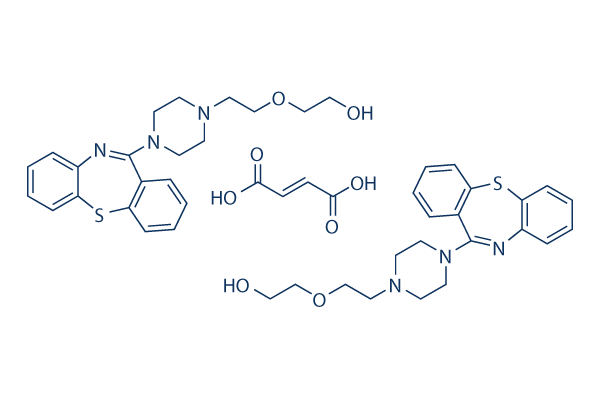
Chemische Struktur
Molekulargewicht: 883.09
Qualitätskontrolle (Quality Control)
| Verwandte Targets | Adrenergic Receptor AChR 5-HT Receptor COX Calcium Channel Histamine Receptor GABA Receptor TRP Channel Cholinesterase (ChE) GluR |
|---|---|
| Andere Dopamine Receptor Inhibitors | MPTP Hydrochloride Trifluoperazine Trifluoperazine 2HCl Penfluridol Rotundine Domperidone Sulpiride Azaperone Levosulpiride SCH-23390 hydrochloride |
Chemische Informationen, Lagerung & Stabilität (Chemical Information, Storage & Stability)
| Molekulargewicht | 883.09 | Formel | C46H54N6O8S2 |
Lagerung (Ab Erhaltdatum) | |
|---|---|---|---|---|---|
| CAS-Nr. | 111974-72-2 | SDF herunterladen | Lagerung von Stammlösungen |
|
|
| Synonyme | ICI-204636 fumarate | Smiles | C1CN(CCN1CCOCCO)C2=NC3=CC=CC=C3SC4=CC=CC=C42.C1CN(CCN1CCOCCO)C2=NC3=CC=CC=C3SC4=CC=CC=C42.C(=CC(=O)O)C(=O)O | ||
Löslichkeit (Solubility)
|
In vitro |
DMSO
: 36 mg/mL
(40.76 mM)
Water : Insoluble Ethanol : Insoluble |
Molaritätsrechner
|
In vivo |
|||||
In-vivo-Formulierungsrechner (Klare Lösung)
Schritt 1: Geben Sie unten die Informationen ein (Empfohlen: Ein zusätzliches Tier einplanen, um Verluste während des Experiments auszugleichen)
Schritt 2: Geben Sie die In-vivo-Formulierung ein (Dies ist nur der Rechner, nicht die Formulierung. Bitte kontaktieren Sie uns zuerst, wenn im Abschnitt Löslichkeit keine In-vivo-Formulierung angegeben ist.)
Berechnungsergebnisse:
Arbeitskonzentration: mg/ml;
Methode zur Herstellung der DMSO-Stammflüssigkeit: mg Wirkstoff voraufgelöst in μL DMSO ( Konzentration der Stammflüssigkeit mg/mL, Bitte kontaktieren Sie uns zuerst, wenn die Konzentration die DMSO-Löslichkeit der jeweiligen Wirkstoffcharge überschreitet. )
Methode zur Herstellung der In-vivo-Formulierung: Nehmen Sie μL DMSO Stammflüssigkeit, fügen Sie als Nächstes hinzuμL PEG300, mischen und aufklären, fügen Sie als Nächstes hinzuμL Tween 80, mischen und aufklären, fügen Sie als Nächstes hinzu μL ddH2O, mischen und aufklären.
Methode zur Herstellung der In-vivo-Formulierung: Nehmen Sie μL DMSO Stammflüssigkeit, fügen Sie als Nächstes hinzu μL Maisöl, mischen und aufklären.
Hinweis: 1. Bitte stellen Sie sicher, dass die Flüssigkeit klar ist, bevor Sie das nächste Lösungsmittel hinzufügen.
2. Achten Sie darauf, die Lösungsmittel in der richtigen Reihenfolge hinzuzufügen. Sie müssen sicherstellen, dass die im vorherigen Schritt erhaltene Lösung klar ist, bevor Sie das nächste Lösungsmittel hinzufügen. Physikalische Methoden wie Vortexen, Ultraschall oder ein warmes Wasserbad können zur Unterstützung des Lösungsvorgangs verwendet werden.
Wirkungsmechanismus (Mechanism of Action)
| Targets/IC50/Ki |
Dopamine receptor
Histamine receptor
Adrenergic Receptor
|
|---|---|
| In vitro |
Quetiapine shows affinity for various neurotransmitter receptors including serotonin, dopamine, histamine, and adrenergic receptors and has binding characteristics at the dopamine-2 receptor similar to those of clozapine.
|
| In vivo |
Quetiapine has a preclinical profile suggestive of antipsychotic activity with a reduced tendency to cause extrapyramidal symptoms (EPS) and sustained prolactin elevation. Guetiapine alters neurotensin neurotransmission and c-fos expression in limbic but not motor brain regions. Quetiapine also demonstrates clozapine-like activity in a range of behavioral and biochemical tests and may possess neuroprotective properties. Quetiapine dose-dependently prevents schizophrenia and depression in hippocampal cell proliferation and BDNF expression caused by chronic restraint stress (CRS) in rats. Guetiapine (5 mg/kg) combined with Venlafaxine (2.5 mg/kg) increases hippocampal cell proliferation and prevents BDNF decrease in stressed rats, whereas each of the drugs exerts mild or no effects. Guetiapine produces selective effects on cortical and limbic regions of the brain and in particular on dopaminergic neurotransmission in these regions. Guetiapine produces lower levels of putamenal DA D2r occupancy than those reported for typical APDs. Quetiapine also produces preferential occupancy of temporal cortical DA D2r, 46.9%, but does not spare occupancy of substantia nigra DA D2r. Guetiapine attenuates the decrease in levels of brain-derived neurotrophic factor (BDNF) in the hippocampi of rats subjected to chronic-restraint stress. Guetiapine (10 mg/kg) reverses the stress-induced suppression of hippocampal neurogenesis, evidenced in the numbers of BrdU-labeled and pCREB-positive cells that are comparable to those in non-stressed rats but higher than those in the vehicle-treated rats.
|
Referenzen |
|
Informationen zu klinischen Studien (Clinical Trial Information)
(Daten von https://clinicaltrials.gov, aktualisiert am 2026-05-26)
| NCT-Nummer | Rekrutierung | Bedingungen | Sponsor/Kollaboratoren | Startdatum | Phases |
|---|---|---|---|---|---|
| NCT07152184 | NOT_YET_RECRUITING | Patient With Schizophrenia Spectrum Disorder; NLM Classification WM 203, Psychology:Schizophrenic Psychology; Schizophrenia Spectrum and Other Psychotic Disorders |
University Hospital, Strasbourg, France |
2026-10-01 | PHASE2 |
| NCT06433635 | ACTIVE_NOT_RECRUITING | Bipolar I Disorder; Depression |
Massachusetts General Hospital |
2024-10-01 | PHASE4 |
| NCT05085808 | WITHDRAWN | Delirium; Morality; Quality of Life; Psych; Treatment Side Effects |
University of Southern California |
2028-03-01 | PHASE4 |
| NCT07654348 | NOT_YET_RECRUITING | Bipolar Disorder II |
First Affiliated Hospital of Zhejiang University |
2026-07-01 | PHASE2 |
| NCT06062953 | RECRUITING | Psychiatric Disorders; Insomnia |
Lone Baandrup |
2023-09-18 | PHASE2; PHASE3 |
| NCT07760168 | NOT_YET_RECRUITING | Treatment Resistant Depression (TRD) |
All India Institute of Medical Sciences, Bhubaneswar |
2026-08-30 | PHASE3 |
Häufig gestellte Fragen (FAQ) (Frequently Asked Questions)
Frage 1:
I want to know if your recommended formulation for in vivo experiments on the website is suitable for oral administration or injection?
Antwort:
It can be dissolved in 0.5% CMC Na at 30 mg/ml as a suspension and is fine for oral gavage.

Die Produkte sind nur für Forschungszwecke bestimmt. Nicht zur Anwendung am Menschen. Kein Verkauf an Patienten.
©Copyright 2013 Selleck Chemicals. Alle Rechte vorbehalten.