
Nur für die Forschung bestimmt
Pelitinib (EKB-569) EGFR Inhibitor
Kat.-Nr.: S1392
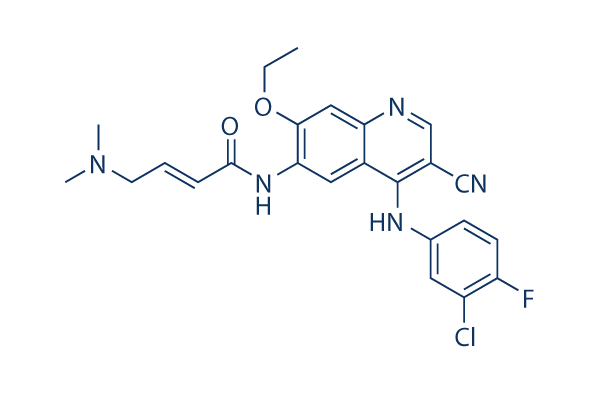
Chemische Struktur
Molekulargewicht: 467.92
Qualitätskontrolle (Quality Control)
| Verwandte Targets | VEGFR FGFR PDGFR c-Met Src MEK CSF-1R FLT3 HER2 c-Kit |
|---|---|
| Andere EGFR Inhibitors | Lazertinib (YH25448) Icotinib Hydrochloride Sunvozertinib AG-490 AG-1478 Canertinib (CI-1033) Genistein Rociletinib (CO-1686) Poziotinib (NOV120101, HM781-36B) WZ4002 |
Zellkultur, Behandlung & Arbeitskonzentration
(Cell Culture, Treatment & Working Concentration)
| Zelllinien | Assay-Typ | Konzentration | Inkubationszeit | Formulierung | Aktivitätsbeschreibung | PMID |
|---|---|---|---|---|---|---|
| A431 | Function assay | Inhibition of EGFR autophosphorylation in human A431 cells, IC50=0.00802μM. | 20797871 | |||
| Sf9 | Function assay | 10 mins | Inhibition of recombinant human His6-tagged EGFR cytoplasmic domain (645 to 1186 residues) expressed in baculovirus infected Sf9 insect cells assessed as reduction in autophosphorylation preincubated for 10 mins followed by ATP-MgCl2 addition and measured, IC50=0.0385μM. | 30600149 | ||
| A431 | Function assay | 90 mins | Inhibition of EGFR in human A431 cells assessed as reduction in EGF-stimulated EGFR autophosphorylation preincuabted for 90 mins followed by EGF-stimulation by sandwich-ELISA, IC50=0.039μM. | 30973735 | ||
| DiFi | Function assay | 2 hrs | Inhibition autophosphorylation of EGFR in human DiFi cells after 2 hrs by ELISA, IC50=0.07943μM. | 17689836 | ||
| UCH1 | Antiproliferative assay | 72 hrs | Antiproliferative activity against human UCH1 cells measured after 72 hrs by alamar blue assay, IC50=0.09μM. | 30973735 | ||
| UCH2 | Antiproliferative assay | 72 hrs | Antiproliferative activity against human UCH2 cells measured after 72 hrs by alamar blue assay, IC50=1.6μM. | 30973735 | ||
| Klicken Sie hier, um weitere experimentelle Zellliniendaten anzuzeigen | ||||||
Chemische Informationen, Lagerung & Stabilität (Chemical Information, Storage & Stability)
| Molekulargewicht | 467.92 | Formel | C24H23ClFN5O2 |
Lagerung (Ab Erhaltdatum) | |
|---|---|---|---|---|---|
| CAS-Nr. | 257933-82-7 | SDF herunterladen | Lagerung von Stammlösungen |
|
|
| Synonyme | N/A | Smiles | CCOC1=C(C=C2C(=C1)N=CC(=C2NC3=CC(=C(C=C3)F)Cl)C#N)NC(=O)C=CCN(C)C | ||
Löslichkeit (Solubility)
|
In vitro |
DMSO
: 13 mg/mL
(27.78 mM)
Water : Insoluble Ethanol : Insoluble |
Molaritätsrechner
|
In vivo |
|||||
In-vivo-Formulierungsrechner (Klare Lösung)
Schritt 1: Geben Sie unten die Informationen ein (Empfohlen: Ein zusätzliches Tier einplanen, um Verluste während des Experiments auszugleichen)
Schritt 2: Geben Sie die In-vivo-Formulierung ein (Dies ist nur der Rechner, nicht die Formulierung. Bitte kontaktieren Sie uns zuerst, wenn im Abschnitt Löslichkeit keine In-vivo-Formulierung angegeben ist.)
Berechnungsergebnisse:
Arbeitskonzentration: mg/ml;
Methode zur Herstellung der DMSO-Stammflüssigkeit: mg Wirkstoff voraufgelöst in μL DMSO ( Konzentration der Stammflüssigkeit mg/mL, Bitte kontaktieren Sie uns zuerst, wenn die Konzentration die DMSO-Löslichkeit der jeweiligen Wirkstoffcharge überschreitet. )
Methode zur Herstellung der In-vivo-Formulierung: Nehmen Sie μL DMSO Stammflüssigkeit, fügen Sie als Nächstes hinzuμL PEG300, mischen und aufklären, fügen Sie als Nächstes hinzuμL Tween 80, mischen und aufklären, fügen Sie als Nächstes hinzu μL ddH2O, mischen und aufklären.
Methode zur Herstellung der In-vivo-Formulierung: Nehmen Sie μL DMSO Stammflüssigkeit, fügen Sie als Nächstes hinzu μL Maisöl, mischen und aufklären.
Hinweis: 1. Bitte stellen Sie sicher, dass die Flüssigkeit klar ist, bevor Sie das nächste Lösungsmittel hinzufügen.
2. Achten Sie darauf, die Lösungsmittel in der richtigen Reihenfolge hinzuzufügen. Sie müssen sicherstellen, dass die im vorherigen Schritt erhaltene Lösung klar ist, bevor Sie das nächste Lösungsmittel hinzufügen. Physikalische Methoden wie Vortexen, Ultraschall oder ein warmes Wasserbad können zur Unterstützung des Lösungsvorgangs verwendet werden.
Wirkungsmechanismus (Mechanism of Action)
| Eigenschaften |
An improved version of EKI-785.
|
|---|---|
| Targets/IC50/Ki |
EGFR
38.5 nM
Src
282 nM
MEK/ERK
800 nM
ErbB2
1.255 μM
Raf
3.353 μM
|
| In vitro |
Pelitinib (EKB-569) displays much higher inhibitory activity against EGFR, compared with the closely related c-erbB-2, as well as other kinases such as Src, Cdk4, c-Met, Raf, and MEK/ERK, with IC50 ranging from 282 nM for Src to >20 μM for Cdk4. Consistently, this compound treatment significantly inhibits the autophosphorylation of EGFR but not c-Met in A431 cells. It potently inhibits the proliferation of normal human keratinocytes (NHEK), as well as A431 and MDA-468 tumor cells with IC50 of 61 nM, 125 nM, and 260 nM, respectively, while displaying little activity against MCF-7 cells with IC50 of 3.6 μM. This chemical inhibits EGF-induced phosphorylation of EGFR in A431 and NHEK cells with IC50 of 20-80 nM, as well as the phosphorylation of STAT3 with IC50 of 30-70 nM. It at 75-500 nM also specifically inhibits the activation of AKT and ERK1/2, without affecting NF-κB pathway. In NHEK cells, this compound also potently inhibits TGF-α mediated EGFR activation with IC50 of 56 nM, as well as activation of STAT3 and ERK1/2 with IC50 of 60 nM and 62 nM, respectively.
|
| Kinase-Assay |
Autophosphorylierung von EGFR in Zellen
|
|
Für Experimente mit Zellen in Kultur werden A431-Zellen 2,75 Stunden lang mit verschiedenen Konzentrationen von Pelitinib (EKB-569) behandelt, bevor sie 0,25 Stunden lang mit 100 ng/mL EGF koinkubiert werden. Die Zellen werden zweimal mit kalter phosphatgepufferter Salzlösung (PBS) gewaschen, bevor sie in Lysepuffer (10 mM Tris, pH 7,5, 5 mM Ethylendiamintetraessigsäure (EDTA), 150 mM NaCl, 1% Triton X-100, 1% Natriumdesoxycholat, 0,1% SDS, 1 mM PMSF, 10 mg/mL Pepstatin A, 10 mg/mL Leupeptin, 20 KIU/mL Aprotinin, 2 mM Natriumorthovanadat und 100 mM Natriumfluorid) für 20 Minuten auf Eis gegeben werden, vor der Immunpräzipitation und SDS-PAGE-Immunblotting. Für die Immunpräzipitation werden kultivierte Zellen in kalten Lysepuffer gegeben und sofort auf Eis mit einem Polytron mit mehreren Impulsen homogenisiert. Das Homogenat wird zuerst bei 2500 U/min (20 Minuten, 4 °C) und dann erneut bei 14.000 U/min in einer Mikrozentrifuge (10 Minuten, 4 °C) zentrifugiert. Überstände (1000 μg Protein) werden 2 Stunden lang bei 4 °C mit 15 mL polyklonalem EGFR-Antikörper inkubiert. Nach 2 Stunden werden 50 μL Protein G plus/Protein A Agarose-Kügelchen hinzugefügt und unter konstanter Rotation 2 Stunden lang bei 4 °C inkubiert. Nach dem Waschen mit Lysepuffer werden die Kügelchen 2 Minuten lang in Laemmli-Probenpuffer gekocht. Proteine werden dann durch SDS-PAGE aufgetrennt, auf eine Immobilon-Membran übertragen und über Nacht mit einem an Meerrettichperoxidase (HRP) konjugierten Anti-Phosphotyrosin-Antikörper inkubiert. Membranen werden mit dem ECL-Reagenz entwickelt. Das Gesamt-EGFR-Protein wird durch Strippen der Membranen und erneutes Inkubieren mit rezeptorspezifischen Antikörpern bestimmt. Die Quantifizierung der Banden erfolgt durch Densitometrie unter Verwendung der ImageQuant-Software mit einem Molecular Dynamics Laser-Transmissionsscanner.
|
|
| In vivo |
A single oral dose of 10 mg/kg Pelitinib (EKB-569) potently inhibits the EGFR phosphorylation in A431 xenografts with over-expressed EGFR, by 90% within 1 hour, and by >50% after 24 hours. Administration of this compound at 20 mg/kg/day inhibits tumorigenesis in APCMin/+ mice by 87%, equivalent to the effect of used with 2 times doses of EKI-785 (40 mg/kg/day), consistent with greater in vivo potency. This chemical selectively inhibits EGFR signaling in airway epithelial cells in vivo. In the mouse model of airway epithelial remodeling that is inducible by viral infection and features a delayed but permanent switch to goblet cell metaplasia, this compound treatment at 20 mg/kg/day corrects all 3 aspects of epithelial remodeling, by completely blocking the increase of ciliated cells and decrease of Clara cells, and significantly inhibiting the metaplasia of goblet cells.
|
Referenzen |
|

Die Produkte sind nur für Forschungszwecke bestimmt. Nicht zur Anwendung am Menschen. Kein Verkauf an Patienten.
©Copyright 2013 Selleck Chemicals. Alle Rechte vorbehalten.