
Nur für die Forschung bestimmt
Odanacatib Cysteine Protease Inhibitor
Kat.-Nr.: S1115
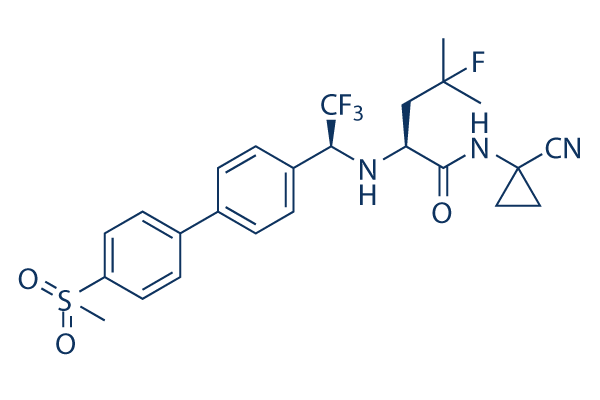
Chemische Struktur
Molekulargewicht: 525.56
Qualitätskontrolle (Quality Control)
| Verwandte Targets | HDAC Caspase Proteasome Secretase MMP HCV Protease Tyrosinase HIV Protease DPP Serine Protease |
|---|---|
| Andere Cysteine Protease Inhibitors | N-Ethylmaleimide (NEM) MG132 SSS Calpeptin Aloxistatin (E-64d) E-64 MG-101 (ALLN) Z-FA-FMK Cathepsin Inhibitor 1 PD 151746 Loxistatin Acid (E-64C) |
Zellkultur, Behandlung & Arbeitskonzentration
(Cell Culture, Treatment & Working Concentration)
| Zelllinien | Assay-Typ | Konzentration | Inkubationszeit | Formulierung | Aktivitätsbeschreibung | PMID |
|---|---|---|---|---|---|---|
| ramos cells | Function assay | Inhibition of cathepsin S in human ramos cells, IC50=0.045μM | 18226527 | |||
| stem cells | Function assay | 7 days | Inhibition of osteoclastogenesis in human bone marrow-derived stem cells assessed as reduction of pit formation by measuring TRACP5b activity after 7 days by bone TRAP assay, IC50=0.1μM | 22984809 | ||
| HepG2 | Function assay | Inhibition of cathepsin B in human HepG2 cells, IC50=1.05μM | 18226527 | |||
| B cells | Function assay | Inhibition of antigen presenting mouse B cells, IC50=1.5μM | 18226527 | |||
| HepG2 | Function assay | Inhibition of cathepsin L in human HepG2 cells, IC50=4.843μM | 18226527 | |||
| SJ-GBM2 | qHTS assay | qHTS of pediatric cancer cell lines to identify multiple opportunities for drug repurposing: Primary screen for SJ-GBM2 cells | 29435139 | |||
| Klicken Sie hier, um weitere experimentelle Zellliniendaten anzuzeigen | ||||||
Chemische Informationen, Lagerung & Stabilität (Chemical Information, Storage & Stability)
| Molekulargewicht | 525.56 | Formel | C25H27F4N3O3S |
Lagerung (Ab Erhaltdatum) | |
|---|---|---|---|---|---|
| CAS-Nr. | 603139-19-1 | SDF herunterladen | Lagerung von Stammlösungen |
|
|
| Synonyme | MK-0822 | Smiles | CC(C)(CC(C(=O)NC1(CC1)C#N)NC(C2=CC=C(C=C2)C3=CC=C(C=C3)S(=O)(=O)C)C(F)(F)F)F | ||
Löslichkeit (Solubility)
|
In vitro |
DMSO
: 100 mg/mL
(190.27 mM)
Water : Insoluble Ethanol : Insoluble |
Molaritätsrechner
|
In vivo |
|||||
In-vivo-Formulierungsrechner (Klare Lösung)
Schritt 1: Geben Sie unten die Informationen ein (Empfohlen: Ein zusätzliches Tier einplanen, um Verluste während des Experiments auszugleichen)
Schritt 2: Geben Sie die In-vivo-Formulierung ein (Dies ist nur der Rechner, nicht die Formulierung. Bitte kontaktieren Sie uns zuerst, wenn im Abschnitt Löslichkeit keine In-vivo-Formulierung angegeben ist.)
Berechnungsergebnisse:
Arbeitskonzentration: mg/ml;
Methode zur Herstellung der DMSO-Stammflüssigkeit: mg Wirkstoff voraufgelöst in μL DMSO ( Konzentration der Stammflüssigkeit mg/mL, Bitte kontaktieren Sie uns zuerst, wenn die Konzentration die DMSO-Löslichkeit der jeweiligen Wirkstoffcharge überschreitet. )
Methode zur Herstellung der In-vivo-Formulierung: Nehmen Sie μL DMSO Stammflüssigkeit, fügen Sie als Nächstes hinzuμL PEG300, mischen und aufklären, fügen Sie als Nächstes hinzuμL Tween 80, mischen und aufklären, fügen Sie als Nächstes hinzu μL ddH2O, mischen und aufklären.
Methode zur Herstellung der In-vivo-Formulierung: Nehmen Sie μL DMSO Stammflüssigkeit, fügen Sie als Nächstes hinzu μL Maisöl, mischen und aufklären.
Hinweis: 1. Bitte stellen Sie sicher, dass die Flüssigkeit klar ist, bevor Sie das nächste Lösungsmittel hinzufügen.
2. Achten Sie darauf, die Lösungsmittel in der richtigen Reihenfolge hinzuzufügen. Sie müssen sicherstellen, dass die im vorherigen Schritt erhaltene Lösung klar ist, bevor Sie das nächste Lösungsmittel hinzufügen. Physikalische Methoden wie Vortexen, Ultraschall oder ein warmes Wasserbad können zur Unterstützung des Lösungsvorgangs verwendet werden.
Wirkungsmechanismus (Mechanism of Action)
| Eigenschaften |
A potent, selective, and neutral cathepsin K inhibitor.
|
|---|---|
| Targets/IC50/Ki |
Cathepsin K (human)
0.2 nM
Cathepsin K (rabbit)
1 nM
|
| In vitro |
In vitro, Odanacatib shows the high inhibitory activity and selectivity on cathepsin K with IC50 values of 0.2 nM and 1 nM for human cathepsin K and rabbit cathepsin K, respectively. Furthermore, this compound also shows similar potencies in whole human cell enzyme occupancy assays with corrected IC50 of 5 nM. A recent study shows that this chemical results in reduction of Osteoclast (OC) resorption activity by interrupting intracellular vesicular trafficking.
|
| In vivo |
In preclinical rats, Odanacatib (10 mg/kg) exhibits excellent pharmacokinetics with clearance (Cl: 2 mL kg-1 min-1), low volume of distribution (Vdss: 1.1 L kg-1), half-life (T1/2: 6 hours) and oral bioavailability (F: 8%), respectively. Besides, this compound also exhibits excellent metabolic stability in rat hepatocytes with a 96% recovery of the parent identity. This chemical administrated by p.o. prevents bone loss in ovariectomized (OVX) rabbits in a dose-related manner. Moreover, it (9 µM/day) leads to a significant increase in proximal femur bone mineral density (BMD) (7.8%), femoral neck BMD (10.8%) and the greater trochanter BMD (6.5%). In the estrogen-deficient, skeletally mature rhesus monkeys, long-term treatment with this compound effectively inhibits bone turnover without reducing osteoclast number and maintains normal biomechanical properties of the spine of OVX nonhuman primates.
|
Referenzen |
|
Informationen zu klinischen Studien (Clinical Trial Information)
(Daten von https://clinicaltrials.gov, aktualisiert am 2018-08-28)
| NCT-Nummer | Rekrutierung | Bedingungen | Sponsor/Kollaboratoren | Startdatum | Phases |
|---|---|---|---|---|---|
| NCT01630616 | TERMINATED | Osteoporosis |
Merck Sharp & Dohme LLC |
2013-03-12 | PHASE1 |
| NCT01552122 | WITHDRAWN | Osteoporosis; Postmenopausal Osteoporosis |
Merck Sharp & Dohme LLC |
2012-05 | PHASE3 |
| NCT01803607 | TERMINATED | Osteoporosis |
Merck Sharp & Dohme LLC |
2013-03-14 | PHASE3 |
| NCT01120600 | COMPLETED | Osteoporosis |
Merck Sharp & Dohme LLC |
2010-06-09 | PHASE3 |
| NCT01803607 | Terminated | Osteoporosis |
Merck Sharp & Dohme LLC |
2013-03-14 | Phase 3 |
| NCT01630616 | Terminated | Osteoporosis |
Merck Sharp & Dohme LLC |
2013-03-12 | Phase 1 |

Die Produkte sind nur für Forschungszwecke bestimmt. Nicht zur Anwendung am Menschen. Kein Verkauf an Patienten.
©Copyright 2013 Selleck Chemicals. Alle Rechte vorbehalten.