
Nur für die Forschung bestimmt
Mycophenolate mofetil Dehydrogenase Inhibitor
Kat.-Nr.: S1501
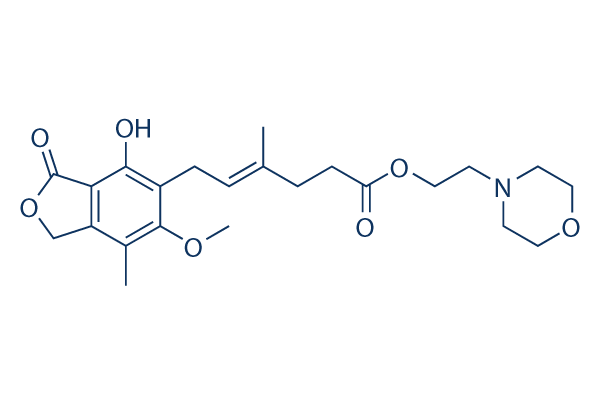
Chemische Struktur
Molekulargewicht: 433.49
Qualitätskontrolle (Quality Control)
Chemische Informationen, Lagerung & Stabilität (Chemical Information, Storage & Stability)
| Molekulargewicht | 433.49 | Formel | C23H31NO7 |
Lagerung (Ab Erhaltdatum) | |
|---|---|---|---|---|---|
| CAS-Nr. | 128794-94-5 | SDF herunterladen | Lagerung von Stammlösungen |
|
|
| Synonyme | Mycophenolic acid morpholinoethyl ester, CellCept, RS-61443, TM-MMF | Smiles | CC1=C2COC(=O)C2=C(C(=C1OC)CC=C(C)CCC(=O)OCCN3CCOCC3)O | ||
Löslichkeit (Solubility)
|
In vitro |
DMSO
: 87 mg/mL
(200.69 mM)
Water : Insoluble Ethanol : Insoluble |
Molaritätsrechner
|
In vivo |
|||||
In-vivo-Formulierungsrechner (Klare Lösung)
Schritt 1: Geben Sie unten die Informationen ein (Empfohlen: Ein zusätzliches Tier einplanen, um Verluste während des Experiments auszugleichen)
Schritt 2: Geben Sie die In-vivo-Formulierung ein (Dies ist nur der Rechner, nicht die Formulierung. Bitte kontaktieren Sie uns zuerst, wenn im Abschnitt Löslichkeit keine In-vivo-Formulierung angegeben ist.)
Berechnungsergebnisse:
Arbeitskonzentration: mg/ml;
Methode zur Herstellung der DMSO-Stammflüssigkeit: mg Wirkstoff voraufgelöst in μL DMSO ( Konzentration der Stammflüssigkeit mg/mL, Bitte kontaktieren Sie uns zuerst, wenn die Konzentration die DMSO-Löslichkeit der jeweiligen Wirkstoffcharge überschreitet. )
Methode zur Herstellung der In-vivo-Formulierung: Nehmen Sie μL DMSO Stammflüssigkeit, fügen Sie als Nächstes hinzuμL PEG300, mischen und aufklären, fügen Sie als Nächstes hinzuμL Tween 80, mischen und aufklären, fügen Sie als Nächstes hinzu μL ddH2O, mischen und aufklären.
Methode zur Herstellung der In-vivo-Formulierung: Nehmen Sie μL DMSO Stammflüssigkeit, fügen Sie als Nächstes hinzu μL Maisöl, mischen und aufklären.
Hinweis: 1. Bitte stellen Sie sicher, dass die Flüssigkeit klar ist, bevor Sie das nächste Lösungsmittel hinzufügen.
2. Achten Sie darauf, die Lösungsmittel in der richtigen Reihenfolge hinzuzufügen. Sie müssen sicherstellen, dass die im vorherigen Schritt erhaltene Lösung klar ist, bevor Sie das nächste Lösungsmittel hinzufügen. Physikalische Methoden wie Vortexen, Ultraschall oder ein warmes Wasserbad können zur Unterstützung des Lösungsvorgangs verwendet werden.
Wirkungsmechanismus (Mechanism of Action)
| Targets/IC50/Ki |
Inosine monophosphate dehydrogenase II
(Cell-free assay) 27 nM
Inosine monophosphate dehydrogenase I
(Cell-free assay) 39 nM
|
|---|---|
| In vitro |
Mycophenolate mofetil is an ester prodrug of the active immunosuppressant mycophenolic acid (MPA). The latter shows a noncompetitive, selective and reversible inhibition activity against inosine monophosphate dehydrogenase type I/II with IC50 of 39 nM and 27 nM, respectively. Moreover, MPA also produces the concentration-dependent inhibition of proliferation of ConA-stimulated T cells, LPS-stimulated B cells and alloantigen-specific T cells with IC50 of 100 nM, 120 nM, and 51 nM, respectively. This compound with high concentration of 10 μg/mL induces a strong apoptosis in microglial cell cultures and increases the number of activated caspase-3 immunoreactive apoptotic cells. In addition, it (1 μg/mL) strongly inhibits proliferation of both microglial cells and astrocytes. A recent study shows that this chemical significantly attenuates the extent of neuronal cell death of organotypic hippocampal slice cultures after neuronal injury in a time-dependent manner. |
| Kinase-Assay |
IMP dehydrogenase Typen I und II enzymatische Aktivität
|
|
IMP dehydrogenase Typen I und II werden aus E. coli, die menschliche Enzyme exprimieren, gereinigt. Der Assay wird in einer flachen, UV-transparenten 96-Well-Platte durchgeführt. Die endgültige 200 μL Reaktionsmischung enthielt 0,1 M Tris, 0,1 M KCl, 3 mM EDTA pH 8,0, 2 mM DTT und 40 nM entweder IMP dehydrogenase Typ I oder Typ II. Die Reaktion wird durch Zugabe von 400 μM NAD und 400 μM IMP initiiert, gefolgt von einer Inkubation bei 37 °C für 2,5 Stunden. Die Reaktionsrate der Umwandlung von NAD zu NADH wird dann basierend auf dem Anstieg der Absorption bei 340 nm gemessen. Die Assays werden auch in Gegenwart von 50 % menschlichem Serum durchgeführt, um die Serumproteinbindung durch verschiedene IMP dehydrogenase Inhibitoren abzuschätzen.
|
|
| In vivo |
In an ACI-to-Lewis rat heterotopic cardiac transplant model, treatment of Mycophenolate mofetil at doses of 20 mg/kg and 40 mg/kg leads to a prolongation of graft survival, with median survival time (MST) of 14.5 days and 18.5 days, respectively. In bleomycin (BLM)-induced scleroderma mouse model, this compound reduces inflammatory-cell infiltration, tissue hydroxyproline content and dermal thickness. |
Referenzen |
|
Informationen zu klinischen Studien (Clinical Trial Information)
(Daten von https://clinicaltrials.gov, aktualisiert am 2026-06-03)
| NCT-Nummer | Rekrutierung | Bedingungen | Sponsor/Kollaboratoren | Startdatum | Phases |
|---|---|---|---|---|---|
| NCT06412497 | RECRUITING | Severe Aplastic Anemia; Acquired Amegakaryocytic Thrombocytopenia; Acquired Pure Red Cell Aplasia; Paroxysmal Nocturnal Hemoglobinuria |
Masonic Cancer Center, University of Minnesota |
2024-06-05 | PHASE2 |
| NCT07524530 | NOT_YET_RECRUITING | Core Binding Factor Alpha Subunits; Hematologic Neoplasms; Leukemia; Lymphoma |
National Cancer Institute (NCI) |
2026-09-09 | PHASE2 |
| NCT04877288 | RECRUITING | Renal Allograft Recipients |
Bristol-Myers Squibb |
2021-07-21 | PHASE3 |
| NCT06013423 | RECRUITING | Acute Leukemia of Ambiguous Lineage; Acute Lymphoblastic Leukemia; Acute Myeloid Leukemia; Blastic Plasmacytoid Dendritic Cell Neoplasm; Hematopoietic and Lymphatic System Neoplasm; Mixed Phenotype Acute Leukemia; Myelodysplastic Syndrome; Myeloproliferative Neoplasm; Non-Hodgkin Lymphoma; Chronic Myeloid Leukemia, BCR-ABL1 Positive |
Fred Hutchinson Cancer Center |
2024-07-23 | PHASE2 |
| NCT05027945 | RECRUITING | Immunodeficiency; Hematopoietic Stem Cell Transplantation |
National Cancer Institute (NCI) |
2023-02-23 | PHASE2 |
| NCT06568549 | RECRUITING | Kidney Transplantation; Mycophenolate Mofetil |
Mayo Clinic |
2025-06-13 | PHASE4 |

Die Produkte sind nur für Forschungszwecke bestimmt. Nicht zur Anwendung am Menschen. Kein Verkauf an Patienten.
©Copyright 2013 Selleck Chemicals. Alle Rechte vorbehalten.