
Nur für die Forschung bestimmt
Mitoxantrone Dihydrochloride (NSC 301739) PKC/Topoisomerase II Inhibitor
Kat.-Nr.: S2485
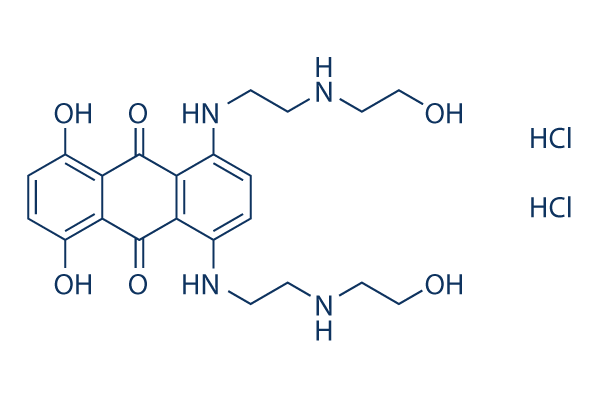
Chemische Struktur
Molekulargewicht: 517.4
Qualitätskontrolle (Quality Control)
| Verwandte Targets | HDAC PARP ATM/ATR DNA-PK WRN DNA/RNA Synthesis PPAR Sirtuin Casein Kinase eIF |
|---|---|
| Andere Topoisomerase Inhibitors | Camptothecin (CPT) Betulinic acid (S)-10-Hydroxycamptothecin Beta-Lapachone Ellagic acid Amonafide Voreloxin (SNS-595) hydrochloride Hydroxy Camptothecine Cu(II)-Elesclomol 7-Ethylcamptothecin |
Zellkultur, Behandlung & Arbeitskonzentration
(Cell Culture, Treatment & Working Concentration)
| Zelllinien | Assay-Typ | Konzentration | Inkubationszeit | Formulierung | Aktivitätsbeschreibung | PMID |
|---|---|---|---|---|---|---|
| L1210 cell | Cytotoxicity assay | 48 h | Cytotoxic potency required to inhibit L1210 cell growth by 50% after cell drug contact for 48 hrs, IC50=4e-05 μM | |||
| HL60 cells | Cytotoxicity assay | 48 h | Cytotoxicity against human HL60 cells after 48 hrs by MTT assay, GI50=0.33 μM | |||
| MDA435/LCC6 cells | Proliferation assay | Antiproliferative activity against MDA435/LCC6 cells by ELISA, IC50=0.35 nM | ||||
| A2780-cell | Growth inhibition assay | Concentration required to inhibit A2780-cell growth by 50%, IC50=0.55 nM | ||||
| G-361 cell | Growth inhibition assay | Cytotoxic potency required to inhibit G-361 cell growth by 50%, IC50=0.65 nM | ||||
| human HL60 cells | Proliferation assay | 72 h | Antiproliferative activity against human HL60 cells after 72 hrs by SRB assay, IC50=2.5 nM | |||
| human K562 cells | Cytotoxicity assay | 5 days | Cytotoxicity against human K562 cells after 5 days by XTT assay, IC50=2.6 nM | |||
| CH1 cell | Cytotoxicity assay | Cytotoxic potency required to inhibit CH1 cell growth by 50%, IC50=2.65 nM | ||||
| MES-SA cells | Proliferation assay | 72 h | Antiproliferative activity against MES-SA cells by MTT assay after 72 hrs, IC50=3 nM | |||
| A549 cells | Function assay | Activity against A549 cancer cell line, IC50=3.1 nM | ||||
| LoVo cells | Cytotoxicity assay | 144 h | Cytotoxicity against human LoVo cancer cell line was determined after 144 hr, IC50=3.3 nM | |||
| P388 cells | Proliferation assay | Antiproliferative activity against P388 cells by ELISA, IC50=4.3 nM | ||||
| human Daudi cells | Proliferation assay | 72 h | Antiproliferative activity against human Daudi cells after 72 hrs by MTT assay, IC50=5 nM | |||
| SKOV-3 cell | Cytotoxicity assay | Cytotoxic potency required to inhibit SKOV-3 cell growth 50%, IC50=5.3 nM | ||||
| OVCAR-3 cell | Function assay | Antitumor activity against human ovarian OVCAR-3 cell lines, IC50=5.8 nM | ||||
| human MES-SA cells | Proliferation assay | 72 h | Antiproliferative activity against human MES-SA cells after 72 hrs by MTT assay, IC50=6 nM | |||
| PC3 cancer cell | Cytotoxicity assay | 144 h | Cytotoxicity against human PC3 cancer cell line was determined after 144 hr, IC50=7 nM | |||
| MXF7 breast cell | Function assay | Antitumor activity against human mammary carcinoma sensitive MXF7 breast cell line, IC50=8.7 nM | ||||
| HT-29 cell | Cytotoxicity assay | 144 h | Cytotoxic potency required to inhibit HT-29 cell growth by 50% after cell drug contact for 144 hrs, IC5=0.01 μM | |||
| HEK293 cells | Cytotoxicity assay | 72 h | Cytotoxicity against HEK293 cells after 72 hrs by MTT assay, IC50=0.01 μM | |||
| MKN45 cells | Cytotoxicity assay | 144 h | Cytotoxicity against human MKN45 cancer cell line was determined after 144 hr, IC50=0.012 μM | |||
| MES-SA cells | Cytotoxicity assay | 72 h | Cytotoxicity against human MES-SA cells assessed as inhibition of cell proliferation after 72 hrs by MTT assay, IC50=0.012 μM | |||
| FM3 cells | Proliferation assay | 72 h | Antiproliferative activity against human FM3 cells after 72 hrs by MTT assay, IC50=0.013 μM | |||
| MCF-7 cells | Growth inhibition assay | Inhibitory activity against human tumor cell line MCF-7 breast adenocarcinoma, IC50=0.02 μM | ||||
| human small-cell lung cancer | Cytotoxicity assay | Cytotoxicity against human small-cell lung cancer (SCLC), IC50=0.02 μM | ||||
| human HCT116 cells | Cytotoxicity assay | 72 h | Cytotoxicity against human HCT116 cells assessed as inhibition of cell proliferation after 72 hrs by MTT assay, IC50=0.022 μM | |||
| human HCT116 cells | Proliferation assay | 72 h | Antiproliferative activity against human HCT116 cells after 72 hrs by MTT assay, IC50=0.025 μM | |||
| NCI-H460 cells | Cytotoxicity assay | 48 h | Cytotoxicity against human NCI-H460 cells after 48 hrs by resazurin dye assay, EC50=0.03 μM | |||
| CCRF-CEM cells | Cytotoxicity assay | 48 h | Cytotoxicity against human CCRF-CEM cells assessed as cell viability after 48 hrs by celltiter-blue assay, IC50=0.036 μM | |||
| HeLa cells | Proliferation assay | 72 h | Antiproliferative activity against human HeLa cells after 72 hrs by MTT assay, IC50=0.044 μM | |||
| NCI60 cells | Function assay | 48 h | Antitumor activity against human NCI60 cells after 48 hrs by SRB assay, GI50=47.86 nM | |||
| UACC375 cell | Function assay | Antitumor activity against human melanoma UACC375 cell line, IC50=0.048 μM | ||||
| HT1080 cell | Growth inhibition assay | Inhibitory activity against human tumor cell line HT1080, IC50=0.066 μM | ||||
| MES-SA/Dx5 cells | Proliferation assay | 72 h | Antiproliferative activity against human MES-SA/Dx5 cells after 72 hrs by MTT assay, IC50=0.073 μM | |||
| SF268 cells | Proliferation assay | 48 h | Antiproliferative activity against human SF268 cells after 48 hrs, EC50=0.32 μM | |||
| KB/HeLa cells | Proliferation assay | 48 h | Antiproliferative activity against human KB/HeLa cells after 48 hrs, EC50=0.36 μM | |||
| K562 cells | Growth inhibition assay | 72 h | Growth inhibition of human K562 cells after 72 hrs by MTS method, IC50=0.42 μM | |||
| MDA-MB-231 cells | Proliferation assay | 72 h | Antiproliferative activity against human MDA-MB-231 cells by WST-1 method after 72 hrs, IC50=0.96 μM | |||
| SF268 cells | Cytotoxicity assay | 48 h | Cytotoxicity against human SF268 cells after 48 hrs by SRB assay, GI50=0.97 μM | |||
| HCT116 cells | Cytotoxicity assay | Cytotoxicity against human HCT116 cells by MTT assay, IC50=3.96 μM | ||||
| U937 cells | Cytotoxicity assay | Cytotoxicity against human U937 cells by MTT assay, IC50=6.2 μM | ||||
| HepG2 cells | Proliferation assay | 48 h | Antiproliferative activity against human HepG2 cells after 48 hrs by MTT assay, IC50=11.05 μM | |||
| Klicken Sie hier, um weitere experimentelle Zellliniendaten anzuzeigen | ||||||
Chemische Informationen, Lagerung & Stabilität (Chemical Information, Storage & Stability)
| Molekulargewicht | 517.4 | Formel | C22H29ClN4O6.2HCl |
Lagerung (Ab Erhaltdatum) | 3 years-20°C(in the dark) powder |
|---|---|---|---|---|---|
| CAS-Nr. | 70476-82-3 | SDF herunterladen | Lagerung von Stammlösungen | Lösungen sind instabil. Bitte frisch ansetzen oder kleine, vorabgepackte Grössen kaufen. Nach Erhalt umfüllen. | |
| Synonyme | NSC-301739 2HCl, Mitozantrone 2HCl | Smiles | C1=CC(=C2C(=C1NCCNCCO)C(=O)C3=C(C=CC(=C3C2=O)O)O)NCCNCCO.Cl.Cl | ||
Löslichkeit (Solubility)
|
In vitro |
DMSO
: 104 mg/mL
(201.0 mM)
Water : 104 mg/mL Ethanol : Insoluble |
Molaritätsrechner
|
In vivo |
|||||
In-vivo-Formulierungsrechner (Klare Lösung)
Schritt 1: Geben Sie unten die Informationen ein (Empfohlen: Ein zusätzliches Tier einplanen, um Verluste während des Experiments auszugleichen)
Schritt 2: Geben Sie die In-vivo-Formulierung ein (Dies ist nur der Rechner, nicht die Formulierung. Bitte kontaktieren Sie uns zuerst, wenn im Abschnitt Löslichkeit keine In-vivo-Formulierung angegeben ist.)
Berechnungsergebnisse:
Arbeitskonzentration: mg/ml;
Methode zur Herstellung der DMSO-Stammflüssigkeit: mg Wirkstoff voraufgelöst in μL DMSO ( Konzentration der Stammflüssigkeit mg/mL, Bitte kontaktieren Sie uns zuerst, wenn die Konzentration die DMSO-Löslichkeit der jeweiligen Wirkstoffcharge überschreitet. )
Methode zur Herstellung der In-vivo-Formulierung: Nehmen Sie μL DMSO Stammflüssigkeit, fügen Sie als Nächstes hinzuμL PEG300, mischen und aufklären, fügen Sie als Nächstes hinzuμL Tween 80, mischen und aufklären, fügen Sie als Nächstes hinzu μL ddH2O, mischen und aufklären.
Methode zur Herstellung der In-vivo-Formulierung: Nehmen Sie μL DMSO Stammflüssigkeit, fügen Sie als Nächstes hinzu μL Maisöl, mischen und aufklären.
Hinweis: 1. Bitte stellen Sie sicher, dass die Flüssigkeit klar ist, bevor Sie das nächste Lösungsmittel hinzufügen.
2. Achten Sie darauf, die Lösungsmittel in der richtigen Reihenfolge hinzuzufügen. Sie müssen sicherstellen, dass die im vorherigen Schritt erhaltene Lösung klar ist, bevor Sie das nächste Lösungsmittel hinzufügen. Physikalische Methoden wie Vortexen, Ultraschall oder ein warmes Wasserbad können zur Unterstützung des Lösungsvorgangs verwendet werden.
Wirkungsmechanismus (Mechanism of Action)
| Targets/IC50/Ki |
Topoisomerase II
PKC
(Cell-free assay) 8.5 μM
|
|---|---|
| In vitro |
Mitoxantrone induces DNA fragmentation and the proteolytic cleavage of poly(ADP-ribose) polymerase (PARP), a marker of the activation of caspases, in all the patients studied, demonstrating that the cytotoxic effect of mitoxantrone is due to induction of apoptosis. Mitoxantrone activates NFkappaB and stimulates IkappaBalpha degradation in the promyelocytic leukemia cell line HL60 but not in the variant cells, HL60/MX2 cells, which lack the beta isoform of topoisomerase II and express a truncated alpha isoform that results in an altered subcellular distribution. Mitoxantrone inhibits proliferation of activated PBMCs, B lymphocytes, or antigen-specific T-cell lines (TCLs) stimulated on antigen-presenting cells (APCs) in a dose-dependent manner. Mitoxantrone induces apoptosis of PBMCs, monocytes and DCs at low concentrations, whereas higher doses causes cell lysis. |
| In vivo |
Mitoxantrone transiently decreases the growth rate of HID xenografts in mice but does not affect that of PAC120 xenografts. Mitoxantrone results in the severity of the cardiac lesions and the nephropathy and the intestinal toxicity in spontaneously hypertensive rats. Mitoxantrone and iron(III) form a strong 2:1 complex, in which mitoxantrone may be acting as a tridentate ligand. |
Referenzen |
|
Anwendungen (Applications)
| Methoden | Biomarker | Bilder | PMID |
|---|---|---|---|
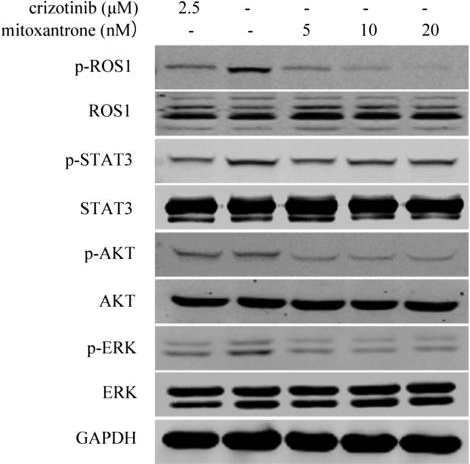
| Western blot | p-ROS1 / ROS1 / p-STAT3 / STAT3 / p-AKT / AKT / p-ERK / ERK |
|
30108778 |
| Growth inhibition assay | Cell number |

|
24349321 |
Informationen zu klinischen Studien (Clinical Trial Information)
(Daten von https://clinicaltrials.gov, aktualisiert am 2026-06-29)
| NCT-Nummer | Rekrutierung | Bedingungen | Sponsor/Kollaboratoren | Startdatum | Phases |
|---|---|---|---|---|---|
| NCT02724163 | ACTIVE_NOT_RECRUITING | Acute Myeloid Leukaemia |
University of Birmingham |
2016-04 | PHASE3 |
| NCT07754799 | NOT_YET_RECRUITING | Acute Myeloid Leukemia (AML) |
Institute of Hematology & Blood Diseases Hospital, China |
2026-09-30 | PHASE2 |
| NCT04293562 | RECRUITING | Acute Myeloid Leukemia |
Children's Oncology Group |
2020-07-21 | PHASE3 |
| NCT03591510 | ACTIVE_NOT_RECRUITING | FLT3-mutated Acute Myeloid Leukemia |
Novartis Pharmaceuticals |
2019-03-13 | PHASE2 |
| NCT05848687 | RECRUITING | Lymphoblastic Leukemia |
Tanja Andrea Gruber |
2023-11-03 | PHASE1; PHASE2 |
| NCT06221683 | RECRUITING | AML, Childhood; Acute Myeloid Leukemia |
Children's Hospital of Soochow University |
2024-01-01 | PHASE2 |

Die Produkte sind nur für Forschungszwecke bestimmt. Nicht zur Anwendung am Menschen. Kein Verkauf an Patienten.
©Copyright 2013 Selleck Chemicals. Alle Rechte vorbehalten.