
Nur für die Forschung bestimmt
Meropenem Antibiotics Chemisch
Kat.-Nr.: S1381
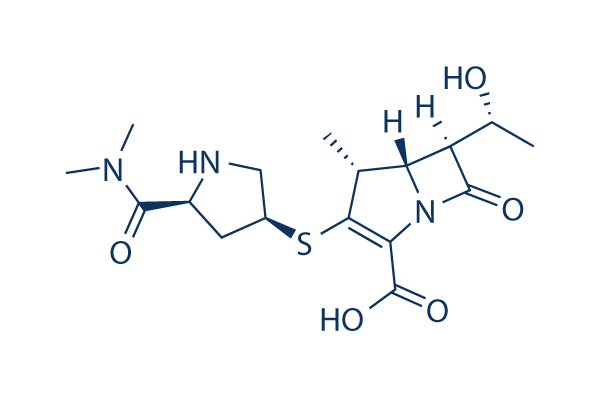
Chemische Struktur
Molekulargewicht: 383.46
Qualitätskontrolle (Quality Control)
| Verwandte Targets | Integrase Bacterial Anti-infection Fungal Antiviral COVID-19 Parasite Reverse Transcriptase HIV HCV Protease |
|---|---|
| Andere Antibiotics Inhibitors | Puromycin G418 Sulfate (Geneticin) Nanchangmycin Sitafloxacin Hydrate Nadifloxacin Spiramycin Trovafloxacin Mesylate G-418 Thiamphenicol Kitasamycin |
Chemische Informationen, Lagerung & Stabilität (Chemical Information, Storage & Stability)
| Molekulargewicht | 383.46 | Formel | C17H25N3O5S |
Lagerung (Ab Erhaltdatum) | |
|---|---|---|---|---|---|
| CAS-Nr. | 96036-03-2 | SDF herunterladen | Lagerung von Stammlösungen |
|
|
| Synonyme | SM 7338 | Smiles | CC1C2C(C(=O)N2C(=C1SC3CC(NC3)C(=O)N(C)C)C(=O)O)C(C)O | ||
Löslichkeit (Solubility)
|
In vitro |
Water : 77 mg/mL
DMSO
: Insoluble
Ethanol : Insoluble |
Molaritätsrechner
|
In vivo |
|||||
In-vivo-Formulierungsrechner (Klare Lösung)
Schritt 1: Geben Sie unten die Informationen ein (Empfohlen: Ein zusätzliches Tier einplanen, um Verluste während des Experiments auszugleichen)
Schritt 2: Geben Sie die In-vivo-Formulierung ein (Dies ist nur der Rechner, nicht die Formulierung. Bitte kontaktieren Sie uns zuerst, wenn im Abschnitt Löslichkeit keine In-vivo-Formulierung angegeben ist.)
Berechnungsergebnisse:
Arbeitskonzentration: mg/ml;
Methode zur Herstellung der DMSO-Stammflüssigkeit: mg Wirkstoff voraufgelöst in μL DMSO ( Konzentration der Stammflüssigkeit mg/mL, Bitte kontaktieren Sie uns zuerst, wenn die Konzentration die DMSO-Löslichkeit der jeweiligen Wirkstoffcharge überschreitet. )
Methode zur Herstellung der In-vivo-Formulierung: Nehmen Sie μL DMSO Stammflüssigkeit, fügen Sie als Nächstes hinzuμL PEG300, mischen und aufklären, fügen Sie als Nächstes hinzuμL Tween 80, mischen und aufklären, fügen Sie als Nächstes hinzu μL ddH2O, mischen und aufklären.
Methode zur Herstellung der In-vivo-Formulierung: Nehmen Sie μL DMSO Stammflüssigkeit, fügen Sie als Nächstes hinzu μL Maisöl, mischen und aufklären.
Hinweis: 1. Bitte stellen Sie sicher, dass die Flüssigkeit klar ist, bevor Sie das nächste Lösungsmittel hinzufügen.
2. Achten Sie darauf, die Lösungsmittel in der richtigen Reihenfolge hinzuzufügen. Sie müssen sicherstellen, dass die im vorherigen Schritt erhaltene Lösung klar ist, bevor Sie das nächste Lösungsmittel hinzufügen. Physikalische Methoden wie Vortexen, Ultraschall oder ein warmes Wasserbad können zur Unterstützung des Lösungsvorgangs verwendet werden.
Wirkungsmechanismus (Mechanism of Action)
| In vitro |
Meropenem has an antibacterial spectrum which is broadly similar to that of imipenem but, whilst slightly less active against staphylococci and enterococci, it is more active against Pseudomonas aeruginosa, all Enterobacteriaceae and Haemophilus influenzae. This compound is two- to four-fold more active than imipenem against Gram-negative organisms and its spectrum of antimicrobial activity is wider than those of all other drugs tested. Its MICs are not significantly influenced by high inocula and the drug is generally bactericidal. It demonstrates antagonism with several other beta-lactams against strains producing Type I cephalosporinases. This antibiotic binds most strongly to penicillin-binding protein 2 of Escherichia coli and Pseudomonas aeruginosa, and to penicillin-binding proteins 1 of Staphylococcus aureus. This chemical is a new carbapenem antibiotic which differs chemically from imipenem/cilastatin by having a 1-beta-methyl substitution, providing it with excellent intrinsic stability to human renal dehydropeptidase-I. It has one identified metabolite, a beta-lactam ring-opened form which is devoid of microbiological activity.
|
|---|---|
| In vivo |
Meropenem significantly increases the plamsa total clearance of valproate to about 1.5 times the control (6.09 mL/min/kg vs. 4.28 mL/min/kg) in rabbits. This compound significantly increases the urinary excretion of valproate- glucuronide in rabbits.
|
Referenzen |
|
Informationen zu klinischen Studien (Clinical Trial Information)
(Daten von https://clinicaltrials.gov, aktualisiert am 2026-08-12)
| NCT-Nummer | Rekrutierung | Bedingungen | Sponsor/Kollaboratoren | Startdatum | Phases |
|---|---|---|---|---|---|
| NCT07759453 | NOT_YET_RECRUITING | Liver Transplant; Carbapenem-resistant Enterobacterales; CRE Colonization |
IRCCS Azienda Ospedaliero-Universitaria di Bologna |
2026-10-01 | PHASE3 |
| NCT07004049 | RECRUITING | Bloodstream Infection; Ventilator Associated Bacterial Pneumonia; Hospital Acquired Bacterial Pneumonia; Carbapenem Resistant Bacterial Infection; Multidrug Resistance |
National University of Singapore |
2025-04-21 | PHASE4 |
| NCT06184659 | RECRUITING | Sepsis; Septic Shock |
Scandinavian Critical Care Trials Group |
2025-06-26 | PHASE4 |
| NCT07556107 | RECRUITING | Infection; Acute Kidney Injury; Sepsis |
Bassett Healthcare |
2026-08-17 | PHASE4 |
| NCT07327619 | RECRUITING | Hospital-acquired Bacterial Pneumonia and Ventilator-associated Bacterial Pneumonia |
Qilu Pharmaceutical Co., Ltd. |
2026-01-22 | PHASE3 |
| NCT07484633 | NOT_YET_RECRUITING | Infection; Sepsis; NICU; PICU; Beta Lactams |
Semmelweis University |
2026-04 | PHASE4 |

Die Produkte sind nur für Forschungszwecke bestimmt. Nicht zur Anwendung am Menschen. Kein Verkauf an Patienten.
©Copyright 2013 Selleck Chemicals. Alle Rechte vorbehalten.