
Nur für die Forschung bestimmt
Menadione (Vitamin K3) phosphatase Inhibitor
Kat.-Nr.: S1949
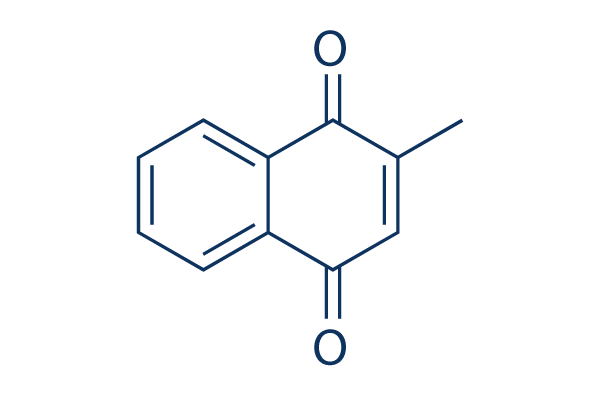
Chemische Struktur
Molekulargewicht: 172.18
Qualitätskontrolle (Quality Control)
Zellkultur, Behandlung & Arbeitskonzentration
(Cell Culture, Treatment & Working Concentration)
| Zelllinien | Assay-Typ | Konzentration | Inkubationszeit | Formulierung | Aktivitätsbeschreibung | PMID |
|---|---|---|---|---|---|---|
| HT22 cells | Function assay | Neuroprotective activity in mouse HT22 cells assessed as prevention from glutamate-induced oxidative cell death by MTS assay, PD50=0.797 μM | ||||
| HeLa cell | Cytotoxicity assay | Cytotoxicity against HeLa cell lines, EC50=3.7 μM | ||||
| PaCa2 cell | Proliferation assay | Antiproliferative activity against human pancreatic carcinoma Mia PaCa2 cell line by colorimetric assay, IC50=6.2 μM | ||||
| HT-29 cells | Cytotoxicity assay | 72 h | Cytotoxicity against human HT-29 cells assessed as growth inhibition after 72 hrs by MTS assay, IC50=9.69 μM | |||
| DU145 cells | Cytotoxicity assay | 72 h | Cytotoxicity against human DU145 cells assessed as growth inhibition after 72 hrs by MTS assay, IC50=9.86 μM | |||
| MDA-MB-231 cells | Cytotoxicity assay | 72 h | Cytotoxicity against human MDA-MB-231 cells assessed as growth inhibition after 72 hrs by MTS assay, IC50=12.68 μM | |||
| human A2058 cells | Cytotoxicity assay | Cytotoxicity against human A2058 cells assessed as inhibition of formazan formation at day 5 by measuring absorbance at 430 nm, IC50=13.4 μM | ||||
| SAS cells | Cytotoxicity assay | 48 h | Cytotoxicity against human SAS cells assessed as reduction in cell viability after 48 hrs by MTT assay, IC50=14 μM | |||
| HaCaT cells | Function assay | 48 h | Antihyperproliferative activity against human HaCaT cells assessed as inhibition of cell growth after 48 hrs by phase contrast microscopy, IC50=15.8 μM | |||
| HeLa cells | Cytotoxicity assay | 48 h | Cytotoxicity against human HeLa cells assessed as reduction in cell viability after 48 hrs by MTT assay, IC50=18 μM | |||
| CRL2796 cells | Cytotoxicity assay | Cytotoxicity against human CRL2796 cells assessed as inhibition of formazan formation at day 4 by measuring absorbance at 430 nm, IC50=21 μM | ||||
| HL60 cells | Function assay | 50 μM | Induction of necrosis in intact human HL60 cells assessed as cytosolic LDH release at 50 uM | |||
| Klicken Sie hier, um weitere experimentelle Zellliniendaten anzuzeigen | ||||||
Chemische Informationen, Lagerung & Stabilität (Chemical Information, Storage & Stability)
| Molekulargewicht | 172.18 | Formel | C11H8O2 |
Lagerung (Ab Erhaltdatum) | 3 years-20°C(in the dark) powder |
|---|---|---|---|---|---|
| CAS-Nr. | 58-27-5 | SDF herunterladen | Lagerung von Stammlösungen | Lösungen sind instabil. Bitte frisch ansetzen oder kleine, vorabgepackte Grössen kaufen. Nach Erhalt umfüllen. | |
| Synonyme | NSC 4170 | Smiles | CC1=CC(=O)C2=CC=CC=C2C1=O | ||
Löslichkeit (Solubility)
|
In vitro |
DMSO
: 34 mg/mL
(197.46 mM)
Ethanol : 34 mg/mL Water : Insoluble |
Molaritätsrechner
|
In vivo |
|||||
In-vivo-Formulierungsrechner (Klare Lösung)
Schritt 1: Geben Sie unten die Informationen ein (Empfohlen: Ein zusätzliches Tier einplanen, um Verluste während des Experiments auszugleichen)
Schritt 2: Geben Sie die In-vivo-Formulierung ein (Dies ist nur der Rechner, nicht die Formulierung. Bitte kontaktieren Sie uns zuerst, wenn im Abschnitt Löslichkeit keine In-vivo-Formulierung angegeben ist.)
Berechnungsergebnisse:
Arbeitskonzentration: mg/ml;
Methode zur Herstellung der DMSO-Stammflüssigkeit: mg Wirkstoff voraufgelöst in μL DMSO ( Konzentration der Stammflüssigkeit mg/mL, Bitte kontaktieren Sie uns zuerst, wenn die Konzentration die DMSO-Löslichkeit der jeweiligen Wirkstoffcharge überschreitet. )
Methode zur Herstellung der In-vivo-Formulierung: Nehmen Sie μL DMSO Stammflüssigkeit, fügen Sie als Nächstes hinzuμL PEG300, mischen und aufklären, fügen Sie als Nächstes hinzuμL Tween 80, mischen und aufklären, fügen Sie als Nächstes hinzu μL ddH2O, mischen und aufklären.
Methode zur Herstellung der In-vivo-Formulierung: Nehmen Sie μL DMSO Stammflüssigkeit, fügen Sie als Nächstes hinzu μL Maisöl, mischen und aufklären.
Hinweis: 1. Bitte stellen Sie sicher, dass die Flüssigkeit klar ist, bevor Sie das nächste Lösungsmittel hinzufügen.
2. Achten Sie darauf, die Lösungsmittel in der richtigen Reihenfolge hinzuzufügen. Sie müssen sicherstellen, dass die im vorherigen Schritt erhaltene Lösung klar ist, bevor Sie das nächste Lösungsmittel hinzufügen. Physikalische Methoden wie Vortexen, Ultraschall oder ein warmes Wasserbad können zur Unterstützung des Lösungsvorgangs verwendet werden.
Wirkungsmechanismus (Mechanism of Action)
| Targets/IC50/Ki |
Cdc25 phosphatase
DNA polymerase γ
|
|---|---|
| In vitro |
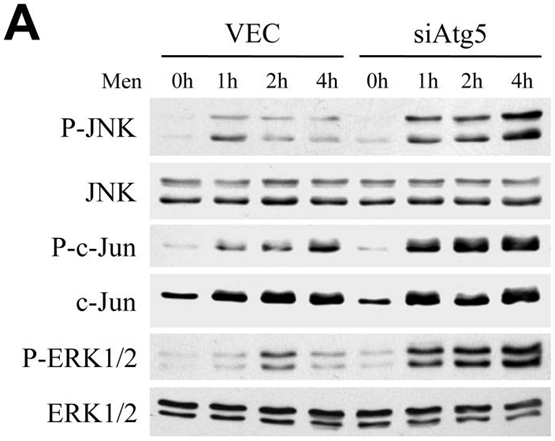
Menadione (Vitamin K3) prevents mitochondrial Ca(2+) uptake in normal pancreatic acinar cells, which permits rapid spread of Ca(2+) throughout the cell. Its-induced mitochondrial depolarisation is due to induction of the permeability transition pore. At nontoxic concentration, this compound results in a brief activation of extracellular signal-regulated kinase (ERK) and c-Jun N-terminal kinase (JNK) in the RALA255-10G rat hepatocyte cell line. It is equipotent against multidrug-resistant and parental leukemia cell lines with IC50 values of 13.5 mM and 18 mM, respectively. The compound inhibits the incorporation of radioactive thymidine, uridine and amino acids into DNA, RNA and protein, respectively, in three humancancer cell lines. At 1-20 mM, it dose- and time-dependently inhibits cell proliferation of AR4-2J cells. A concentration of 100 mM causes rapid cell death. This level (100 mM) induces DNA smear in electrophoresis indicative of necrosis, while lower concentrations (10-20 mM) induces a DNA ladder indicative of apoptosis. Concentrations of 1-20 mM induce wild-type P53, whereas 100 mM has a minor effect on wild-type P53. Treatment with it clearly affects the mitochondrial function of Jurkat T cells by inducing a collapse of the inner transmembrane potential (DeltaPsi(m)) and a decrease in inner membrane mass, which could be completely reversed by N-acetylcysteine. |
Referenzen |
|
Anwendungen (Applications)
| Methoden | Biomarker | Bilder | PMID |
|---|---|---|---|
| Western blot | p-JNK / JNK / p-c-Jun / c-Jun / p-ERK / ERK Cyclin B1 / CDK1 / CDC25C c-Fos / HO-1 |
|
20578144 |
Informationen zu klinischen Studien (Clinical Trial Information)
(Daten von https://clinicaltrials.gov, aktualisiert am 2020-01-29)
| NCT-Nummer | Rekrutierung | Bedingungen | Sponsor/Kollaboratoren | Startdatum | Phases |
|---|---|---|---|---|---|
| NCT04247087 | COMPLETED | Coronary Calcification |
Instituto Mexicano del Seguro Social |
2017-09-07 | |
| NCT03547895 | COMPLETED | Decompensated Cirrhosis |
Zagazig University |
2015-06-01 | |
| NCT01094444 | COMPLETED | Folliculitis |
Per Pfeiffer |
2010-05 | PHASE2 |
| NCT01393821 | COMPLETED | Dermatologic Complications; Malignant Neoplasm; Pain |
Mayo Clinic |
2012-01-23 | |
| NCT01094444 | Completed | Folliculitis |
Per Pfeiffer|Odense University Hospital |
2010-05 | Phase 2 |
| NCT00656786 | COMPLETED | EGFR Inhibitor-associated Rash |
Spectrum Pharmaceuticals, Inc |
2008-04-03 | PHASE1 |

Die Produkte sind nur für Forschungszwecke bestimmt. Nicht zur Anwendung am Menschen. Kein Verkauf an Patienten.
©Copyright 2013 Selleck Chemicals. Alle Rechte vorbehalten.