
Nur für die Forschung bestimmt
Zosuquidar 3HCl P-gp Modulator
Kat.-Nr.: S1481
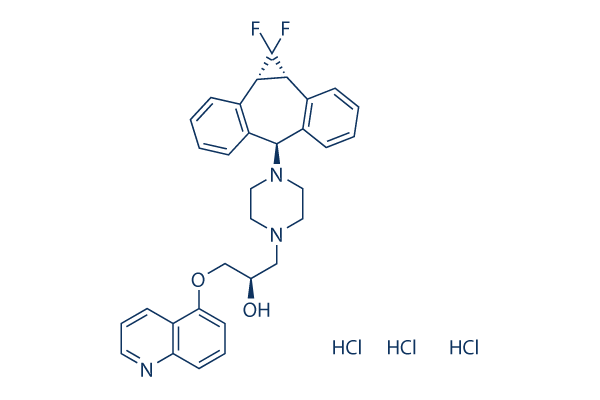
Chemische Struktur
Molekulargewicht: 636.99
Qualitätskontrolle (Quality Control)
| Verwandte Targets | CFTR CRM1 CD markers AChR Calcium Channel Sodium Channel Potassium Channel GABA Receptor TRP Channel ATPase |
|---|---|
| Andere P-gp Inhibitors | Tariquidar (XR9576) Elacridar (GF120918) (20S)-Protopanaxadiol Solamargine Sinapine UCLA GP130 2 Reversan Biricodar Levistilide A Evodine |
Zellkultur, Behandlung & Arbeitskonzentration
(Cell Culture, Treatment & Working Concentration)
| Zelllinien | Assay-Typ | Konzentration | Inkubationszeit | Formulierung | Aktivitätsbeschreibung | PMID |
|---|---|---|---|---|---|---|
| CCRF-CEM/VCR1000 | Function assay | 240 secs | Inhibition of P-glycoprotein-mediated efflux from human CCRF-CEM/VCR1000 cells after 240 secs by FACS flow cytometric analysis, IC50=0.05888μM | 22452412 | ||
| DAOY | qHTS assay | qHTS of pediatric cancer cell lines to identify multiple opportunities for drug repurposing: Primary screen for DAOY cells | 29435139 | |||
| SJ-GBM2 | qHTS assay | qHTS of pediatric cancer cell lines to identify multiple opportunities for drug repurposing: Primary screen for SJ-GBM2 cells | 29435139 | |||
| A673 | qHTS assay | qHTS of pediatric cancer cell lines to identify multiple opportunities for drug repurposing: Primary screen for A673 cells | 29435139 | |||
| SK-N-MC | qHTS assay | qHTS of pediatric cancer cell lines to identify multiple opportunities for drug repurposing: Primary screen for SK-N-MC cells | 29435139 | |||
| NB-EBc1 | qHTS assay | qHTS of pediatric cancer cell lines to identify multiple opportunities for drug repurposing: Primary screen for NB-EBc1 cells | 29435139 | |||
| SK-N-SH | qHTS assay | qHTS of pediatric cancer cell lines to identify multiple opportunities for drug repurposing: Primary screen for SK-N-SH cells | 29435139 | |||
| NB1643 | qHTS assay | qHTS of pediatric cancer cell lines to identify multiple opportunities for drug repurposing: Primary screen for NB1643 cells | 29435139 | |||
| LAN-5 | qHTS assay | qHTS of pediatric cancer cell lines to identify multiple opportunities for drug repurposing: Primary screen for LAN-5 cells | 29435139 | |||
| BT-12 | qHTS assay | qHTS of pediatric cancer cell lines to identify multiple opportunities for drug repurposing: Primary screen for BT-12 cells | 29435139 | |||
| OHS-50 | qHTS assay | qHTS of pediatric cancer cell lines to identify multiple opportunities for drug repurposing: Primary screen for OHS-50 cells | 29435139 | |||
| RD | qHTS assay | qHTS of pediatric cancer cell lines to identify multiple opportunities for drug repurposing: Primary screen for RD cells | 29435139 | |||
| MG 63 (6-TG R) | qHTS assay | qHTS of pediatric cancer cell lines to identify multiple opportunities for drug repurposing: Primary screen for MG 63 (6-TG R) cells | 29435139 | |||
| Rh30 | qHTS assay | qHTS of pediatric cancer cell lines to identify multiple opportunities for drug repurposing: Primary screen for Rh30 cells | 29435139 | |||
| Rh41 | qHTS assay | qHTS of pediatric cancer cell lines to identify multiple opportunities for drug repurposing: Primary screen for Rh41 cells | 29435139 | |||
| Klicken Sie hier, um weitere experimentelle Zellliniendaten anzuzeigen | ||||||
Chemische Informationen, Lagerung & Stabilität (Chemical Information, Storage & Stability)
| Molekulargewicht | 636.99 | Formel | C32H31F2N3O2.3HCl |
Lagerung (Ab Erhaltdatum) | |
|---|---|---|---|---|---|
| CAS-Nr. | 167465-36-3 | SDF herunterladen | Lagerung von Stammlösungen |
|
|
| Synonyme | LY335979 3HCl, RS 33295-198 3HCl, D06387 3HCl | Smiles | C1CN(CCN1CC(COC2=CC=CC3=C2C=CC=N3)O)C4C5=CC=CC=C5C6C(C6(F)F)C7=CC=CC=C47.Cl.Cl.Cl | ||
Löslichkeit (Solubility)
|
In vitro |
DMSO
: 127 mg/mL
(199.37 mM)
Water : 23 mg/mL Ethanol : Insoluble |
Molaritätsrechner
|
In vivo |
|||||
In-vivo-Formulierungsrechner (Klare Lösung)
Schritt 1: Geben Sie unten die Informationen ein (Empfohlen: Ein zusätzliches Tier einplanen, um Verluste während des Experiments auszugleichen)
Schritt 2: Geben Sie die In-vivo-Formulierung ein (Dies ist nur der Rechner, nicht die Formulierung. Bitte kontaktieren Sie uns zuerst, wenn im Abschnitt Löslichkeit keine In-vivo-Formulierung angegeben ist.)
Berechnungsergebnisse:
Arbeitskonzentration: mg/ml;
Methode zur Herstellung der DMSO-Stammflüssigkeit: mg Wirkstoff voraufgelöst in μL DMSO ( Konzentration der Stammflüssigkeit mg/mL, Bitte kontaktieren Sie uns zuerst, wenn die Konzentration die DMSO-Löslichkeit der jeweiligen Wirkstoffcharge überschreitet. )
Methode zur Herstellung der In-vivo-Formulierung: Nehmen Sie μL DMSO Stammflüssigkeit, fügen Sie als Nächstes hinzuμL PEG300, mischen und aufklären, fügen Sie als Nächstes hinzuμL Tween 80, mischen und aufklären, fügen Sie als Nächstes hinzu μL ddH2O, mischen und aufklären.
Methode zur Herstellung der In-vivo-Formulierung: Nehmen Sie μL DMSO Stammflüssigkeit, fügen Sie als Nächstes hinzu μL Maisöl, mischen und aufklären.
Hinweis: 1. Bitte stellen Sie sicher, dass die Flüssigkeit klar ist, bevor Sie das nächste Lösungsmittel hinzufügen.
2. Achten Sie darauf, die Lösungsmittel in der richtigen Reihenfolge hinzuzufügen. Sie müssen sicherstellen, dass die im vorherigen Schritt erhaltene Lösung klar ist, bevor Sie das nächste Lösungsmittel hinzufügen. Physikalische Methoden wie Vortexen, Ultraschall oder ein warmes Wasserbad können zur Unterstützung des Lösungsvorgangs verwendet werden.
Wirkungsmechanismus (Mechanism of Action)
| Targets/IC50/Ki |
P-gp
(Cell-free assay) 60 nM(Ki)
|
|---|---|
| In vitro |
LY335979 competitively inhibits equilibrium binding of Pgp by blocking [3H]azidopine photoaffinity labeling of the Pgp in CEM/VLB100 plasma membranes. LY335979 alone shows the cytotoxicity to drug-sensitive and MDR cell lines with IC50 ranging from 6 μM-16 μM and produces its ability to completely reverse the resistance of the oncolytics to the MDR cell lines P388/ADR, MCF7/ADR, 2780AD, or UCLA-P3.003VLB at concentration of 0.1 and 0.5 μM. LY335979 significantly restores drug sensitivity in P-gp-expressing leukemia cell lines including K562/HHT40, K562/HHT90, K562/DOX and HL60/DNR, and enhances the cytotoxicity of anthracyclines and ozogamicin (Mylotarg) in primary AML blasts with active P-gp. A latest paper indicates that LY335979 completely inhibits apically directed transport of (Z)-endoxifen in the ABCB1-transduced cells. |
| Kinase-Assay |
ATPase-Assay
|
|
Die P-Glycoprotein-ATPase-Aktivität wird durch die Freisetzung von anorganischem Phosphat aus ATP gemessen. Der Assay wird in einer 96-Well-Platte für 90 Minuten bei 37 °C durchgeführt. Membranen (8 μg-10 μg Protein) werden in einem Gesamtvolumen von 100 μL Puffer A inkubiert, der 5 mM Natriumazid, 1 mM Ouabain, 1 mM EGTA, 3 mM ATP, ein ATP-regenerierendes System bestehend aus 5 mM Phosphoenolpyruvat und 3,6 Einheiten/mL Pyruvatkinase in Anwesenheit und Abwesenheit von 1 mM Natriumvanadat enthält. Die Pgp-ATPase-Aktivität ist als der Vanadat-sensitive Anteil der gesamten ATPase-Aktivität definiert. Die Platten werden 3 Minuten nach Zugabe der Detektionslösung abgelesen. Die Absorption wird bei 690 nm mit einem Mikrotiterplattenleser gemessen. Eine Phosphat-Standardkurve wird verwendet, um die gebildete μmol Phosphat zu berechnen. Proben werden in dreifacher Ausführung gemessen.
|
Referenzen |
|

Die Produkte sind nur für Forschungszwecke bestimmt. Nicht zur Anwendung am Menschen. Kein Verkauf an Patienten.
©Copyright 2013 Selleck Chemicals. Alle Rechte vorbehalten.