
Nur für die Forschung bestimmt
LY2886721 BACE Inhibitor
Kat.-Nr.: S2156
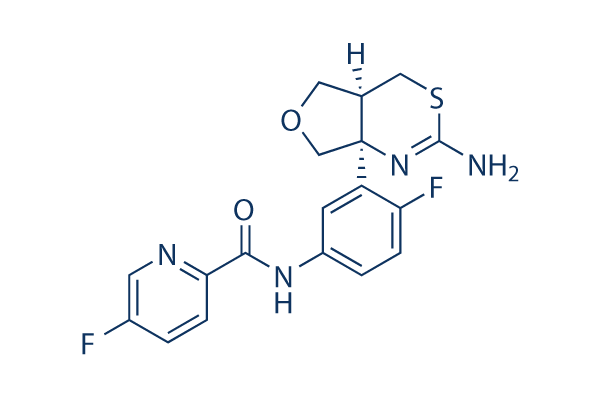
Chemische Struktur
Molekulargewicht: 390.41
Qualitätskontrolle (Quality Control)
Chemische Informationen, Lagerung & Stabilität (Chemical Information, Storage & Stability)
| Molekulargewicht | 390.41 | Formel | C18H16F2N4O2S |
Lagerung (Ab Erhaltdatum) | |
|---|---|---|---|---|---|
| CAS-Nr. | 1262036-50-9 | SDF herunterladen | Lagerung von Stammlösungen |
|
|
| Synonyme | N/A | Smiles | C1C2CSC(=NC2(CO1)C3=C(C=CC(=C3)NC(=O)C4=NC=C(C=C4)F)F)N | ||
Löslichkeit (Solubility)
|
In vitro |
DMSO
: 35 mg/mL
(89.64 mM)
Water : Insoluble Ethanol : Insoluble |
Molaritätsrechner
|
In vivo |
|||||
In-vivo-Formulierungsrechner (Klare Lösung)
Schritt 1: Geben Sie unten die Informationen ein (Empfohlen: Ein zusätzliches Tier einplanen, um Verluste während des Experiments auszugleichen)
Schritt 2: Geben Sie die In-vivo-Formulierung ein (Dies ist nur der Rechner, nicht die Formulierung. Bitte kontaktieren Sie uns zuerst, wenn im Abschnitt Löslichkeit keine In-vivo-Formulierung angegeben ist.)
Berechnungsergebnisse:
Arbeitskonzentration: mg/ml;
Methode zur Herstellung der DMSO-Stammflüssigkeit: mg Wirkstoff voraufgelöst in μL DMSO ( Konzentration der Stammflüssigkeit mg/mL, Bitte kontaktieren Sie uns zuerst, wenn die Konzentration die DMSO-Löslichkeit der jeweiligen Wirkstoffcharge überschreitet. )
Methode zur Herstellung der In-vivo-Formulierung: Nehmen Sie μL DMSO Stammflüssigkeit, fügen Sie als Nächstes hinzuμL PEG300, mischen und aufklären, fügen Sie als Nächstes hinzuμL Tween 80, mischen und aufklären, fügen Sie als Nächstes hinzu μL ddH2O, mischen und aufklären.
Methode zur Herstellung der In-vivo-Formulierung: Nehmen Sie μL DMSO Stammflüssigkeit, fügen Sie als Nächstes hinzu μL Maisöl, mischen und aufklären.
Hinweis: 1. Bitte stellen Sie sicher, dass die Flüssigkeit klar ist, bevor Sie das nächste Lösungsmittel hinzufügen.
2. Achten Sie darauf, die Lösungsmittel in der richtigen Reihenfolge hinzuzufügen. Sie müssen sicherstellen, dass die im vorherigen Schritt erhaltene Lösung klar ist, bevor Sie das nächste Lösungsmittel hinzufügen. Physikalische Methoden wie Vortexen, Ultraschall oder ein warmes Wasserbad können zur Unterstützung des Lösungsvorgangs verwendet werden.
Wirkungsmechanismus (Mechanism of Action)
| Targets/IC50/Ki |
BACE2
(Cell-free assay) 10.2 nM
BACE1
(Cell-free assay) 20.3 nM
|
|---|---|
| In vitro |
LY2886721 is an oral, small molecule of β-site amyloid protein cleaving enzyme (BACE) inhibitor with the potential to inhibit the synthesis of β-amyloid and thereby to slow the clinical progression of AD. This compound can also targetγ-secretase to nhibit the synthesis of β-amyloid. It inhibits recombinant hBACE1 with an IC50 of 20.3 nM. In cellular assays, this chemical inhibits Abeta with an IC50 of 18.7 nM and 10.7 nM, HEK293Swe and PDAPP neuronal culture, respectively. It has high selectivity against key off-target proteases, which efficiently translates in vitro activity into robust in vivo amyloid β lowering in nonclinical animal models. Assessment of its activity against hBACE2 demonstrates an IC50 of 10.2 nM. Assessment of the compound's activity against cathepsin D, pepsin, renin, or other important aspartyl proteases shows essentially no inhibition (IC50 >100,000 nM), suggesting that activity against these common aspartyl proteases is unlikely to be significant.
|
| In vivo |
Oral administration of LY2886721 to PDAPP mice produces dose-dependent reductions in brain Abeta, C99 and sAPPbeta. Brain Abeta levels are decreased ∼20%-65% relative to vehicle-treated groups three hours after a 3-30 mg/kg dose of this compound. Brain C99 and sAPPb levels also are reduced in a dose-dependent manner consistent with BACE1 inhibition in vivo. The pharmacodynamic responses to this chemical persists out to 9 hours post dose in brains of PDAPP mice. Pharmacodynamic studies in beagle dog reveal robust and sustained reductions in plasma Abeta following 1 mg/kg dosing. Central effects of BACE1 inhibition in dog are manifested by a 50% reduction in CSF Abeta at 9 hours after a 0.5 mg/kg dose. The geometric mean terminal elimination t1/2 is determined to be 17.2 h (range 8.19-36.3 h). The geometric mean apparent oral clearance is 34.8 L/h (38% CV) and the apparent volume of distribution during the terminal phase was 863 L (56% CV) across dose levels. This compound is freely permeable across the blood-brain barrier.
|
Referenzen |
|
Informationen zu klinischen Studien (Clinical Trial Information)
(Daten von https://clinicaltrials.gov, aktualisiert am 2018-05-18)
| NCT-Nummer | Rekrutierung | Bedingungen | Sponsor/Kollaboratoren | Startdatum | Phases |
|---|---|---|---|---|---|
| NCT01561430 | TERMINATED | Alzheimer's Disease |
Eli Lilly and Company |
2012-03 | PHASE1; PHASE2 |
| NCT01775904 | COMPLETED | Healthy Volunteers |
Eli Lilly and Company |
2013-02 | PHASE1 |
| NCT01807026 | COMPLETED | Alzheimer Disease; Healthy Volunteers |
Eli Lilly and Company |
2013-03 | PHASE1 |
| NCT01807026 | Completed | Alzheimer Disease|Healthy Volunteers |
Eli Lilly and Company |
2013-03 | Phase 1 |
| NCT01534273 | COMPLETED | Healthy Volunteers |
Eli Lilly and Company |
2012-02 | PHASE1 |
| NCT01534273 | Completed | Healthy Volunteers |
Eli Lilly and Company |
2012-02 | Phase 1 |

Die Produkte sind nur für Forschungszwecke bestimmt. Nicht zur Anwendung am Menschen. Kein Verkauf an Patienten.
©Copyright 2013 Selleck Chemicals. Alle Rechte vorbehalten.