
Nur für die Forschung bestimmt
Ispinesib (SB-715992) Kinesin Inhibitor
Kat.-Nr.: S1452
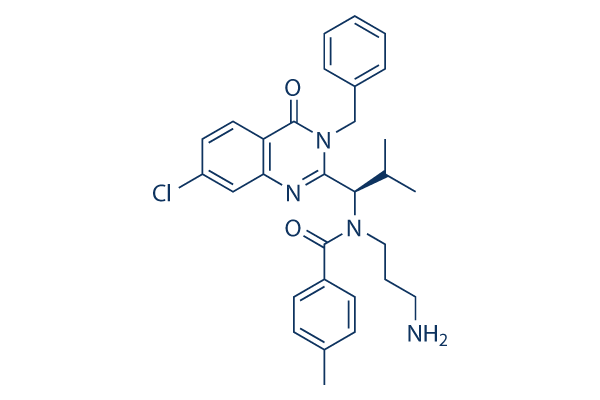
Chemische Struktur
Molekulargewicht: 517.06
Qualitätskontrolle (Quality Control)
| Verwandte Targets | Akt Wnt/beta-catenin PKC HSP ROCK Microtubule Associated Integrin Bcr-Abl Actin FAK |
|---|---|
| Andere Kinesin Inhibitors | GSK-923295 SB743921 HCl Monastrol ARQ 621 GW406108X H-Cys(Trt)-OH K 858 BTB-1 SB-743921 VLS-1488(KIF18A-IN-6 ) |
Zellkultur, Behandlung & Arbeitskonzentration
(Cell Culture, Treatment & Working Concentration)
| Zelllinien | Assay-Typ | Konzentration | Inkubationszeit | Formulierung | Aktivitätsbeschreibung | PMID |
|---|---|---|---|---|---|---|
| HCT116 | Antiproliferative assay | 72 hrs | Antiproliferative activity against human HCT116 cells after 72 hrs by Alamar blue assay, GI50=0.025μM | 22248262 | ||
| hTERT-HME1 | Antiproliferative assay | 72 hrs | Antiproliferative activity against human hTERT-HME1 cells after 72 hrs by Alamar blue assay, GI50=0.032μM | 22248262 | ||
| K562 | Antiproliferative assay | 72 hrs | Antiproliferative activity against human K562 cells after 72 hrs by Alamar blue assay, GI50=0.071μM | 22248262 | ||
| BxPC3 | Antiproliferative assay | 72 hrs | Antiproliferative activity against human BxPC3 cells after 72 hrs by Alamar blue assay, GI50=0.08μM | 22248262 | ||
| NCI-H1299 | Antiproliferative assay | 72 hrs | Antiproliferative activity against human NCI-H1299 cells after 72 hrs by Alamar blue assay, GI50=0.082μM | 22248262 | ||
| LNCAP | Growth inhibition assay | 72 hrs | Growth inhibition of human LNCAP cells after 72 hrs by Alamar blue assay, GI50=0.022μM | 23394180 | ||
| HCT116 | Growth inhibition assay | 72 hrs | Growth inhibition of human HCT116 cells after 72 hrs by Alamar blue assay, GI50=0.025μM | 23394180 | ||
| PC3 | Growth inhibition assay | 72 hrs | Growth inhibition of human PC3 cells after 72 hrs by Alamar blue assay, GI50=0.05μM | 23394180 | ||
| BxPC3 | Growth inhibition assay | 72 hrs | Growth inhibition of human BxPC3 cells after 72 hrs by Alamar blue assay, GI50=0.08μM | 23394180 | ||
| NCI-H1299 | Growth inhibition assay | 72 hrs | Growth inhibition of human NCI-H1299 cells after 72 hrs by Alamar blue assay, GI50=0.082μM | 23394180 | ||
| LXFS 538 | Antitumor assay | 6 mg/kg | Antitumor activity against human LXFS 538 cells xenografted in NMRI nu/nu mouse assessed as tumor regression at 6 mg/kg, ip measured on day 13 | 23394180 | ||
| HeLa | Antiproliferative assay | 48 hrs | Antiproliferative activity against human HeLa cells after 48 hrs by MTT assay, IC50=1μM | 24184776 | ||
| MCF7 | Antiproliferative assay | 48 hrs | Antiproliferative activity against human MCF7 cells after 48 hrs by MTT assay, IC50=1.3μM | 24184776 | ||
| HCT116 | Growth inhibition assay | 72 hrs | Growth inhibition of human HCT116 cells after 72 hrs by MTS assay, IC50=0.0011μM | 26396688 | ||
| TC32 | qHTS assay | qHTS of pediatric cancer cell lines to identify multiple opportunities for drug repurposing: Primary screen for TC32 cells | 29435139 | |||
| DAOY | qHTS assay | qHTS of pediatric cancer cell lines to identify multiple opportunities for drug repurposing: Primary screen for DAOY cells | 29435139 | |||
| SJ-GBM2 | qHTS assay | qHTS of pediatric cancer cell lines to identify multiple opportunities for drug repurposing: Primary screen for SJ-GBM2 cells | 29435139 | |||
| A673 | qHTS assay | qHTS of pediatric cancer cell lines to identify multiple opportunities for drug repurposing: Primary screen for A673 cells | 29435139 | |||
| SK-N-MC | qHTS assay | qHTS of pediatric cancer cell lines to identify multiple opportunities for drug repurposing: Primary screen for SK-N-MC cells | 29435139 | |||
| NB-EBc1 | qHTS assay | qHTS of pediatric cancer cell lines to identify multiple opportunities for drug repurposing: Primary screen for NB-EBc1 cells | 29435139 | |||
| Saos-2 | qHTS assay | qHTS of pediatric cancer cell lines to identify multiple opportunities for drug repurposing: Primary screen for Saos-2 cells | 29435139 | |||
| LAN-5 | qHTS assay | qHTS of pediatric cancer cell lines to identify multiple opportunities for drug repurposing: Primary screen for LAN-5 cells | 29435139 | |||
| BT-12 | qHTS assay | qHTS of pediatric cancer cell lines to identify multiple opportunities for drug repurposing: Primary screen for BT-12 cells | 29435139 | |||
| OHS-50 | qHTS assay | qHTS of pediatric cancer cell lines to identify multiple opportunities for drug repurposing: Primary screen for OHS-50 cells | 29435139 | |||
| A673 | qHTS assay | qHTS of pediatric cancer cell lines to identify multiple opportunities for drug repurposing: Confirmatory screen for A673 cells) | 29435139 | |||
| SK-N-MC | qHTS assay | qHTS of pediatric cancer cell lines to identify multiple opportunities for drug repurposing: Confirmatory screen for SK-N-MC cells | 29435139 | |||
| BT-12 | qHTS assay | qHTS of pediatric cancer cell lines to identify multiple opportunities for drug repurposing: Confirmatory screen for BT-12 cells | 29435139 | |||
| DAOY | qHTS assay | qHTS of pediatric cancer cell lines to identify multiple opportunities for drug repurposing: Confirmatory screen for DAOY cells | 29435139 | |||
| BT-37 | qHTS assay | qHTS of pediatric cancer cell lines to identify multiple opportunities for drug repurposing: Confirmatory screen for BT-37 cells | 29435139 | |||
| TC32 | qHTS assay | qHTS of pediatric cancer cell lines to identify multiple opportunities for drug repurposing: Confirmatory screen for TC32 cells | 29435139 | |||
| MG 63 (6-TG R) | qHTS assay | qHTS of pediatric cancer cell lines to identify multiple opportunities for drug repurposing: Confirmatory screen for MG 63 (6-TG R) cells | 29435139 | |||
| U-2 OS | qHTS assay | qHTS of pediatric cancer cell lines to identify multiple opportunities for drug repurposing: Confirmatory screen for U-2 OS cells | 29435139 | |||
| Rh41 | qHTS assay | qHTS of pediatric cancer cell lines to identify multiple opportunities for drug repurposing: Confirmatory screen for Rh41 cells | 29435139 | |||
| RD | qHTS assay | qHTS of pediatric cancer cell lines to identify multiple opportunities for drug repurposing: Confirmatory screen for RD cells | 29435139 | |||
| Rh30 | qHTS assay | qHTS of pediatric cancer cell lines to identify multiple opportunities for drug repurposing: Confirmatory screen for Rh30 cells | 29435139 | |||
| Saos-2 | qHTS assay | qHTS of pediatric cancer cell lines to identify multiple opportunities for drug repurposing: Confirmatory screen for Saos-2 cells | 29435139 | |||
| SK-N-SH | qHTS assay | qHTS of pediatric cancer cell lines to identify multiple opportunities for drug repurposing: Confirmatory screen for SK-N-SH cells | 29435139 | |||
| Klicken Sie hier, um weitere experimentelle Zellliniendaten anzuzeigen | ||||||
Chemische Informationen, Lagerung & Stabilität (Chemical Information, Storage & Stability)
| Molekulargewicht | 517.06 | Formel | C30H33ClN4O2 |
Lagerung (Ab Erhaltdatum) | |
|---|---|---|---|---|---|
| CAS-Nr. | 336113-53-2 | SDF herunterladen | Lagerung von Stammlösungen |
|
|
| Synonyme | CK0238273 | Smiles | CC1=CC=C(C=C1)C(=O)N(CCCN)C(C2=NC3=C(C=CC(=C3)Cl)C(=O)N2CC4=CC=CC=C4)C(C)C | ||
Löslichkeit (Solubility)
|
In vitro |
DMSO
: 103 mg/mL
(199.2 mM)
Ethanol : 103 mg/mL Water : Insoluble |
Molaritätsrechner
|
In vivo |
|||||
In-vivo-Formulierungsrechner (Klare Lösung)
Schritt 1: Geben Sie unten die Informationen ein (Empfohlen: Ein zusätzliches Tier einplanen, um Verluste während des Experiments auszugleichen)
Schritt 2: Geben Sie die In-vivo-Formulierung ein (Dies ist nur der Rechner, nicht die Formulierung. Bitte kontaktieren Sie uns zuerst, wenn im Abschnitt Löslichkeit keine In-vivo-Formulierung angegeben ist.)
Berechnungsergebnisse:
Arbeitskonzentration: mg/ml;
Methode zur Herstellung der DMSO-Stammflüssigkeit: mg Wirkstoff voraufgelöst in μL DMSO ( Konzentration der Stammflüssigkeit mg/mL, Bitte kontaktieren Sie uns zuerst, wenn die Konzentration die DMSO-Löslichkeit der jeweiligen Wirkstoffcharge überschreitet. )
Methode zur Herstellung der In-vivo-Formulierung: Nehmen Sie μL DMSO Stammflüssigkeit, fügen Sie als Nächstes hinzuμL PEG300, mischen und aufklären, fügen Sie als Nächstes hinzuμL Tween 80, mischen und aufklären, fügen Sie als Nächstes hinzu μL ddH2O, mischen und aufklären.
Methode zur Herstellung der In-vivo-Formulierung: Nehmen Sie μL DMSO Stammflüssigkeit, fügen Sie als Nächstes hinzu μL Maisöl, mischen und aufklären.
Hinweis: 1. Bitte stellen Sie sicher, dass die Flüssigkeit klar ist, bevor Sie das nächste Lösungsmittel hinzufügen.
2. Achten Sie darauf, die Lösungsmittel in der richtigen Reihenfolge hinzuzufügen. Sie müssen sicherstellen, dass die im vorherigen Schritt erhaltene Lösung klar ist, bevor Sie das nächste Lösungsmittel hinzufügen. Physikalische Methoden wie Vortexen, Ultraschall oder ein warmes Wasserbad können zur Unterstützung des Lösungsvorgangs verwendet werden.
Wirkungsmechanismus (Mechanism of Action)
| Eigenschaften |
An allosteric, potent, specific, and reversible inhibitor of the mitotic kinesin spindle protein (KSP) (HsEg5).
|
|---|---|
| Targets/IC50/Ki |
KSP (HsEg5)
(Cell-free assay) 1.7 nM(Ki app)
|
| In vitro |
Ispinesib (SB-715992) is a potent, allosteric, reversible, and specific inhibitor of KSP, which changes the binding property of KSP to microtubules and disturbs its movement by inhibiting ADP release without altering the release of the KSP-ADP complex from the microtubule. This compound shows potent cytotoxic activity in a panel of tumor cell lines, including Colo205, Colo201, HT-29, M5076, Madison-109, and MX-1, with IC50 of 1.2 nM to 9.5 nM. In PC-3 prostate cancer cells, it (15 nM and 30 nM) blocks cell proliferation and induces apoptosis by regulating the expression levels of genes that controls apoptosis, cell proliferation, cell cycle, and cell signaling, such as EGFR, p27, p15, and IL-11. In a panel of 53 breast cell lines, Ispinesib (7.4 nM–600 nM) demonstrates broad inhibitory activity. In BT-474 and MDA-MB-468 cells, it (150 nM) induces apoptosis, as revealed by a higher proportion of apoptotic cells, lower antiapoptotic Bcl-XL level, and higher proapoptotic Bax and Bid levels. |
| Kinase-Assay |
Kinetische Analyse der ATPase-Aktivität von humanem KSP im Steady-State und Hemmung durch Ispinesib
|
|
Die Kinesin-Spezifitätsanalyse wird unter Verwendung eines Pyruvatkinase-Laktatdehydrogenase-Nachweissystems durchgeführt, das die Produktion von ADP mit der Oxidation von NADH koppelt. Änderungen der Absorption werden bei 340 nm überwacht. Steady-State-Studien mit nanomolaren Konzentrationen von KSP werden unter Verwendung eines empfindlichen fluoreszenzbasierten Assays durchgeführt, der ein Pyruvatkinase-, Pyruvatoxidase- und Meerrettichperoxidase (HRP)-gekoppeltes Nachweissystem nutzt, das die Generierung von ADP mit der Oxidation von Amplex Red zu fluoreszierendem Resorufin koppelt. Die Generierung von Resorufin wird durch Fluoreszenz überwacht (λAnregung = 520 nm und λEmission = 580 nm). Biochemische Steady-State-Experimente werden in PEM25-Puffer [25 mM Pipes-K+ (pH 6,8), 2 mM MgCl2, 1 mM EGTA] für Experimente mit Mikrotubuli durchgeführt. Der IC50 für die Steady-State-Hemmung wird bei 500 µM ATP, 5 µM Mikrotubuli und 1 nM KSP in PEM25-Puffer bestimmt. Ki app (scheinbare Inhibitor-Dissoziationskonstante)-Werte von Ispinesib (SB-715992) werden aus den Dosis-Wirkungs-Kurven extrahiert, mit expliziter Korrektur für die Enzymkonzentration unter Verwendung der Morrison-Gleichung. Die Inhibitor-Modalität (z. B. kompetitiv, nicht-kompetitiv, unkompetitiv oder gemischt) unter Steady-State-Bedingungen wird durch Messung des Effekts seiner Konzentration auf die Anfangsgeschwindigkeit als Funktion der Substratkonzentrationen bestimmt. Die Daten werden unter Verwendung von Gleichungen in GraFit an Geschwindigkeitsgleichungen für die verschiedenen Hemmungsmodi angepasst.
|
|
| In vivo |
Ispinesib (SB-715992) (4.5 mg/kg–15 mg/kg) exhibits inhibitory effects against Colo205, Colo201, HT-29, but not MX-1 cells, in mouse xenograft models. This compound (6 mg/kg–10 mg/kg) also inhibits murine solid tumors, including Madison 109 lung carcinoma, M5076 sarcoma, as well as L1210 and P388 leukemias. In mice xenograft models of breast cancer cells MCF-7, HCC1954, MDA-MB-468, and KPL4, it (8 mg/kg–10 mg/kg) inhibits tumor growth. |
Referenzen |
|
Informationen zu klinischen Studien (Clinical Trial Information)
(Daten von https://clinicaltrials.gov, aktualisiert am 2017-03-06)
| NCT-Nummer | Rekrutierung | Bedingungen | Sponsor/Kollaboratoren | Startdatum | Phases |
|---|---|---|---|---|---|
| NCT00095628 | COMPLETED | Metastatic Squamous Neck Cancer With Occult Primary Squamous Cell Carcinoma; Recurrent Metastatic Squamous Neck Cancer With Occult Primary; Recurrent Salivary Gland Cancer; Recurrent Squamous Cell Carcinoma of the Hypopharynx; Recurrent Squamous Cell Carcinoma of the Larynx; Recurrent Squamous Cell Carcinoma of the Lip and Oral Cavity; Recurrent Squamous Cell Carcinoma of the Oropharynx; Recurrent Squamous Cell Carcinoma of the Paranasal Sinus and Nasal Cavity; Recurrent Verrucous Carcinoma of the Larynx; Recurrent Verrucous Carcinoma of the Oral Cavity; Stage IV Squamous Cell Carcinoma of the Hypopharynx; Stage IV Squamous Cell Carcinoma of the Larynx; Stage IV Squamous Cell Carcinoma of the Lip and Oral Cavity; Stage IV Squamous Cell Carcinoma of the Oropharynx; Stage IV Verrucous Carcinoma of the Larynx; Stage IV Verrucous Carcinoma of the Oral Cavity; Stage IVA Salivary Gland Cancer; Stage IVA Squamous Cell Carcinoma of the Paranasal Sinus and Nasal Cavity; Stage IVB Salivary Gland Cancer; Stage IVB Squamous Cell Carcinoma of the Paranasal Sinus and Nasal Cavity; Stage IVC Salivary Gland Cancer; Stage IVC Squamous Cell Carcinoma of the Paranasal Sinus and Nasal Cavity |
National Cancer Institute (NCI) |
2005-01 | PHASE2 |
| NCT00101244 | TERMINATED | Adult Grade III Lymphomatoid Granulomatosis; Extranodal Marginal Zone B-cell Lymphoma of Mucosa-associated Lymphoid Tissue; Nodal Marginal Zone B-cell Lymphoma; Recurrent Adult Burkitt Lymphoma; Recurrent Adult Diffuse Large Cell Lymphoma; Recurrent Adult Diffuse Mixed Cell Lymphoma; Recurrent Adult Diffuse Small Cleaved Cell Lymphoma; Recurrent Adult Grade III Lymphomatoid Granulomatosis; Recurrent Adult Hodgkin Lymphoma; Recurrent Adult Immunoblastic Large Cell Lymphoma; Recurrent Adult Lymphoblastic Lymphoma; Recurrent Grade 1 Follicular Lymphoma; Recurrent Grade 2 Follicular Lymphoma; Recurrent Grade 3 Follicular Lymphoma; Recurrent Mantle Cell Lymphoma; Recurrent Marginal Zone Lymphoma; Recurrent Small Lymphocytic Lymphoma; Splenic Marginal Zone Lymphoma; Stage IV Adult Burkitt Lymphoma; Stage IV Adult Diffuse Large Cell Lymphoma; Stage IV Adult Diffuse Mixed Cell Lymphoma; Stage IV Adult Diffuse Small Cleaved Cell Lymphoma; Stage IV Adult Hodgkin Lymphoma; Stage IV Adult Immunoblastic Large Cell Lymphoma; Stage IV Adult Lymphoblastic Lymphoma; Stage IV Grade 1 Follicular Lymphoma; Stage IV Grade 2 Follicular Lymphoma; Stage IV Grade 3 Follicular Lymphoma; Stage IV Mantle Cell Lymphoma; Stage IV Marginal Zone Lymphoma; Stage IV Small Lymphocytic Lymphoma; Unspecified Adult Solid Tumor, Protocol Specific; Waldenström Macroglobulinemia |
National Cancer Institute (NCI) |
2004-11 | PHASE1 |
| NCT00103311 | COMPLETED | Recurrent Colon Cancer; Recurrent Rectal Cancer; Stage IIIA Colon Cancer; Stage IIIA Rectal Cancer; Stage IIIB Colon Cancer; Stage IIIB Rectal Cancer; Stage IIIC Colon Cancer; Stage IIIC Rectal Cancer; Stage IVA Colon Cancer; Stage IVA Rectal Cancer; Stage IVB Colon Cancer; Stage IVB Rectal Cancer |
National Cancer Institute (NCI) |
2005-01 | PHASE2 |
| NCT00607841 | TERMINATED | Breast Neoplasms |
Cytokinetics |
2007-12 | PHASE1 |
| NCT00363272 | COMPLETED | Childhood Burkitt Lymphoma; Childhood Central Nervous System Germ Cell Tumor; Childhood Choroid Plexus Tumor; Childhood Craniopharyngioma; Childhood Grade I Meningioma; Childhood Grade II Meningioma; Childhood Grade III Meningioma; Childhood High-grade Cerebral Astrocytoma; Childhood Infratentorial Ependymoma; Childhood Low-grade Cerebral Astrocytoma; Childhood Spinal Cord Neoplasm; Childhood Supratentorial Ependymoma; Recurrent Childhood Brain Stem Glioma; Recurrent Childhood Brain Tumor; Recurrent Childhood Cerebellar Astrocytoma; Recurrent Childhood Cerebral Astrocytoma; Recurrent Childhood Ependymoma; Recurrent Childhood Grade III Lymphomatoid Granulomatosis; Recurrent Childhood Large Cell Lymphoma; Recurrent Childhood Lymphoblastic Lymphoma; Recurrent Childhood Medulloblastoma; Recurrent Childhood Small Noncleaved Cell Lymphoma; Recurrent Childhood Supratentorial Primitive Neuroectodermal Tumor; Recurrent Childhood Visual Pathway and Hypothalamic Glioma; Unspecified Childhood Solid Tumor, Protocol Specific |
National Cancer Institute (NCI) |
2006-06 | PHASE1 |
| NCT00098826 | COMPLETED | Acute Undifferentiated Leukemia; Adult Acute Megakaryoblastic Leukemia (M7); Adult Acute Minimally Differentiated Myeloid Leukemia (M0); Adult Acute Monoblastic Leukemia (M5a); Adult Acute Monocytic Leukemia (M5b); Adult Acute Myeloblastic Leukemia With Maturation (M2); Adult Acute Myeloblastic Leukemia Without Maturation (M1); Adult Acute Myeloid Leukemia With 11q23 (MLL) Abnormalities; Adult Acute Myeloid Leukemia With Inv(16)(p13;q22); Adult Acute Myeloid Leukemia With t(15;17)(q22;q12); Adult Acute Myeloid Leukemia With t(16;16)(p13;q22); Adult Acute Myeloid Leukemia With t(8;21)(q22;q22); Adult Acute Myelomonocytic Leukemia (M4); Adult Acute Promyelocytic Leukemia (M3); Adult Erythroleukemia (M6a); Adult Pure Erythroid Leukemia (M6b); Blastic Phase Chronic Myelogenous Leukemia; de Novo Myelodysplastic Syndromes; Previously Treated Myelodysplastic Syndromes; Recurrent Adult Acute Lymphoblastic Leukemia; Recurrent Adult Acute Myeloid Leukemia; Refractory Anemia With Excess Blasts; Refractory Anemia With Excess Blasts in Transformation; Relapsing Chronic Myelogenous Leukemia; Secondary Acute Myeloid Leukemia; Secondary Myelodysplastic Syndromes; Untreated Adult Acute Myeloid Leukemia |
National Cancer Institute (NCI) |
2004-12 | PHASE1 |

Die Produkte sind nur für Forschungszwecke bestimmt. Nicht zur Anwendung am Menschen. Kein Verkauf an Patienten.
©Copyright 2013 Selleck Chemicals. Alle Rechte vorbehalten.