
Nur für die Forschung bestimmt
Indomethacin COX Inhibitor
Kat.-Nr.: S1723
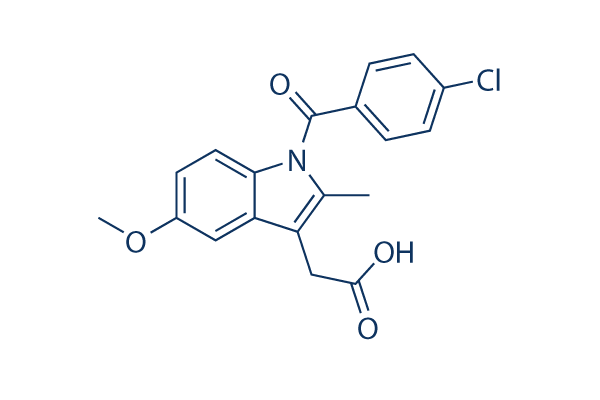
Chemische Struktur
Molekulargewicht: 357.79
Qualitätskontrolle (Quality Control)
Zellkultur, Behandlung & Arbeitskonzentration
(Cell Culture, Treatment & Working Concentration)
| Zelllinien | Assay-Typ | Konzentration | Inkubationszeit | Formulierung | Aktivitätsbeschreibung | PMID |
|---|---|---|---|---|---|---|
| HeLa cells | Function assay | 20 mins | Agonist activity at androgen receptor (unknown origin) expressed in HeLa cells co-expressing PSA-(ARE)4-Luc13 assessed as induction of DHT-induced luciferase activity after 20 mins by luciferase reporter gene assay, EC50=0.14 nM | |||
| J774 cells | Function assay | In vitro inhibitory activity against Prostaglandin G/H synthase 1 in murine J774 cells, IC50=2 nM | ||||
| U-937 cells | Function assay | In vitro inhibitory activity against human Prostaglandin G/H synthase 1 (COX-1) in U-937 cells, IC50=2 nM | ||||
| rat synovial cells | Function assay | In vitro inhibitory effect on production of prostaglandin E2 (PGE2) in rat synovial cells, IC50=2.9 nM | ||||
| 143982 cells | Function assay | In vitro inhibitory activity against human Prostaglandin G/H synthase 2 (COX-2) in 143982 cells, IC50=9 nM | ||||
| CHO cells | Function assay | In vitro inhibitory potency against human COX-1 in stably transfected chinese hamster ovary (CHO) cells, IC50=18 nM | ||||
| RBL-1 cell line | Function assay | Inhibition of Prostaglandin G/H synthase in intact RBL-1 cell line, IC50=0.5 μM | ||||
| SF-9 insect cells | Function assay | 20 Mins | Inhibition of human COX2 expressed in SF-9 insect cells assessed as conversion of [14C]-arachidonic acid to [14C]-prostaglandins preincubated for 20 mins by thin-layer chromatography analysis, IC50=0.75 μM | |||
| mouse RAW264.7 cells | Function assay | 24 h | Antiinflammatory activity in mouse RAW264.7 cells assessed as inhibition of LPS-induced NO production after 24 hrs by Griess assay, IC50=1.25 μM | |||
| mouse BV2 cells | Function assay | 24 h | Antiinflammatory activity in mouse BV2 cells assessed as inhibition of LPS-induced NO production after 24 hrs by Griess assay, IC50=7.1 μM | |||
| human 2008 cells | Function assay | Inhibition of human MRP1 in human 2008 cells, IC50=12 μM | ||||
| A549 cells | Function assay | 10 μM | Inhibition of mPGES1 in human A549 cells assessed as inhibition of IL-1-beta-induced PGE2 formation at 10 uM by cell-intact assay | |||
| HepG2 cells | Function assay | 100 μM | Inhibition of MRP1-mediated doxorubicin efflux in doxorubicin resistant human HepG2 cells at 100 uM by flow cytometry | |||
| THP1 cells | Function assay | 100 μM | 30 mins | Irreversible inhibition of COX-1 in human THP1 cells assessed as inhibition of arachidonic acid-induced TXB2 formation at 100 uM incubated for 30 mins followed by compound washout measured 30 mins post arachidonic acid challenge by radioimmunoassay | ||
| MDA-MB-231 cells | Function assay | 100 μM | 30 mins | Irreversible inhibition of COX-1 in human MDA-MB-231 cells assessed as inhibition of arachidonic acid-induced PGE2 formation at 100 uM incubated for 30 mins followed by compound washout measured 30 mins post arachidonic acid challenge by radioimmunoassay | ||
| LNCAP cells | Function assay | 30 μM | 48 h | Inhibition of AKR1C3 (unknown origin)-mediated testosterone-17beta-glucuronide formation expressed in human LNCAP cells at 30 uM after 48 hrs in presence of 4-androstene-3,17-dione | ||
| mouse BV2 cells | Cytotoxicity assay | 24 h | Cytotoxicity against mouse BV2 cells assessed as maximum non-toxic concentration after 24 hrs by MTT assay | |||
| Klicken Sie hier, um weitere experimentelle Zellliniendaten anzuzeigen | ||||||
Chemische Informationen, Lagerung & Stabilität (Chemical Information, Storage & Stability)
| Molekulargewicht | 357.79 | Formel | C19H16ClNO4 |
Lagerung (Ab Erhaltdatum) | |
|---|---|---|---|---|---|
| CAS-Nr. | 53-86-1 | SDF herunterladen | Lagerung von Stammlösungen |
|
|
| Synonyme | Indometacin,NSC-77541 | Smiles | CC1=C(C2=C(N1C(=O)C3=CC=C(C=C3)Cl)C=CC(=C2)OC)CC(=O)O | ||
Löslichkeit (Solubility)
|
In vitro |
DMSO
: 72 mg/mL
(201.23 mM)
Ethanol : 24 mg/mL Water : Insoluble |
Molaritätsrechner
|
In vivo |
|||||
In-vivo-Formulierungsrechner (Klare Lösung)
Schritt 1: Geben Sie unten die Informationen ein (Empfohlen: Ein zusätzliches Tier einplanen, um Verluste während des Experiments auszugleichen)
Schritt 2: Geben Sie die In-vivo-Formulierung ein (Dies ist nur der Rechner, nicht die Formulierung. Bitte kontaktieren Sie uns zuerst, wenn im Abschnitt Löslichkeit keine In-vivo-Formulierung angegeben ist.)
Berechnungsergebnisse:
Arbeitskonzentration: mg/ml;
Methode zur Herstellung der DMSO-Stammflüssigkeit: mg Wirkstoff voraufgelöst in μL DMSO ( Konzentration der Stammflüssigkeit mg/mL, Bitte kontaktieren Sie uns zuerst, wenn die Konzentration die DMSO-Löslichkeit der jeweiligen Wirkstoffcharge überschreitet. )
Methode zur Herstellung der In-vivo-Formulierung: Nehmen Sie μL DMSO Stammflüssigkeit, fügen Sie als Nächstes hinzuμL PEG300, mischen und aufklären, fügen Sie als Nächstes hinzuμL Tween 80, mischen und aufklären, fügen Sie als Nächstes hinzu μL ddH2O, mischen und aufklären.
Methode zur Herstellung der In-vivo-Formulierung: Nehmen Sie μL DMSO Stammflüssigkeit, fügen Sie als Nächstes hinzu μL Maisöl, mischen und aufklären.
Hinweis: 1. Bitte stellen Sie sicher, dass die Flüssigkeit klar ist, bevor Sie das nächste Lösungsmittel hinzufügen.
2. Achten Sie darauf, die Lösungsmittel in der richtigen Reihenfolge hinzuzufügen. Sie müssen sicherstellen, dass die im vorherigen Schritt erhaltene Lösung klar ist, bevor Sie das nächste Lösungsmittel hinzufügen. Physikalische Methoden wie Vortexen, Ultraschall oder ein warmes Wasserbad können zur Unterstützung des Lösungsvorgangs verwendet werden.
Wirkungsmechanismus (Mechanism of Action)
| Targets/IC50/Ki |
COX1
0.28 μM
COX-2
14 μM
|
|---|---|
| In vitro |
Indomethacin inhibits transcription of a beta-catenin/TCF-responsive reporter gene in a dose dependent manner. This compound also downregulates the beta-catenin/TCF transcriptional target cyclin D1. It attenuates the transcription of beta-catenin/TCF-responsive genes, by modulating TCF activity without disrupting beta-catenin/TCF complex formation.
|
| In vivo |
Indomethacin increases BrdU+ cells of all lineages and reduces microglial/monocyte activation in rats after focal cerebral ischemia. This compound (7.5 mg/kg, one injection) produces acute injury and inflammation in the distal jejunum and proximal ileum that are maximal at three days and completely resolves within one week. It (two daily subcutaneous injections) produces a more extensive and chronic inflammation that lasts in an active form in more than 75% of the rats for at least two weeks. This chemical (4ppm) reduces tumor yield by 78% in SKH:HR-1-hrBr hairless mice. It (20 mg/kg, orally) increases the total area of gastric erosions and concentration of lipid peroxides in the gastric mucosa of rats. This compound increases the alpha-tocopherol:total cholesterol ratio in serum. It inhibits the increases in gastric mucosal erosions and lipid peroxides in the gastric mucosa, and the reduction of serum alpha-tocopherol.
|
Referenzen |
|
Informationen zu klinischen Studien (Clinical Trial Information)
(Daten von https://clinicaltrials.gov, aktualisiert am 2026-06-22)
| NCT-Nummer | Rekrutierung | Bedingungen | Sponsor/Kollaboratoren | Startdatum | Phases |
|---|---|---|---|---|---|
| NCT07661498 | NOT_YET_RECRUITING | Pancreatitis Biliary; Pancreatitis Acute Biliary; Pancreatitis; Post-ERCP Pancreatitis; Post-ERCP Acute Pancreatitis; Post-ERCP Adverse Events |
University of California, San Francisco |
2026-07 | PHASE4 |
| NCT07218653 | NOT_YET_RECRUITING | Metabolic Syndrome |
University of Wisconsin, Madison |
2026-09 | EARLY_PHASE1 |
| NCT00262470 | ACTIVE_NOT_RECRUITING | Tachycardia; Chronic Orthostatic Intolerance |
Satish R. Raj |
1997-04 | PHASE1; PHASE2 |
| NCT07330284 | RECRUITING | Pancreatitis; ERCP Surgery |
University of Kansas Medical Center |
2025-12-05 | |
| NCT07560566 | RECRUITING | Hepato Cellular Carcinoma (HCC); Hand Foot Skin Syndrome |
National Taiwan University Hospital |
2025-12-09 | PHASE2 |
| NCT06572917 | NOT_YET_RECRUITING | Extreme Prematurity; Intraventricular Hemorrhage; Morbidity;Newborn |
University of British Columbia |
2025-11-01 | PHASE2 |

Die Produkte sind nur für Forschungszwecke bestimmt. Nicht zur Anwendung am Menschen. Kein Verkauf an Patienten.
©Copyright 2013 Selleck Chemicals. Alle Rechte vorbehalten.