
Nur für die Forschung bestimmt
Ezetimibe (SCH-58235) LDL Modulator
Kat.-Nr.: S1655
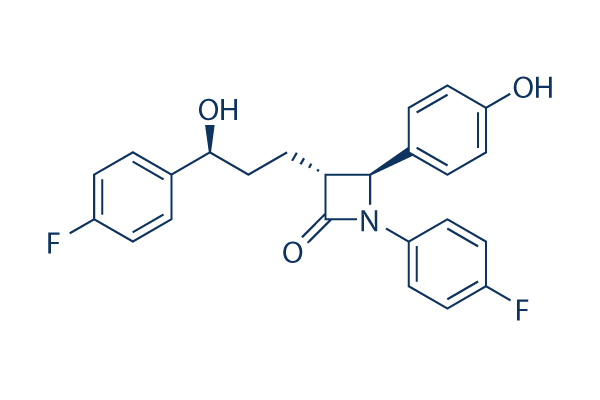
Chemische Struktur
Molekulargewicht: 409.4
Qualitätskontrolle (Quality Control)
| Verwandte Targets | Dehydrogenase HSP Transferase P450 (e.g. CYP17) PDE phosphatase PPAR Vitamin Carbohydrate Metabolism Mitochondrial Metabolism |
|---|---|
| Andere LDL Inhibitors | Phillygenin Cashew Extract |
Chemische Informationen, Lagerung & Stabilität (Chemical Information, Storage & Stability)
| Molekulargewicht | 409.4 | Formel | C24H21F2NO3 |
Lagerung (Ab Erhaltdatum) | |
|---|---|---|---|---|---|
| CAS-Nr. | 163222-33-1 | SDF herunterladen | Lagerung von Stammlösungen |
|
|
| Synonyme | SCH-58235 | Smiles | C1=CC(=CC=C1C2C(C(=O)N2C3=CC=C(C=C3)F)CCC(C4=CC=C(C=C4)F)O)O | ||
Löslichkeit (Solubility)
|
In vitro |
DMSO
: 82 mg/mL
(200.29 mM)
Ethanol : 82 mg/mL Water : Insoluble |
Molaritätsrechner
|
In vivo |
|||||
In-vivo-Formulierungsrechner (Klare Lösung)
Schritt 1: Geben Sie unten die Informationen ein (Empfohlen: Ein zusätzliches Tier einplanen, um Verluste während des Experiments auszugleichen)
Schritt 2: Geben Sie die In-vivo-Formulierung ein (Dies ist nur der Rechner, nicht die Formulierung. Bitte kontaktieren Sie uns zuerst, wenn im Abschnitt Löslichkeit keine In-vivo-Formulierung angegeben ist.)
Berechnungsergebnisse:
Arbeitskonzentration: mg/ml;
Methode zur Herstellung der DMSO-Stammflüssigkeit: mg Wirkstoff voraufgelöst in μL DMSO ( Konzentration der Stammflüssigkeit mg/mL, Bitte kontaktieren Sie uns zuerst, wenn die Konzentration die DMSO-Löslichkeit der jeweiligen Wirkstoffcharge überschreitet. )
Methode zur Herstellung der In-vivo-Formulierung: Nehmen Sie μL DMSO Stammflüssigkeit, fügen Sie als Nächstes hinzuμL PEG300, mischen und aufklären, fügen Sie als Nächstes hinzuμL Tween 80, mischen und aufklären, fügen Sie als Nächstes hinzu μL ddH2O, mischen und aufklären.
Methode zur Herstellung der In-vivo-Formulierung: Nehmen Sie μL DMSO Stammflüssigkeit, fügen Sie als Nächstes hinzu μL Maisöl, mischen und aufklären.
Hinweis: 1. Bitte stellen Sie sicher, dass die Flüssigkeit klar ist, bevor Sie das nächste Lösungsmittel hinzufügen.
2. Achten Sie darauf, die Lösungsmittel in der richtigen Reihenfolge hinzuzufügen. Sie müssen sicherstellen, dass die im vorherigen Schritt erhaltene Lösung klar ist, bevor Sie das nächste Lösungsmittel hinzufügen. Physikalische Methoden wie Vortexen, Ultraschall oder ein warmes Wasserbad können zur Unterstützung des Lösungsvorgangs verwendet werden.
Wirkungsmechanismus (Mechanism of Action)
| Targets/IC50/Ki |
NPC1L1
|
|---|---|
| In vitro |
Ezetimibe (SCH-58235) produces a significant reduction in total cholesterol, LDL cholesterol, and triglycerides as well as a small but significant increase in HDL cholesterol. This compound reduces cholesterol transport by 31% in Caco-2 cells, but not retinol transport. It results in a significant decrease in mRNA expression for the surface receptors SR-BI, Niemann-Pick type C1 Like 1 protein (NPC1L1), and ATP-binding cassette transporter, subfamily A (ABCA1) and for the nuclear receptors retinoid acid receptor (RAR)gamma, sterol-regulatory element binding proteins (SREBP)-1 and -2, and liver X receptor (LXR)beta as assessed by real-time PCR analysis in Caco-2 cells.
|
| In vivo |
Ezetimibe (SCH-58235) reduces plasma cholesterol levels from 964 to 374 mg/dL, from 726 to 231 mg/dL, and from 516 to 178 mg/dL in the western, low-fat, and cholesterol-free diet mice, respectively. It reduces aortic atherosclerotic lesion surface area from 20.2% to 4.1% in the western diet group and from 24.1% to 7.0% in the low-fat cholesterol diet mice. This compound reduces carotid artery atherosclerotic lesion cross-sectional area by 97% in the western and low-fat cholesterol groups and by 91% in the cholesterol-free mice. It inhibits cholesterol absorption, reduces plasma cholesterol, increases high density lipoprotein levels, and inhibits the progression of atherosclerosis under western, low-fat, and cholesterol-free dietary conditions in apoE-/- mice. Ezetimibe potently inhibits the transport of cholesterol across the intestinal wall, thereby reducing plasma cholesterol in preclinical animal models of hypercholesterolemia. It eliminates exocrine pancreatic function from the intestine while maintaining bile flow, as established in the rat. The compound reduces plasma cholesterol and hepatic cholesterol accumulation in cholesterol-fed hamsters with an ED(50) of 0.04 mg /kg.
|
Referenzen |
|
Anwendungen (Applications)
| Methoden | Biomarker | Bilder | PMID |
|---|---|---|---|
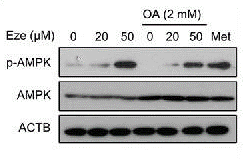
| Western blot | p-AMPK / AMPK LC3B-I / LC3B-II / Nuclear TFEB PCSK9 / LDLR / SREBP2 / HNF1-a |
|
28933629 |
Informationen zu klinischen Studien (Clinical Trial Information)
(Daten von https://clinicaltrials.gov, aktualisiert am 2025-08-07)
| NCT-Nummer | Rekrutierung | Bedingungen | Sponsor/Kollaboratoren | Startdatum | Phases |
|---|---|---|---|---|---|
| NCT06722521 | RECRUITING | Primary Prevention; Vascular Calcification |
Asan Medical Center |
2025-07-09 | PHASE4 |
| NCT07524101 | RECRUITING | Renal Insufficiency; Atherosclerosis; Dyslipidemia; Hypercholesterolemia; Cardiovascular Diseases |
Yonsei University |
2026-05-28 | |
| NCT05579626 | ENROLLING_BY_INVITATION | Pre Diabetes; ASCVD |
Seung-Whan Lee, M.D., Ph.D. |
2023-03-14 | PHASE4 |
| NCT06649240 | RECRUITING | Ischemic Stroke; Small Vessel Cerebrovascular Disease; Cholesterol, LDL; Secondary Prevention; Cardiovascular Diseases |
Seoul National University Hospital |
2024-10-04 | |
| NCT07359105 | RECRUITING | Dyslipidemia Associated With Type II Diabetes Mellitus |
Sin Gon Kim |
2026-03-09 | |
| NCT07799779 | NOT_YET_RECRUITING | Acute Coronary Syndromes (ACS) |
Seoul National University Bundang Hospital |
2026-09 | PHASE4 |
Häufig gestellte Fragen (FAQ) (Frequently Asked Questions)
Frage 1:
I am planning to deliver it per orally and wonder proper vehicle for this compound and effective dose level for lowering intestinal cholesterol absorption.
Antwort:
It can be dissolved in 2% DMSO/30% PEG 300/5% Tween 80/ddH2O at 10 mg/ml clearly. If you are going to use this vehicle, please dissolve the compound in DMSO clearly first. Then add PEG 300 and Tween 80, after mixed homogeneously, then dilute with water.

Die Produkte sind nur für Forschungszwecke bestimmt. Nicht zur Anwendung am Menschen. Kein Verkauf an Patienten.
©Copyright 2013 Selleck Chemicals. Alle Rechte vorbehalten.