
Nur für die Forschung bestimmt
Eltrombopag Olamine TpoR Agonist
Kat.-Nr.: S2229
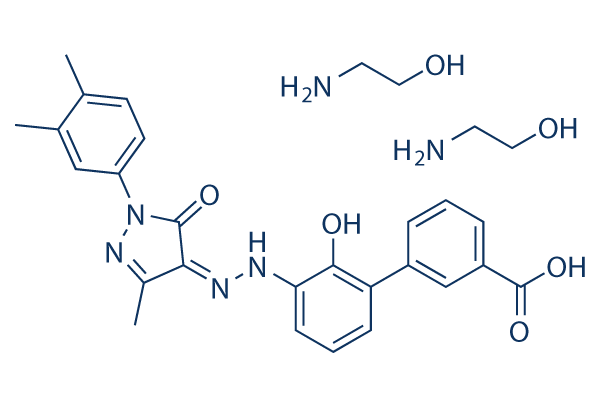
Chemische Struktur
Molekulargewicht: 564.63
Qualitätskontrolle (Quality Control)
| Verwandte Targets | PD-1/PD-L1 CXCR STING AhR Immunology & Inflammation related CD markers Interleukins Anti-infection Antioxidant COX |
|---|---|
| Andere TpoR Inhibitors | Butyzamide |
Chemische Informationen, Lagerung & Stabilität (Chemical Information, Storage & Stability)
| Molekulargewicht | 564.63 | Formel | C29H36N6O6 |
Lagerung (Ab Erhaltdatum) | |
|---|---|---|---|---|---|
| CAS-Nr. | 496775-62-3 | SDF herunterladen | Lagerung von Stammlösungen |
|
|
| Synonyme | SB497115,SB-497115-GR | Smiles | CC1=C(C=C(C=C1)N2C(=O)C(=C(N2)C)N=NC3=CC=CC(=C3O)C4=CC(=CC=C4)C(=O)O)C.C(CO)N.C(CO)N | ||
Löslichkeit (Solubility)
|
In vitro |
DMSO
: 89 mg/mL
(157.62 mM)
Water : Insoluble Ethanol : Insoluble |
Molaritätsrechner
|
In vivo |
|||||
In-vivo-Formulierungsrechner (Klare Lösung)
Schritt 1: Geben Sie unten die Informationen ein (Empfohlen: Ein zusätzliches Tier einplanen, um Verluste während des Experiments auszugleichen)
Schritt 2: Geben Sie die In-vivo-Formulierung ein (Dies ist nur der Rechner, nicht die Formulierung. Bitte kontaktieren Sie uns zuerst, wenn im Abschnitt Löslichkeit keine In-vivo-Formulierung angegeben ist.)
Berechnungsergebnisse:
Arbeitskonzentration: mg/ml;
Methode zur Herstellung der DMSO-Stammflüssigkeit: mg Wirkstoff voraufgelöst in μL DMSO ( Konzentration der Stammflüssigkeit mg/mL, Bitte kontaktieren Sie uns zuerst, wenn die Konzentration die DMSO-Löslichkeit der jeweiligen Wirkstoffcharge überschreitet. )
Methode zur Herstellung der In-vivo-Formulierung: Nehmen Sie μL DMSO Stammflüssigkeit, fügen Sie als Nächstes hinzuμL PEG300, mischen und aufklären, fügen Sie als Nächstes hinzuμL Tween 80, mischen und aufklären, fügen Sie als Nächstes hinzu μL ddH2O, mischen und aufklären.
Methode zur Herstellung der In-vivo-Formulierung: Nehmen Sie μL DMSO Stammflüssigkeit, fügen Sie als Nächstes hinzu μL Maisöl, mischen und aufklären.
Hinweis: 1. Bitte stellen Sie sicher, dass die Flüssigkeit klar ist, bevor Sie das nächste Lösungsmittel hinzufügen.
2. Achten Sie darauf, die Lösungsmittel in der richtigen Reihenfolge hinzuzufügen. Sie müssen sicherstellen, dass die im vorherigen Schritt erhaltene Lösung klar ist, bevor Sie das nächste Lösungsmittel hinzufügen. Physikalische Methoden wie Vortexen, Ultraschall oder ein warmes Wasserbad können zur Unterstützung des Lösungsvorgangs verwendet werden.
Wirkungsmechanismus (Mechanism of Action)
| Targets/IC50/Ki |
thrombopoietin receptor
|
|---|---|
| In vitro |
Eltrombopag demonstrates a half maximal effective concentration (EC50) of 0.27 μM in murine BAF3 cells transfected with the luciferase reporter gene under direction of the STAT-activated IRF-1 promoter and human TpoR (BAF3/IRF-1/hTpoR). Eltrombopag activates the receptor by association with metal ions (i.e., Zn2+) and specific amino acids within the transmembrane and juxtamembrane domains of the TpoR. Eltrombopag (30 μM) results in activation of STAT5 in N2C-Tpo cells, as detected with an antiphospho-STAT5 antibody on Western blots. Eltrombopag stimulates proliferation after a 2-day incubation with an EC50 of 0.03 μM in a BrdU assay conducted in BAF3/hTpoR cells. Eltrombopag also induces differentiation of hematopoietic stem cells into committed megakaryocyte progenitor cells. Eltrombopag increases the differentiation of bone marrow CD34+ cells into CD41+ megakaryocytes in a dose-dependent manner with an EC50 of 0.1 μM. Eltrombopag inhibits N2C-Tpo cell and HEL92.1.7 cell proliferating with IC50 of 20.7 μg/mL and 2.3 μg/mL. Eltrombopag (20 μg/mL) leads to a decreased cell division rate, a block in G(1) phase of cell cycle, and increased differentiation in human and murine leukemia cells. Eltrombopag (5 μg/mL) shows clear signs of differentiation, significant changes in the organization of the nuclear contents, and an increase in the cytoplasm/nucleus ratio in HL60 cells. Eltrombopag (5 μg/mL) causes an increase in CD11b, which is consistent with a premacrophage state in U937 cells, and also causes an increase in CD11b in URE cells. Eltrombopag leads to a reduction in free intracellular iron in leukemic cells in a dose-dependent manner in HL60 cells. |
| In vivo |
Eltrombopag (10 mg/kg per day) increases platelet counts over twofold approximately 1 week after the last dose for one chimpanzee and approximately 1.5-fold for the other two chimpanzees. Eltrombopag (1 mg/mL) prolongs survival in mouse models of leukemia. |
Referenzen |
|
Informationen zu klinischen Studien (Clinical Trial Information)
(Daten von https://clinicaltrials.gov, aktualisiert am 2025-09-24)
| NCT-Nummer | Rekrutierung | Bedingungen | Sponsor/Kollaboratoren | Startdatum | Phases |
|---|---|---|---|---|---|
| NCT07189910 | NOT_YET_RECRUITING | Primary Immune Thrombocytopenia (ITP) |
Union Hospital, Tongji Medical College, Huazhong University of Science and Technology |
2025-12-01 | PHASE4 |
| NCT05961410 | RECRUITING | Lymphoma; Peripheral Blood Stem Cell Transplantation |
National Taiwan University Hospital |
2023-08-15 | PHASE2 |
| NCT01927731 | COMPLETED | Bone Marrow Transplantation Recipient; Cord Blood Transplant Recipient; Hematopoietic Cell Transplantation Recipient |
M.D. Anderson Cancer Center |
2013-10-14 | PHASE2 |
| NCT06768619 | COMPLETED | Thrombocytopenia |
Chia Tai Tianqing Pharmaceutical Group Co., Ltd. |
2023-03-20 | |
| NCT01428635 | COMPLETED | Accelerated Phase Chronic Myelogenous Leukemia, BCR-ABL1 Positive; Blast Phase Chronic Myelogenous Leukemia, BCR-ABL1 Positive; Chronic Phase Chronic Myelogenous Leukemia, BCR-ABL1 Positive; Primary Myelofibrosis; Thrombocytopenia |
M.D. Anderson Cancer Center |
2012-01-13 | PHASE2; PHASE3 |
| NCT01772420 | COMPLETED | Adult Myelodysplastic Syndrome; Anemia; Chronic Myelomonocytic Leukemia |
Albert Einstein College of Medicine |
2012-10 | PHASE2 |

Die Produkte sind nur für Forschungszwecke bestimmt. Nicht zur Anwendung am Menschen. Kein Verkauf an Patienten.
©Copyright 2013 Selleck Chemicals. Alle Rechte vorbehalten.