
Nur für die Forschung bestimmt
Dofetilide Potassium Channel Inhibitor
Kat.-Nr.: S1658
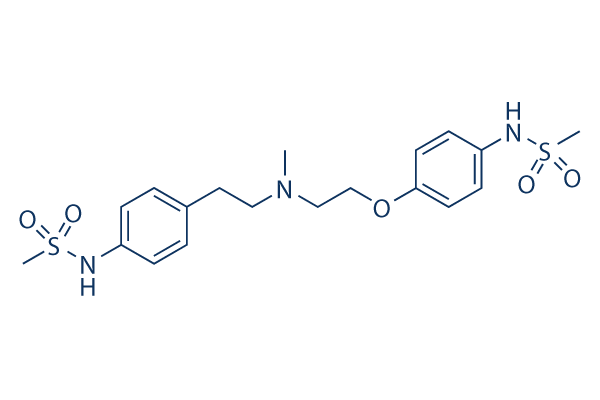
Chemische Struktur
Molekulargewicht: 441.56
Qualitätskontrolle (Quality Control)
| Verwandte Targets | CFTR CRM1 CD markers AChR Calcium Channel Sodium Channel GABA Receptor TRP Channel ATPase GluR |
|---|---|
| Andere Potassium Channel Inhibitors | Nigericin TRAM-34 ML133 HCl Nicorandil Hydralazine HCl Sophocarpine Gliquidone Senicapoc (ICA-17043) Butamben E-4031 dihydrochloride |
Chemische Informationen, Lagerung & Stabilität (Chemical Information, Storage & Stability)
| Molekulargewicht | 441.56 | Formel | C19H27N3O5S2 |
Lagerung (Ab Erhaltdatum) | |
|---|---|---|---|---|---|
| CAS-Nr. | 115256-11-6 | SDF herunterladen | Lagerung von Stammlösungen |
|
|
| Synonyme | UK-68798 | Smiles | CN(CCC1=CC=C(C=C1)NS(=O)(=O)C)CCOC2=CC=C(C=C2)NS(=O)(=O)C | ||
Löslichkeit (Solubility)
|
In vitro |
DMSO
: 88 mg/mL
(199.29 mM)
Water : Insoluble Ethanol : Insoluble |
Molaritätsrechner
|
In vivo |
|||||
In-vivo-Formulierungsrechner (Klare Lösung)
Schritt 1: Geben Sie unten die Informationen ein (Empfohlen: Ein zusätzliches Tier einplanen, um Verluste während des Experiments auszugleichen)
Schritt 2: Geben Sie die In-vivo-Formulierung ein (Dies ist nur der Rechner, nicht die Formulierung. Bitte kontaktieren Sie uns zuerst, wenn im Abschnitt Löslichkeit keine In-vivo-Formulierung angegeben ist.)
Berechnungsergebnisse:
Arbeitskonzentration: mg/ml;
Methode zur Herstellung der DMSO-Stammflüssigkeit: mg Wirkstoff voraufgelöst in μL DMSO ( Konzentration der Stammflüssigkeit mg/mL, Bitte kontaktieren Sie uns zuerst, wenn die Konzentration die DMSO-Löslichkeit der jeweiligen Wirkstoffcharge überschreitet. )
Methode zur Herstellung der In-vivo-Formulierung: Nehmen Sie μL DMSO Stammflüssigkeit, fügen Sie als Nächstes hinzuμL PEG300, mischen und aufklären, fügen Sie als Nächstes hinzuμL Tween 80, mischen und aufklären, fügen Sie als Nächstes hinzu μL ddH2O, mischen und aufklären.
Methode zur Herstellung der In-vivo-Formulierung: Nehmen Sie μL DMSO Stammflüssigkeit, fügen Sie als Nächstes hinzu μL Maisöl, mischen und aufklären.
Hinweis: 1. Bitte stellen Sie sicher, dass die Flüssigkeit klar ist, bevor Sie das nächste Lösungsmittel hinzufügen.
2. Achten Sie darauf, die Lösungsmittel in der richtigen Reihenfolge hinzuzufügen. Sie müssen sicherstellen, dass die im vorherigen Schritt erhaltene Lösung klar ist, bevor Sie das nächste Lösungsmittel hinzufügen. Physikalische Methoden wie Vortexen, Ultraschall oder ein warmes Wasserbad können zur Unterstützung des Lösungsvorgangs verwendet werden.
Wirkungsmechanismus (Mechanism of Action)
| Targets/IC50/Ki |
Potassium channel
|
|---|---|
| In vitro |
Dofetilide blocks HERG currents in excised macro patches of Xenopus oocytes. This compound (1 μM) reduces the amplitude of IKr to 61% of control currents in guinea pig cardiomyocytes, as measured by 200-ms test pulses and analysis of the deactivating tail currents of IKr. It increases apico-basal disparity of repolarization, due to a more marked increase of ERPs in the apex than in the base in the intact canine heart.
|
| In vivo |
Dofetilide (100 mg/kg, i.v.) does not suppress automaticity arrhythmias induced by two-stage coronary ligation and epinephrine or the coronary ligation and reperfusion arrhythmias, but suppresses the reentry arrhythmia induced by PES in dogs with old myocardial infarction (MI). This compound also shows antiarrhythmic effect in some dogs with digitalis arrhythmia. It increases QT interval and shows negative chronotropic effect like that of other class III drugs, but is different in antiarrhythmic profiles from those of other class III agents such as D-sotalol, E-4031, and MS-551 in that it does not prevent the occurrence of ventricular fibrillation (VF) immediately after coronary reperfusion and has some antiarrhythmic effects on digitalis arrhythmia. This chemical causes increased resorptions and the same stage-dependent malformations in Sprague-Dawley rats.
|
Referenzen |
|
Informationen zu klinischen Studien (Clinical Trial Information)
(Daten von https://clinicaltrials.gov, aktualisiert am 2026-08-28)
| NCT-Nummer | Rekrutierung | Bedingungen | Sponsor/Kollaboratoren | Startdatum | Phases |
|---|---|---|---|---|---|
| NCT06096337 | ACTIVE_NOT_RECRUITING | Persistent Atrial Fibrillation |
Boston Scientific Corporation |
2023-12-28 | |
| NCT05906732 | TERMINATED | Long QT Syndrome |
Thryv Therapeutics, Inc. |
2023-03-12 | PHASE1; PHASE2 |
| NCT05906732 | Recruiting | Long QT Syndrome |
Thryv Therapeutics Inc. |
2023-03-12 | Phase 1|Phase 2 |
| NCT03070470 | COMPLETED | Drug-induced QT Prolongation; Pharmacokinetics; Pharmacodynamics |
Food and Drug Administration (FDA) |
2017-03-14 | PHASE1 |
| NCT02365532 | COMPLETED | Long QT Syndrome |
Gilead Sciences |
2015-02 | PHASE1 |
| NCT02308748 | COMPLETED | Drug-induced QT Prolongation; Pharmacokinetics; Pharmacodynamics |
Food and Drug Administration (FDA) |
2014-05 | PHASE1 |

Die Produkte sind nur für Forschungszwecke bestimmt. Nicht zur Anwendung am Menschen. Kein Verkauf an Patienten.
©Copyright 2013 Selleck Chemicals. Alle Rechte vorbehalten.