
Nur für die Forschung bestimmt
Clopidogrel (SR-25990C) Bisulfate P2 Receptor Modulator
Kat.-Nr.: S1415
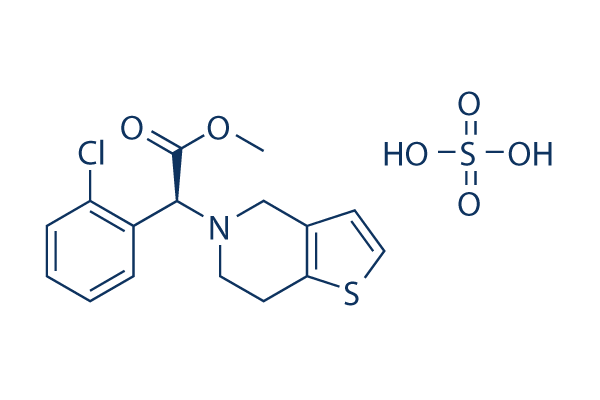
Chemische Struktur
Molekulargewicht: 419.9
Qualitätskontrolle (Quality Control)
| Verwandte Targets | Adrenergic Receptor AChR 5-HT Receptor COX Calcium Channel Histamine Receptor Dopamine Receptor GABA Receptor TRP Channel Cholinesterase (ChE) |
|---|---|
| Andere P2 Receptor Inhibitors | A-438079 Hydrochloride A-804598 MRS 2578 AF-353 A-740003 5-BDBD A-317491 Gefapixant Aurintricarboxylic acid Minodronic acid |
Chemische Informationen, Lagerung & Stabilität (Chemical Information, Storage & Stability)
| Molekulargewicht | 419.9 | Formel | C16H16ClNO2S.H2SO4 |
Lagerung (Ab Erhaltdatum) | |
|---|---|---|---|---|---|
| CAS-Nr. | 120202-66-6 | SDF herunterladen | Lagerung von Stammlösungen |
|
|
Löslichkeit (Solubility)
|
In vitro |
DMSO
: 83 mg/mL
(197.66 mM)
Ethanol : 83 mg/mL Water : Insoluble |
Molaritätsrechner
|
In vivo |
|||||
In-vivo-Formulierungsrechner (Klare Lösung)
Schritt 1: Geben Sie unten die Informationen ein (Empfohlen: Ein zusätzliches Tier einplanen, um Verluste während des Experiments auszugleichen)
Schritt 2: Geben Sie die In-vivo-Formulierung ein (Dies ist nur der Rechner, nicht die Formulierung. Bitte kontaktieren Sie uns zuerst, wenn im Abschnitt Löslichkeit keine In-vivo-Formulierung angegeben ist.)
Berechnungsergebnisse:
Arbeitskonzentration: mg/ml;
Methode zur Herstellung der DMSO-Stammflüssigkeit: mg Wirkstoff voraufgelöst in μL DMSO ( Konzentration der Stammflüssigkeit mg/mL, Bitte kontaktieren Sie uns zuerst, wenn die Konzentration die DMSO-Löslichkeit der jeweiligen Wirkstoffcharge überschreitet. )
Methode zur Herstellung der In-vivo-Formulierung: Nehmen Sie μL DMSO Stammflüssigkeit, fügen Sie als Nächstes hinzuμL PEG300, mischen und aufklären, fügen Sie als Nächstes hinzuμL Tween 80, mischen und aufklären, fügen Sie als Nächstes hinzu μL ddH2O, mischen und aufklären.
Methode zur Herstellung der In-vivo-Formulierung: Nehmen Sie μL DMSO Stammflüssigkeit, fügen Sie als Nächstes hinzu μL Maisöl, mischen und aufklären.
Hinweis: 1. Bitte stellen Sie sicher, dass die Flüssigkeit klar ist, bevor Sie das nächste Lösungsmittel hinzufügen.
2. Achten Sie darauf, die Lösungsmittel in der richtigen Reihenfolge hinzuzufügen. Sie müssen sicherstellen, dass die im vorherigen Schritt erhaltene Lösung klar ist, bevor Sie das nächste Lösungsmittel hinzufügen. Physikalische Methoden wie Vortexen, Ultraschall oder ein warmes Wasserbad können zur Unterstützung des Lösungsvorgangs verwendet werden.
Wirkungsmechanismus (Mechanism of Action)
| Targets/IC50/Ki |
P2Y12
|
|---|---|
| In vitro |
Clopidogrel is converted to its active metabolite by cytochrome P450 (CYP) enzymes. Clopidogrel (1 μM) also inhibits EGF-stimulated EGF receptor, PERK expression, and cell proliferation in RGM-1 cells (P<0.05), and causes much less inhibition of EGF-stimulated cell proliferation in EGF receptor over-expressed RGM-1 cells than in RGM-1 cells (22% vs. 32% reduction). Clopidogrel increases blood vessel number, reduces polymorphonuclear count and decreases attachment and bone loss, also decreases osteoclast number in rats submitted or not to periodontal repair. Clopidogrel decreases CXCL4, CXCL12 and PDGF content compared with saline-treated rats, without affecting CXCL5.
|
| In vivo |
Clopidogrel (2mg and 10mg/kg/day) significantly decreases ulcer-induced gastric epithelial cell proliferation and ulcer-stimulated expressions of EGF receptor and phosphorylated extracellular signal-regulated kinase (PERK) at the ulcer margin of rats. Clopidogrel improves endothelial function and NO bioavailability in rats with congestive heart failure. Clopidogrel-treated Congestive heart failure (CHF) rat displays enhances phosphorylation of AKT and eNOS. The clopidogrel/aspirin combination shows only additive-type effects on bleeding time prolongation induced by ear transection in the rabbit, therefore showing that combined inhibition of cyclooxygenase and ADP's effects provide a marked enhanced antithrombotic efficacy.
|
Referenzen |
|
Anwendungen (Applications)
| Methoden | Biomarker | Bilder | PMID |
|---|---|---|---|
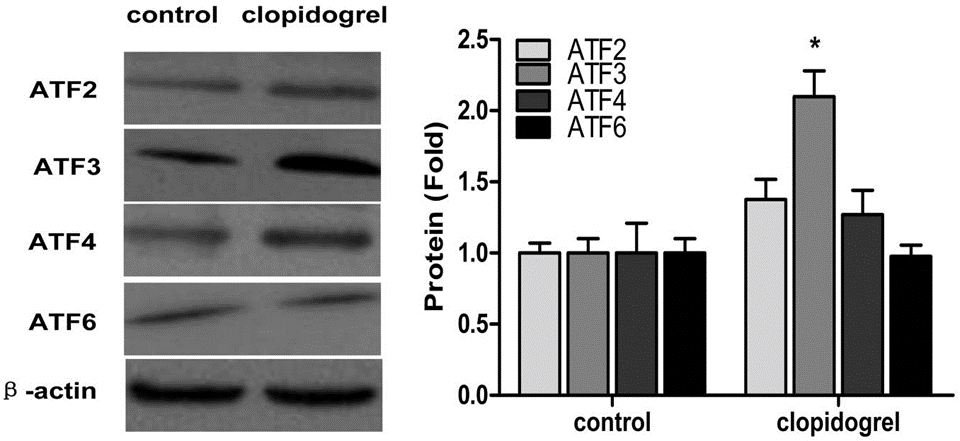
| Western blot | ATF2 / ATF3 / ATF4 / ATF6 TRIB3 / CHOP |
|
24058556 |
Informationen zu klinischen Studien (Clinical Trial Information)
(Daten von https://clinicaltrials.gov, aktualisiert am 2026-07-06)
| NCT-Nummer | Rekrutierung | Bedingungen | Sponsor/Kollaboratoren | Startdatum | Phases |
|---|---|---|---|---|---|
| NCT07683923 | NOT_YET_RECRUITING | SCAD; ACS (Acute Coronary Syndrome) |
Universitätsklinikum Hamburg-Eppendorf |
2027-03-01 | PHASE4 |
| NCT07572747 | NOT_YET_RECRUITING | Chronic Coronary Syndrome |
Khalid F Alhabib |
2027-04-01 | PHASE3 |
| NCT07583784 | RECRUITING | Myocardial Infarction (MI); ST-Segment Elevation Myocardial Infarction(STEMI); NSTEMI - Non-ST-Segment Elevation Myocardial Infarction; AF - Atrial Fibrillation |
Chonnam National University Hospital |
2026-08-26 | |
| NCT07744191 | NOT_YET_RECRUITING | Psoriasis (PsO); Psoriatic Arthritis (PsA) |
NYU Langone Health |
2026-09 | PHASE4 |
| NCT07384702 | NOT_YET_RECRUITING | Bacteremia Due to Staphylococcus Aureus |
Fundación Pública Andaluza para la gestión de la Investigación en Sevilla |
2026-06 | PHASE2 |
| NCT06650488 | RECRUITING | Staphylococcus Aureus Endocarditis; Staphylococcus Aureus Septicemia; Staphylococcus Aureus Bloodstream Infection |
Todd C. Lee MD MPH FIDSA |
2026-01-15 | PHASE4 |

Die Produkte sind nur für Forschungszwecke bestimmt. Nicht zur Anwendung am Menschen. Kein Verkauf an Patienten.
©Copyright 2013 Selleck Chemicals. Alle Rechte vorbehalten.