
Nur für die Forschung bestimmt
Canertinib (CI-1033) EGFR Inhibitor
Kat.-Nr.: S1019
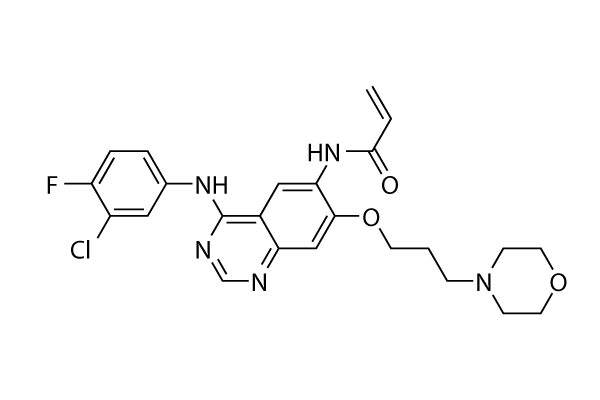
Chemische Struktur
Molekulargewicht: 485.94
Qualitätskontrolle (Quality Control)
| Verwandte Targets | VEGFR FGFR PDGFR c-Met Src MEK CSF-1R FLT3 HER2 c-Kit |
|---|---|
| Andere EGFR Inhibitors | Lazertinib (YH25448) Icotinib Hydrochloride Sunvozertinib AG-490 AG-1478 Genistein Rociletinib (CO-1686) Poziotinib (NOV120101, HM781-36B) WZ4002 PD153035 HCl |
Zellkultur, Behandlung & Arbeitskonzentration
(Cell Culture, Treatment & Working Concentration)
| Zelllinien | Assay-Typ | Konzentration | Inkubationszeit | Formulierung | Aktivitätsbeschreibung | PMID |
|---|---|---|---|---|---|---|
| human HCC827 cells | Proliferation assay | 72 h | Antiproliferative activity against human HCC827 cells harboring EGFR del E746-A750 mutant after 72 hrs by MTS assay, IC50=0.001 μM | |||
| A431 cells | Function assay | Inhibition of EGF-stimulated autophosphorylation of EGFR enzyme in A431 cells detected by immunoblotting, IC50=0.0074 μM | ||||
| MDA-MB 453 cells | Function assay | Inhibition of autophosphorylation of ERBB2 receptor kinase in MDA-MB 453 cells, IC50=0.009 μM | ||||
| human BT474 cells | Proliferation assay | 3 days | Antiproliferative activity against human BT474 cells overexpressing ERBb2 after 3 days by methylene blue staining, EC50=0.01 μM | |||
| mouse BAF3 cells | Function assay | Inhibition of Blk expressed in mouse BAF3 cells assessed as cytotoxicity, IC50=0.029 μM | ||||
| human HN5 cells | Proliferation assay | 3 days | Antiproliferative activity against human HN5 cells overexpressing EGFR after 3 days by methylene blue staining, EC50=0.05 μM | |||
| human NCI-H1975 cells | Proliferation assay | 72 h | Antiproliferative activity against human NCI-H1975 cells harboring EGFR L858R/T790M mutant after 72 hrs by MTS assay, IC50=0.064 μM | |||
| human A431 cells | Proliferation assay | 72 h | Antiproliferative activity against human A431 cells overexpressing EGFR after 72 hrs by MTS assay, IC50=0.15 μM | |||
| human A549 cells | Proliferation assay | 72 h | Antiproliferative activity against human A549 cells expressing wild type EGFR coexpressing k-Ras mutant after 72 hrs by MTS assay, IC50=1.59 μM | |||
| mouse BAF3 cells | Function assay | Inhibition of JAK3 expressed in mouse BAF3 cells assessed as cytotoxicity, IC50=2 μM | ||||
| human HL7702 cells | Proliferation assay | 72 h | Antiproliferative activity against human HL7702 cells expressing wilt type EGFR after 72 hrs by MTS assay, IC50=2.3 μM | |||
| human A431 cells | Function assay | 1 μM | 1 h | Irreversible inhibition of EGFR autophosphorylation in human A431 cells at 1 uM incubated for 1 hr followed by compound wash out measured 5 hrs post EGF addition by Western blotting analysis | ||
| human LNCaP cells | Function assay | 10 μM | 2 h | Inhibition of autophosphorylation of immunoprecipitated flag-tagged Bmx expressed in human LNCaP cells assessed as incorporation of [32P]ATP at 10 uM pretreated for 2 hrs before transfection by immunoblot analysis | ||
| NCI-H1975 cells | Growth inhibition assay | 48 h | Inhibition of EGFR L858R/T790M mutant in human NCI-H1975 cells assessed as growth inhibition after 48 hrs by MTT assay | |||
| Klicken Sie hier, um weitere experimentelle Zellliniendaten anzuzeigen | ||||||
Chemische Informationen, Lagerung & Stabilität (Chemical Information, Storage & Stability)
| Molekulargewicht | 485.94 | Formel | C24H25ClFN5O3 |
Lagerung (Ab Erhaltdatum) | |
|---|---|---|---|---|---|
| CAS-Nr. | 267243-28-7 | SDF herunterladen | Lagerung von Stammlösungen |
|
|
| Synonyme | PD183805 | Smiles | C=CC(=O)NC1=C(C=C2C(=C1)C(=NC=N2)NC3=CC(=C(C=C3)F)Cl)OCCCN4CCOCC4 | ||
Löslichkeit (Solubility)
|
In vitro |
4-Methylpyridine : 100 mg/mL
DMSO
: Insoluble
Water : Insoluble |
Molaritätsrechner
|
In vivo |
|||||
In-vivo-Formulierungsrechner (Klare Lösung)
Schritt 1: Geben Sie unten die Informationen ein (Empfohlen: Ein zusätzliches Tier einplanen, um Verluste während des Experiments auszugleichen)
Schritt 2: Geben Sie die In-vivo-Formulierung ein (Dies ist nur der Rechner, nicht die Formulierung. Bitte kontaktieren Sie uns zuerst, wenn im Abschnitt Löslichkeit keine In-vivo-Formulierung angegeben ist.)
Berechnungsergebnisse:
Arbeitskonzentration: mg/ml;
Methode zur Herstellung der DMSO-Stammflüssigkeit: mg Wirkstoff voraufgelöst in μL DMSO ( Konzentration der Stammflüssigkeit mg/mL, Bitte kontaktieren Sie uns zuerst, wenn die Konzentration die DMSO-Löslichkeit der jeweiligen Wirkstoffcharge überschreitet. )
Methode zur Herstellung der In-vivo-Formulierung: Nehmen Sie μL DMSO Stammflüssigkeit, fügen Sie als Nächstes hinzuμL PEG300, mischen und aufklären, fügen Sie als Nächstes hinzuμL Tween 80, mischen und aufklären, fügen Sie als Nächstes hinzu μL ddH2O, mischen und aufklären.
Methode zur Herstellung der In-vivo-Formulierung: Nehmen Sie μL DMSO Stammflüssigkeit, fügen Sie als Nächstes hinzu μL Maisöl, mischen und aufklären.
Hinweis: 1. Bitte stellen Sie sicher, dass die Flüssigkeit klar ist, bevor Sie das nächste Lösungsmittel hinzufügen.
2. Achten Sie darauf, die Lösungsmittel in der richtigen Reihenfolge hinzuzufügen. Sie müssen sicherstellen, dass die im vorherigen Schritt erhaltene Lösung klar ist, bevor Sie das nächste Lösungsmittel hinzufügen. Physikalische Methoden wie Vortexen, Ultraschall oder ein warmes Wasserbad können zur Unterstützung des Lösungsvorgangs verwendet werden.
Wirkungsmechanismus (Mechanism of Action)
| Eigenschaften |
First kinase inhibitor to show irreversible activity and to have entered clinical trials (serving as a template for further development).
|
|---|---|
| Targets/IC50/Ki |
EGFR
(Cell-free assay) 1.5 nM
ErbB2
(Cell-free assay) 9.0 nM
|
| In vitro |
Canertinib (CI-1033) shows excellent potency for irreversible inhibition of erbB2 autophosphorylation in MDA-MB 453 cells, and also demonstrates high permeability in Caco-2 cells. This compound alone significantly suppresses constitutively activated Akt and MAP kinase, and in combination inhibits Akt while preventing increased levels of MAPK phosphorylation. It stimulates p27 expression and p38 phosphorylation in MDA-MB-453 cells. CI-1033 is highly specific to the erbB receptor family and not sensitive to PGFR, FGFR or IR even at 50 μM. It shows high levels of inhibition in A431 cells expressing EGFR with IC50 of 7.4 nM, and suppresses heregulin-stimulated tyrosine phosphorylation of erbB2, erbB3 and erbB4 with IC50 of 5, 14 and 10 nM, respectively. The compound also inhibits expression of pp62c-fos in response to heregulin. It is predicted to modify Cys773 covalently within the ATP binding site of the HER2 kinase and enhances destruction of both mature and immature ErbB-2 molecules. This compound induces a significant decrease in measurable phosphorylation of tyrosine residues 845 and 1068 of EGFR, which are responsible for Src and Ras/MAPK signaling respectively. The corresponding residues of Her-2, tyrosine residues 877 and 1248 are dephosphorylated significantly by it at a concentration of 3 μM or higher. CI could block EGFR internalization and increase the rate of apoptosis in primary osteosarcoma cells in a titratable fashion. In addition, it inhibits the proliferation of TT, TE2, TE6 and TE10 cells significantly at 0.1 nM. |
| Kinase-Assay |
Tyrosine Kinase Assays
|
|
Enzymassays zur Bestimmung der IC50 werden in 96-Well-Filterplatten in einem Gesamtvolumen von 0,1 ml durchgeführt, enthaltend 20 mM Hepes, pH 7,4, 50 mM Natriumvanadat, 10 μM ATP, das 0,5 mCi [32P]ATP enthält, 20 mg Polyglutaminsäure/Tyrosin, 10 ng EGFR tyrosine kinase und entsprechende Verdünnungen von Canertinib (CI-1033). Alle Komponenten außer dem ATP werden in die Wells gegeben und die Platte wird 10 Minuten bei 25 °C unter Schütteln inkubiert. Die Reaktion wird durch Zugabe von [32P]ATP gestartet, und die Platte wird weitere 10 Minuten bei 25 °C inkubiert. Die Reaktion wird durch Zugabe von 0,1 ml 20%iger Trichloressigsäure (TCA) beendet. Die Platte wird mindestens 15 Minuten bei 4 °C gelagert, damit das Substrat präzipitieren kann. Die Wells werden anschließend fünfmal mit 0,2 ml 10%iger TCA gewaschen und der 32P-Einbau mit einem Wallac β-Plattenzähler bestimmt.
|
|
| In vivo |
Canertinib (CI-1033) shows impressive activity against A431 xenografts in nude mice at 5 mg/kg of body weight. This compound (20 to 80 mg/kg/d) achieves a high degree of tumor regressions in H125 xenograft models. Its oral administration causes a marked inhibition of growth in TT, TE6 and TE10 xenografts in nude mice, without animal death and <10% weight loss. |
Referenzen |
|
Anwendungen (Applications)
| Methoden | Biomarker | Bilder | PMID |
|---|---|---|---|
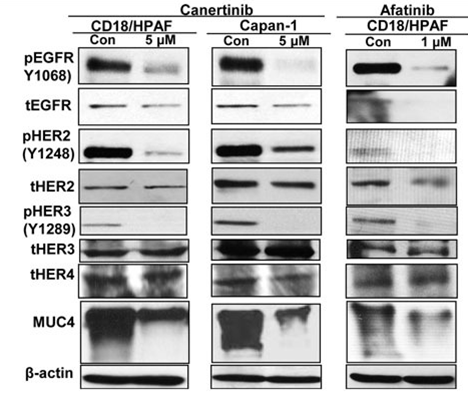
| Western blot | pEGFR / EGFR / p-HER2 / HER2 / p-HER3 / HER3 / MUC4 p-FAK / FAK / p-AKT / AKT |
|
25686822 |
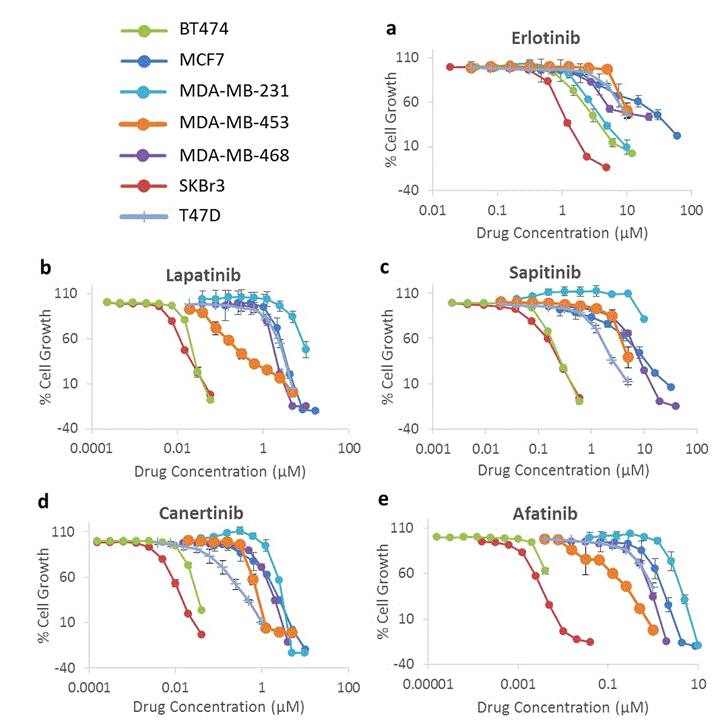
| Growth inhibition assay | Cell viability |
|
28638122 |
Informationen zu klinischen Studien (Clinical Trial Information)
(Daten von https://clinicaltrials.gov, aktualisiert am 2024-05-22)
| NCT-Nummer | Rekrutierung | Bedingungen | Sponsor/Kollaboratoren | Startdatum | Phases |
|---|---|---|---|---|---|
| NCT00050830 | Completed | Lung Neoplasms |
Pfizer |
2003-01 | Phase 2 |
| NCT00174356 | Completed | Carcinoma Non-Small Cell Lung |
Pfizer |
2002-12 | Phase 1 |
| NCT00051051 | Completed | Breast Neoplasms |
Pfizer |
2002-12 | Phase 2 |
| NCT00051051 | COMPLETED | Breast Neoplasms |
Pfizer |
2002-12 | PHASE2 |
| NCT00050830 | COMPLETED | Lung Neoplasms |
Pfizer |
2003-01 | PHASE2 |
| NCT00174356 | COMPLETED | Carcinoma, Non-Small Cell Lung |
Pfizer |
2002-12 | PHASE1 |
Häufig gestellte Fragen (FAQ) (Frequently Asked Questions)
Frage 1:
I would like to know which is the best option/solvent to dilute it for in vivo experiments. (I am treating mice at 30mg/mL of this compound.)
Antwort:
It is a suspension in the formulation recommended (30% Propylene glycol, 5% Tween 80, 65% D5W) on our product page at 30mg/ml. It’s fine for oral gavage.

Die Produkte sind nur für Forschungszwecke bestimmt. Nicht zur Anwendung am Menschen. Kein Verkauf an Patienten.
©Copyright 2013 Selleck Chemicals. Alle Rechte vorbehalten.