
Nur für die Forschung bestimmt
Iniparib (BSI-201) PARP Inhibitor
Kat.-Nr.: S1087
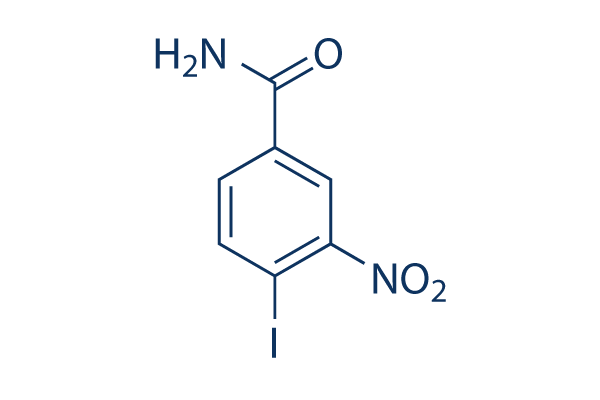
Chemische Struktur
Molekulargewicht: 292.03
Qualitätskontrolle (Quality Control)
| Verwandte Targets | HDAC ATM/ATR DNA-PK WRN DNA/RNA Synthesis Topoisomerase PPAR Sirtuin Casein Kinase eIF |
|---|---|
| Andere PARP Inhibitors | XAV-939 AZD5305 (Saruparib) Veliparib (ABT-888) PJ34 HCl AG-14361 G007-LK A-966492 UPF 1069 Pamiparib ME0328 |
Chemische Informationen, Lagerung & Stabilität (Chemical Information, Storage & Stability)
| Molekulargewicht | 292.03 | Formel | C7H5IN2O3 |
Lagerung (Ab Erhaltdatum) | |
|---|---|---|---|---|---|
| CAS-Nr. | 160003-66-7 | SDF herunterladen | Lagerung von Stammlösungen |
|
|
| Synonyme | NSC-746045, IND-71677 | Smiles | C1=CC(=C(C=C1C(=O)N)[N+](=O)[O-])I | ||
Löslichkeit (Solubility)
|
In vitro |
DMSO
: 58 mg/mL
(198.6 mM)
Ethanol : 28 mg/mL Water : Insoluble |
Molaritätsrechner
|
In vivo |
|||||
In-vivo-Formulierungsrechner (Klare Lösung)
Schritt 1: Geben Sie unten die Informationen ein (Empfohlen: Ein zusätzliches Tier einplanen, um Verluste während des Experiments auszugleichen)
Schritt 2: Geben Sie die In-vivo-Formulierung ein (Dies ist nur der Rechner, nicht die Formulierung. Bitte kontaktieren Sie uns zuerst, wenn im Abschnitt Löslichkeit keine In-vivo-Formulierung angegeben ist.)
Berechnungsergebnisse:
Arbeitskonzentration: mg/ml;
Methode zur Herstellung der DMSO-Stammflüssigkeit: mg Wirkstoff voraufgelöst in μL DMSO ( Konzentration der Stammflüssigkeit mg/mL, Bitte kontaktieren Sie uns zuerst, wenn die Konzentration die DMSO-Löslichkeit der jeweiligen Wirkstoffcharge überschreitet. )
Methode zur Herstellung der In-vivo-Formulierung: Nehmen Sie μL DMSO Stammflüssigkeit, fügen Sie als Nächstes hinzuμL PEG300, mischen und aufklären, fügen Sie als Nächstes hinzuμL Tween 80, mischen und aufklären, fügen Sie als Nächstes hinzu μL ddH2O, mischen und aufklären.
Methode zur Herstellung der In-vivo-Formulierung: Nehmen Sie μL DMSO Stammflüssigkeit, fügen Sie als Nächstes hinzu μL Maisöl, mischen und aufklären.
Hinweis: 1. Bitte stellen Sie sicher, dass die Flüssigkeit klar ist, bevor Sie das nächste Lösungsmittel hinzufügen.
2. Achten Sie darauf, die Lösungsmittel in der richtigen Reihenfolge hinzuzufügen. Sie müssen sicherstellen, dass die im vorherigen Schritt erhaltene Lösung klar ist, bevor Sie das nächste Lösungsmittel hinzufügen. Physikalische Methoden wie Vortexen, Ultraschall oder ein warmes Wasserbad können zur Unterstützung des Lösungsvorgangs verwendet werden.
Wirkungsmechanismus (Mechanism of Action)
| Targets/IC50/Ki |
PARP1
(Cell-free assay) |
|---|---|
| In vitro |
Iniparib (BSI-201) is described as a prodrug of 4-iodo-3-nitrosobenzamide, an agent that covalently inhibits PARP1 by binding to its first zinc finger under cell-free conditions. Treatment of 120 μM of this compound plus buthionine sulfoximine (BSO) induces a 95% cell death among 855-2 cells, and displays a similar effect in other human cancer cells. It inhibits the growth of E-ras 20 cells, the effect of which can be augmented 4-fold when BOS is added. Recently it shows no ability to inhibit PARP enzymatic or cellular activity, but can non-selectively modify cysteine-containing proteins in tumor cells, suggesting the mechanism of action is likely not via inhibition of PARP activity. At 100 μM, it inhibits ionizing radiation-induced single-strand breaks (SSBs) repair in human lymphoid cell lines based on large endogenous Epstein–Barr virus (EBV) circular episomes assay, resulting in 55% repair by 2 hours, which can be reversed surprisingly by knockdown of PARP1, indicating that the mechanism of inhibition does not involve trapping PARP at SSBs. This compound is not able to selectively kill homologous recombination (HR)-deficient cells between BRCA2-deficient PEO1 and BRCA2-revertant PEO4, or ATM-deficient GM16666 and ATM-restored GM16667 fibroblasts. It is cytotoxic to a variety of cell lines at concentrations above 40 μM reflecting a mechanism independent of PARP.
|
Referenzen |
|
Informationen zu klinischen Studien (Clinical Trial Information)
(Daten von https://clinicaltrials.gov, aktualisiert am 2017-09-19)
| NCT-Nummer | Rekrutierung | Bedingungen | Sponsor/Kollaboratoren | Startdatum | Phases |
|---|---|---|---|---|---|
| NCT01593228 | COMPLETED | Solid Tumors |
Sanofi |
2012-05 | PHASE3 |
| NCT00687765 | COMPLETED | Glioblastoma |
Sanofi |
2008-07 | PHASE1; PHASE2 |
| NCT01551680 | TERMINATED | Brain Metastases |
Institut du Cancer de Montpellier - Val d'Aurelle |
2012-09 | PHASE1 |
| NCT01455532 | COMPLETED | Neoplasm Malignant |
Sanofi |
2011-11 | PHASE1 |
| NCT01082549 | COMPLETED | Squamous Cell Lung Cancer |
Sanofi |
2010-03 | PHASE3 |
| NCT01213381 | COMPLETED | Advance Solid Tumors |
Sanofi |
2010-09 | PHASE1 |

Die Produkte sind nur für Forschungszwecke bestimmt. Nicht zur Anwendung am Menschen. Kein Verkauf an Patienten.
©Copyright 2013 Selleck Chemicals. Alle Rechte vorbehalten.