
Nur für die Forschung bestimmt
(E/Z)-BIX02189 MEK Hemmer
Kat.-Nr.: S1531
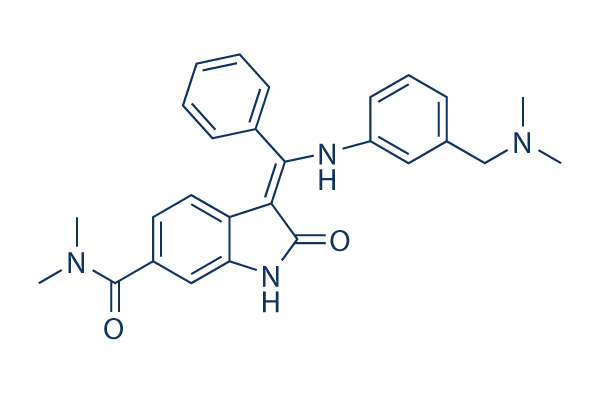
Chemische Struktur
Molekulargewicht: 440.54
Qualitätskontrolle (Quality Control)
| Verwandte Targets | ERK p38 MAPK Raf JNK Ras KRas S6 Kinase MAP4K TAK1 Mixed Lineage Kinase |
|---|---|
| Andere MEK Inhibitors | PD0325901 (Mirdametinib) U0126-EtOH PD 98059 CI-1040 (PD184352) Pimasertib (AS-703026) Refametinib (RDEA119) TAK-733 AZD8330 GDC-0623 SL-327 |
Zellkultur, Behandlung & Arbeitskonzentration
(Cell Culture, Treatment & Working Concentration)
| Zelllinien | Assay-Typ | Konzentration | Inkubationszeit | Formulierung | Aktivitätsbeschreibung | PMID |
|---|---|---|---|---|---|---|
| HeLa | Function assay | Inhibition of ERK5 phosphorylation in sorbitol-stimulated human HeLa cells, IC50 = 0.059 μM. | 23656407 | |||
| DAOY | qHTS assay | qHTS of pediatric cancer cell lines to identify multiple opportunities for drug repurposing: Primary screen for DAOY cells | 29435139 | |||
| SJ-GBM2 | qHTS assay | qHTS of pediatric cancer cell lines to identify multiple opportunities for drug repurposing: Primary screen for SJ-GBM2 cells | 29435139 | |||
| SK-N-MC | qHTS assay | qHTS of pediatric cancer cell lines to identify multiple opportunities for drug repurposing: Primary screen for SK-N-MC cells | 29435139 | |||
| BT-37 | qHTS assay | qHTS of pediatric cancer cell lines to identify multiple opportunities for drug repurposing: Primary screen for BT-37 cells | 29435139 | |||
| NB-EBc1 | qHTS assay | qHTS of pediatric cancer cell lines to identify multiple opportunities for drug repurposing: Primary screen for NB-EBc1 cells | 29435139 | |||
| Saos-2 | qHTS assay | qHTS of pediatric cancer cell lines to identify multiple opportunities for drug repurposing: Primary screen for Saos-2 cells | 29435139 | |||
| SK-N-SH | qHTS assay | qHTS of pediatric cancer cell lines to identify multiple opportunities for drug repurposing: Primary screen for SK-N-SH cells | 29435139 | |||
| BT-12 | qHTS assay | qHTS of pediatric cancer cell lines to identify multiple opportunities for drug repurposing: Primary screen for BT-12 cells | 29435139 | |||
| OHS-50 | qHTS assay | qHTS of pediatric cancer cell lines to identify multiple opportunities for drug repurposing: Primary screen for OHS-50 cells | 29435139 | |||
| Klicken Sie hier, um weitere experimentelle Zellliniendaten anzuzeigen | ||||||
Chemische Informationen, Lagerung & Stabilität (Chemical Information, Storage & Stability)
| Molekulargewicht | 440.54 | Formel | C27H28N4O2 |
Lagerung (Ab Erhaltdatum) | |
|---|---|---|---|---|---|
| CAS-Nr. | 1094614-85-3 | SDF herunterladen | Lagerung von Stammlösungen |
|
|
| Synonyme | N/A | Smiles | CN(C)CC1=CC(=CC=C1)N=C(C2=CC=CC=C2)C3=C(NC4=C3C=CC(=C4)C(=O)N(C)C)O | ||
Löslichkeit (Solubility)
|
In vitro |
DMSO
: 88 mg/mL
(199.75 mM)
Ethanol : 88 mg/mL Water : Insoluble |
Molaritätsrechner
|
In vivo |
|||||
In-vivo-Formulierungsrechner (Klare Lösung)
Schritt 1: Geben Sie unten die Informationen ein (Empfohlen: Ein zusätzliches Tier einplanen, um Verluste während des Experiments auszugleichen)
Schritt 2: Geben Sie die In-vivo-Formulierung ein (Dies ist nur der Rechner, nicht die Formulierung. Bitte kontaktieren Sie uns zuerst, wenn im Abschnitt Löslichkeit keine In-vivo-Formulierung angegeben ist.)
Berechnungsergebnisse:
Arbeitskonzentration: mg/ml;
Methode zur Herstellung der DMSO-Stammflüssigkeit: mg Wirkstoff voraufgelöst in μL DMSO ( Konzentration der Stammflüssigkeit mg/mL, Bitte kontaktieren Sie uns zuerst, wenn die Konzentration die DMSO-Löslichkeit der jeweiligen Wirkstoffcharge überschreitet. )
Methode zur Herstellung der In-vivo-Formulierung: Nehmen Sie μL DMSO Stammflüssigkeit, fügen Sie als Nächstes hinzuμL PEG300, mischen und aufklären, fügen Sie als Nächstes hinzuμL Tween 80, mischen und aufklären, fügen Sie als Nächstes hinzu μL ddH2O, mischen und aufklären.
Methode zur Herstellung der In-vivo-Formulierung: Nehmen Sie μL DMSO Stammflüssigkeit, fügen Sie als Nächstes hinzu μL Maisöl, mischen und aufklären.
Hinweis: 1. Bitte stellen Sie sicher, dass die Flüssigkeit klar ist, bevor Sie das nächste Lösungsmittel hinzufügen.
2. Achten Sie darauf, die Lösungsmittel in der richtigen Reihenfolge hinzuzufügen. Sie müssen sicherstellen, dass die im vorherigen Schritt erhaltene Lösung klar ist, bevor Sie das nächste Lösungsmittel hinzufügen. Physikalische Methoden wie Vortexen, Ultraschall oder ein warmes Wasserbad können zur Unterstützung des Lösungsvorgangs verwendet werden.
Wirkungsmechanismus (Mechanism of Action)
| Targets/IC50/Ki |
MEK5
(Cell-free assay) 1.5 nM
ERK5
(Cell-free assay) 59 nM
|
|---|---|
| In vitro |
BIX02189 blocks MEK5 and ERK5 catalytic activity with IC50 values of 1.5 nM and 59 nM, respectively. They are more potent than the effect caused by BIX02188 with IC50 values of 4.3 nM and 810 nM, respectively. BIX02189 shows inhibitory activity against CSF1R (FMS) with IC50 of 46 nM but displays no activity against related kinases MEK1, MEK2, ERK1, p38α, JNK2, EGFR, and STK16 with IC50 values of >3.7 μM. Pretreatment with BIX02189 inhibits sorbitol-induced phosphorylation of ERK5 in HeLa cells in a dose dependent manner, and displays no inhibitory activity against the phosphorylation of ERK1/2, p38, and JNK1/2 MAPKs. Treatment with only BIX02189 for 24 hours in HeLa or HEK293 cells does not show any cytotoxic effect. BIX02189 inhibits MEK5/ERK5/MEF2C-driven luciferase expression in HeLa and HEK293 cells with IC50 values of 0.53 μM and 0.26 μM, respectively. This is a more significant than the effect caused by BIX02188.BIX02189 inhibits the activation of ERK5, and suppresses C-terminus of Hsc70-interacting protein (CHIP) mediated p53 ubiquitination, leading to the reverse of the protective effect caused by laminar flow (L-flow) in human umbilical vein endothelial cells (HUVECs) exposed to 15d-PGJ2.BIX02189 (10 uM) inhibits ERK5 phosphorylation, and reduces myocyte enhancer factor 2 (MEF2) transcriptional activity in neonatal rat cardiomyocytes (NRCMs) stimulated by isoproterenol. BIX02189 enhances the sorbitol induced apoptosis in NRCMs, confirming the protective role of ERK5 in cardiomyocytes. |
| Kinase-Assay |
Katalytischer Assay
|
|
Das MEK5-Protein, das aus dem Baculovirus-Expressionssystem isoliert wurde, wird verwendet, um die Kinaseaktivität unter Verwendung des PKLight ATP-Detektionsreagenzes zu messen. Der Assay wird mit 15 nM GST-MEK5 und 0,75 μM ATP in einem Assay-Puffer durchgeführt, der aus 25 mM Hepes, pH 7,5, 10 mM MgCl2, 50 mM KCl, 0,2 % BSA, 0,01 % CHAPS, 100 μM Na3VO4, 0,5 mM DTT und 1 % DMSO in Gegenwart von variierenden Konzentrationen von BIX02189 besteht. Die Kinase-Reaktionsmischung wird 90 Minuten bei Raumtemperatur inkubiert, gefolgt von der Zugabe von 10 μL ATP-Detektionsreagenz für 15 Minuten. Das relative Lichtsignaleinheit (RLU)-Signal wird gemessen und die RLU-Signale werden in Prozent der Kontrolle (POC)-Werte für die Bestimmung des IC50-Wertes umgewandelt.
|
Referenzen |
|
Häufig gestellte Fragen (FAQ) (Frequently Asked Questions)
Frage 1:
I would like to perform some in vivo experiments in immunodeficient mice. How to perform the experiment in the best way? How to reconstitute it for in vivo experiments?
Antwort:
We suggest the following vehicle for this compound: 30% PEG400+0.5% Tween80+5% Propylene glycol, you can make a suspension at up to 30mg/ml that can be used for oral gavage. Or for i.p. injection, it can be dissolved in 2% DMSO+30% PEG 300+5% Tween 80+ddH2O at 10 mg/ml clearly.

Die Produkte sind nur für Forschungszwecke bestimmt. Nicht zur Anwendung am Menschen. Kein Verkauf an Patienten.
©Copyright 2013 Selleck Chemicals. Alle Rechte vorbehalten.