
Nur für die Forschung bestimmt
Apixaban Factor Xa Inhibitor
Kat.-Nr.: S1593
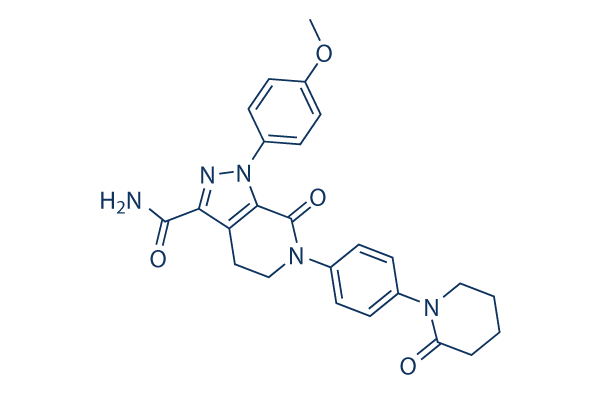
Chemische Struktur
Molekulargewicht: 459.5
Qualitätskontrolle (Quality Control)
| Verwandte Targets | Dehydrogenase HSP Transferase P450 (e.g. CYP17) PDE phosphatase PPAR Vitamin Carbohydrate Metabolism Mitochondrial Metabolism |
|---|---|
| Andere Factor Xa Inhibitors | Asundexian |
Zellkultur, Behandlung & Arbeitskonzentration
(Cell Culture, Treatment & Working Concentration)
| Zelllinien | Assay-Typ | Konzentration | Inkubationszeit | Formulierung | Aktivitätsbeschreibung | PMID |
|---|---|---|---|---|---|---|
| A673 | qHTS assay | qHTS of pediatric cancer cell lines to identify multiple opportunities for drug repurposing: Primary screen for A673 cells | 29435139 | |||
| BT-37 | qHTS assay | qHTS of pediatric cancer cell lines to identify multiple opportunities for drug repurposing: Primary screen for BT-37 cells | 29435139 | |||
| SJ-GBM2 | qHTS assay | qHTS of pediatric cancer cell lines to identify multiple opportunities for drug repurposing: Confirmatory screen for SJ-GBM2 cells | 29435139 | |||
| Rh41 | qHTS assay | qHTS of pediatric cancer cell lines to identify multiple opportunities for drug repurposing: Confirmatory screen for Rh41 cells | 29435139 | |||
| RD | qHTS assay | qHTS of pediatric cancer cell lines to identify multiple opportunities for drug repurposing: Confirmatory screen for RD cells | 29435139 | |||
| Rh30 | qHTS assay | qHTS of pediatric cancer cell lines to identify multiple opportunities for drug repurposing: Confirmatory screen for Rh30 cells | 29435139 | |||
| Caco-2 | Function assay | 48 hrs | Determination of IC50 values for inhibition of SARS-CoV-2 induced cytotoxicity of Caco-2 cells after 48 hours by high content imaging, IC50=5.91μM | ChEMBL | ||
| Caco-2 | Toxicity assay | 48 hrs | Toxicity against Caco-2 cells determined at 48 hours by intracellular ATP concentration using the CellTiter-Glo Luminescent Cell Viability Assay, CC50=18.07μM | ChEMBL | ||
| Klicken Sie hier, um weitere experimentelle Zellliniendaten anzuzeigen | ||||||
Chemische Informationen, Lagerung & Stabilität (Chemical Information, Storage & Stability)
| Molekulargewicht | 459.5 | Formel | C25H25N5O4 |
Lagerung (Ab Erhaltdatum) | |
|---|---|---|---|---|---|
| CAS-Nr. | 503612-47-3 | SDF herunterladen | Lagerung von Stammlösungen |
|
|
| Synonyme | BMS 562247-01 | Smiles | COC1=CC=C(C=C1)N2C3=C(CCN(C3=O)C4=CC=C(C=C4)N5CCCCC5=O)C(=N2)C(=O)N | ||
Löslichkeit (Solubility)
|
In vitro |
DMSO
: 18 mg/mL
(39.17 mM)
Water : Insoluble Ethanol : Insoluble |
Molaritätsrechner
|
In vivo |
|||||
In-vivo-Formulierungsrechner (Klare Lösung)
Schritt 1: Geben Sie unten die Informationen ein (Empfohlen: Ein zusätzliches Tier einplanen, um Verluste während des Experiments auszugleichen)
Schritt 2: Geben Sie die In-vivo-Formulierung ein (Dies ist nur der Rechner, nicht die Formulierung. Bitte kontaktieren Sie uns zuerst, wenn im Abschnitt Löslichkeit keine In-vivo-Formulierung angegeben ist.)
Berechnungsergebnisse:
Arbeitskonzentration: mg/ml;
Methode zur Herstellung der DMSO-Stammflüssigkeit: mg Wirkstoff voraufgelöst in μL DMSO ( Konzentration der Stammflüssigkeit mg/mL, Bitte kontaktieren Sie uns zuerst, wenn die Konzentration die DMSO-Löslichkeit der jeweiligen Wirkstoffcharge überschreitet. )
Methode zur Herstellung der In-vivo-Formulierung: Nehmen Sie μL DMSO Stammflüssigkeit, fügen Sie als Nächstes hinzuμL PEG300, mischen und aufklären, fügen Sie als Nächstes hinzuμL Tween 80, mischen und aufklären, fügen Sie als Nächstes hinzu μL ddH2O, mischen und aufklären.
Methode zur Herstellung der In-vivo-Formulierung: Nehmen Sie μL DMSO Stammflüssigkeit, fügen Sie als Nächstes hinzu μL Maisöl, mischen und aufklären.
Hinweis: 1. Bitte stellen Sie sicher, dass die Flüssigkeit klar ist, bevor Sie das nächste Lösungsmittel hinzufügen.
2. Achten Sie darauf, die Lösungsmittel in der richtigen Reihenfolge hinzuzufügen. Sie müssen sicherstellen, dass die im vorherigen Schritt erhaltene Lösung klar ist, bevor Sie das nächste Lösungsmittel hinzufügen. Physikalische Methoden wie Vortexen, Ultraschall oder ein warmes Wasserbad können zur Unterstützung des Lösungsvorgangs verwendet werden.
Wirkungsmechanismus (Mechanism of Action)
| Eigenschaften |
A highly selective, reversible, and direct factor Xa inhibitor.
|
|---|---|
| Targets/IC50/Ki |
Factor Xa (human)
(Cell-free assay) 0.08 nM(Ki)
Factor Xa (rabbit)
(Cell-free assay) 0.17 nM(Ki)
|
| In vitro |
Apixaban exhibits a high degree of potency, selectivity, and efficacy on Factor Xa with Ki of 0.08 nM and 0.17 nM for Human Factor Xa and Rabbit Factor Xa, respectively. In vitro, this compound prolongs the clotting times of normal human plasma with the concentrations (EC2x) of 3.6 μM, 0.37 μM, 7.4 μM, and 0.4 μM, which are required respectively to double the prothrombin time (PT), modified prothrombin time (mPT), activated partial thromboplastin time (APTT) and HepTest. Besides, it shows the highest potency in human and rabbit plasma, but less potency in rat and dog plasma in both the PT and APTT assays. |
| Kinase-Assay |
Enzym-Affinitäts-Assays.
|
|
Alle Enzym-Ki-Werte werden aus gereinigten menschlichen Enzymen gewonnen. Alle fXa-Assays werden in Mikrotiterplatten mit einem Gesamtvolumen von 250 μL in 0,1 M Natriumphosphatpuffer, enthaltend 0,2 M NaCl und 0,5 % Polyethylenglykol 6000 bei pH 7,0, durchgeführt. Apixaban wird bei 10 μM, 3,16 μM, 1,0 μM, 0,316 μM, 0,1 μM, 0,0316 μM, 0,01 μM und 0,00316 μM getestet. Die Platten werden 30 Minuten lang bei 405 nm abgelesen. Die Raten werden in Anwesenheit der Kontrollen (ohne Inhibitor) und für die Inhibitoren bestimmt. Diese Verbindung wird in Doppelstudien getestet und mit den gleichen internen Standards verglichen. Die Intraassay- und Interassay-Variabilität betragen 5 % bzw. 20 %. Alle Enzymassays werden in pH 7,4 Puffer bei Raumtemperatur durchgeführt. Alle Enzyme werden aus menschlichen Geweben gereinigt und stammen aus kommerziell erhältlichen Quellen. Individuelle Enzym- und Substrat-Km werden in separaten Experimenten bestimmt und liegen nahe an den in der Literatur etablierten Werten. Die Steady-State-Hemmung der Enzymaktivität wird durch Inkubation einer Reihe von Inhibitor-Konzentrationen (1 nM bis 50 μM, in Duplikaten) mit fester Enzymkonzentration (0,1 nM–100 nM) und Peptidsubstratkonzentration (200 μM–1000 μM) für bis zu 30 Minuten bestimmt. Der Ki wird unter Annahme einer kompetitiven Hemmung und einer Ein-Stellen-Bindung entweder aus dem IC50 oder aus dem Ausmaß der Hemmung bei jeder Inhibitor-Konzentration berechnet.
|
|
| In vivo |
In the dog, Apixaban shows the excellent pharmacokinetics with very low clearance (Cl: 0.02 L kg-1 h-1), and low volume of distribution (Vdss: 0.2 L kg-1). Besides, this compound also exhibits a moderate half-life (T1/2: 5.8 hours) and good oral bioavailability (F: 58%). In the arteriovenous-shunt thrombosis (AVST), venous thrombosis (VT) and electrically mediated carotid arterial thrombosis (ECAT) rabbit models, it produces dose-dependent antithrombotic effects with EC50 of 270 nM, 110 nM and 70 nM, respectively. This chemical significantly inhibits factor Xa activity with IC50 of 0.22 μM in rabbit ex vivo. In chimpanzee, it also shows small volume of distribution (Vdss: 0.17 L kg-1), low systemic clearance (Cl: 0.018 L kg-1 h-1), and good oral bioavailability (F: 59%). |
Referenzen |
|
Informationen zu klinischen Studien (Clinical Trial Information)
(Daten von https://clinicaltrials.gov, aktualisiert am 2026-02-05)
| NCT-Nummer | Rekrutierung | Bedingungen | Sponsor/Kollaboratoren | Startdatum | Phases |
|---|---|---|---|---|---|
| NCT07005024 | RECRUITING | Cancer; VTE (Venous Thromboembolism) |
University of Vermont |
2025-10-17 | PHASE3 |
| NCT06953726 | RECRUITING | Atrial Fibrillation |
VA Office of Research and Development |
2026-06-01 | PHASE4 |
| NCT06953778 | NOT_YET_RECRUITING | Atrial Fibrillation |
VA Office of Research and Development |
2027-03-08 | |
| NCT07493304 | RECRUITING | Venous Thromboembolism (VTE) |
Regeneron Pharmaceuticals |
2026-08-31 | PHASE3 |
| NCT07753200 | RECRUITING | Atrial Fibrillation (AF); Coronary Arterial Disease (CAD) |
Samsung Medical Center |
2026-07-20 | PHASE4 |
| NCT06729034 | NOT_YET_RECRUITING | Venous Malformation, Low Flow; Anticoagulants |
Oslo University Hospital |
2025-02-01 | PHASE2 |

Die Produkte sind nur für Forschungszwecke bestimmt. Nicht zur Anwendung am Menschen. Kein Verkauf an Patienten.
©Copyright 2013 Selleck Chemicals. Alle Rechte vorbehalten.