
Nur für die Forschung bestimmt
Abiraterone P450 (e.g. CYP17) Inhibitor
Kat.-Nr.: S1123
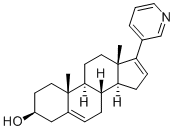
Chemische Struktur
Molekulargewicht: 349.51
Qualitätskontrolle (Quality Control)
| Verwandte Targets | Dehydrogenase HSP Transferase PDE phosphatase PPAR Vitamin Carbohydrate Metabolism Mitochondrial Metabolism Casein Kinase |
|---|---|
| Andere P450 (e.g. CYP17) Inhibitors | Apigenin Baicalein Naringenin Diosmetin Alizarin Orteronel Benzbromarone Sodium Danshensu Naringin Piperine |
Zellkultur, Behandlung & Arbeitskonzentration
(Cell Culture, Treatment & Working Concentration)
| Zelllinien | Assay-Typ | Konzentration | Inkubationszeit | Formulierung | Aktivitätsbeschreibung | PMID |
|---|---|---|---|---|---|---|
| JM109 | Growth inhibition assay | Inhibition of C-terminal His-tagged recombinant human CYP17A1delta19H mutant expressed in Escherichia coli JM109 cells assessed as decrease in progesterone hydroxylation in presence of cytochrome P450 reductase by HPLC-UV method, IC50=0.0094μM. | 29792703 | |||
| P450c17-LNCaP | Growth inhibition assay | In vitro cytochrome P450 17A1 inhibition was assayed using the rapid acetic acid releasing assay (AARA), utilizing intact P450c17-expressing Escherichia coli or P450c17-LNCaP cells as the enzyme source, IC50=0.8μM. | 12773039 | |||
| V79MZh11B1 | Growth inhibition assay | Inhibition of human CYP11B1 expressed in hamster V79MZh11B1 cells, IC50=1.608μM. | 18672868 | |||
| V79MZh11B1 | Growth inhibition assay | Inhibition of recombinant CYP11B1 expressed in expressed in V79MZh11B1 cells, IC50=1.608μM. | 19211174 | |||
| V79MZh | Growth inhibition assay | Inhibition of human CYP11B1 expressed in hamster V79MZh cells, IC50=1.61μM. | 20550118 | |||
| V79MZh | Growth inhibition assay | Inhibition of human CYP11B1 expressed in hamster V79MZh cells using [1,2-3H]-11-deoxycorticosterone as substrate, IC50=1.61μM. | 23859149 | |||
| V79MZh | Growth inhibition assay | Inhibition of human CYP11B2 expressed in hamster V79MZh cells, IC50=1.75μM. | 20550118 | |||
| V79MZh | Growth inhibition assay | Inhibition of human CYP11B2 expressed in hamster V79MZh cells using [1,2-3H]-11-deoxycorticosterone as substrate, IC50=1.75μM. | 23859149 | |||
| V79MZh11B2 | Growth inhibition assay | Inhibition of human CYP11B2 expressed in hamster V79MZh11B2 cells, IC50=1.751μM. | 18672868 | |||
| LNCAP | Antiproliferative assay | 72 hrs | Antiproliferative activity against human LNCAP cells after 72 hrs by MTT assay, IC50=3.29μM. | 29310026 | ||
| hTERT-BJ | Cytotoxicity assay | 48 hrs | Cytotoxicity against human hTERT-BJ cells assessed as cell growth inhibition after 48 hrs SRB assay, GI50=4.5μM. | 29172080 | ||
| PC3 | Antiproliferative assay | 72 hrs | Antiproliferative activity against human PC3 cells after 72 hrs by MTT assay, IC50=5.94μM. | 29310026 | ||
| MGC803 | Antiproliferative assay | 72 hrs | Antiproliferative activity against human MGC803 cells after 72 hrs by MTT assay, IC50=7.72μM. | 29310026 | ||
| HeLa | Antiproliferative assay | 48 hrs | Antiproliferative activity against human HeLa cells after 48 hrs by SRB assay, GI50=7.9μM. | 29172080 | ||
| PC3 | Cytotoxicity assay | 48 hrs | Cytotoxicity against human PC3 cells assessed as growth inhibition after 48 hrs by MTT assay, IC50=9.32μM. | 24148837 | ||
| GES-1 | Antiproliferative assay | 72 hrs | Antiproliferative activity against human GES-1 cells after 72 hrs by MTT assay, IC50=13.12μM. | 29310026 | ||
| T47D | Growth inhibition assay | 72 hrs | Growth inhibition of human T47D cells after 72 hrs by MTT assay, IC50=16.9μM. | 27209562 | ||
| MDA-MB-231 | Growth inhibition assay | 72 hrs | Growth inhibition of human MDA-MB-231 cells after 72 hrs by MTT assay, IC50=19.2μM. | 27209562 | ||
| MCF7 | Growth inhibition assay | 72 hrs | Growth inhibition of human MCF7 cells after 72 hrs by MTT assay, IC50=19.3μM. | 27209562 | ||
| MDA-MB-361 | Growth inhibition assay | 72 hrs | Growth inhibition of human MDA-MB-361 cells after 72 hrs by MTT assay, IC50=20.4μM. | 27209562 | ||
| T47D | Antiproliferative assay | 48 hrs | Antiproliferative activity against human T47D cells after 48 hrs by SRB assay, GI50=24μM. | 29172080 | ||
| WiDr | Antiproliferative assay | 48 hrs | Antiproliferative activity against human WiDr cells after 48 hrs by SRB assay, GI50=42μM. | 29172080 | ||
| Klicken Sie hier, um weitere experimentelle Zellliniendaten anzuzeigen | ||||||
Chemische Informationen, Lagerung & Stabilität (Chemical Information, Storage & Stability)
| Molekulargewicht | 349.51 | Formel | C24H31NO |
Lagerung (Ab Erhaltdatum) | |
|---|---|---|---|---|---|
| CAS-Nr. | 154229-19-3 | SDF herunterladen | Lagerung von Stammlösungen |
|
|
| Synonyme | CB-7598 | Smiles | CC12CCC(CC1=CCC3C2CCC4(C3CC=C4C5=CN=CC=C5)C)O | ||
Löslichkeit (Solubility)
|
In vitro |
Ethanol : 0.2 mg/mL
DMSO
: 0.1 mg/mL
(0.28 mM)
Water : 0.02 mg/mL |
Molaritätsrechner
|
In vivo |
|||||
In-vivo-Formulierungsrechner (Klare Lösung)
Schritt 1: Geben Sie unten die Informationen ein (Empfohlen: Ein zusätzliches Tier einplanen, um Verluste während des Experiments auszugleichen)
Schritt 2: Geben Sie die In-vivo-Formulierung ein (Dies ist nur der Rechner, nicht die Formulierung. Bitte kontaktieren Sie uns zuerst, wenn im Abschnitt Löslichkeit keine In-vivo-Formulierung angegeben ist.)
Berechnungsergebnisse:
Arbeitskonzentration: mg/ml;
Methode zur Herstellung der DMSO-Stammflüssigkeit: mg Wirkstoff voraufgelöst in μL DMSO ( Konzentration der Stammflüssigkeit mg/mL, Bitte kontaktieren Sie uns zuerst, wenn die Konzentration die DMSO-Löslichkeit der jeweiligen Wirkstoffcharge überschreitet. )
Methode zur Herstellung der In-vivo-Formulierung: Nehmen Sie μL DMSO Stammflüssigkeit, fügen Sie als Nächstes hinzuμL PEG300, mischen und aufklären, fügen Sie als Nächstes hinzuμL Tween 80, mischen und aufklären, fügen Sie als Nächstes hinzu μL ddH2O, mischen und aufklären.
Methode zur Herstellung der In-vivo-Formulierung: Nehmen Sie μL DMSO Stammflüssigkeit, fügen Sie als Nächstes hinzu μL Maisöl, mischen und aufklären.
Hinweis: 1. Bitte stellen Sie sicher, dass die Flüssigkeit klar ist, bevor Sie das nächste Lösungsmittel hinzufügen.
2. Achten Sie darauf, die Lösungsmittel in der richtigen Reihenfolge hinzuzufügen. Sie müssen sicherstellen, dass die im vorherigen Schritt erhaltene Lösung klar ist, bevor Sie das nächste Lösungsmittel hinzufügen. Physikalische Methoden wie Vortexen, Ultraschall oder ein warmes Wasserbad können zur Unterstützung des Lösungsvorgangs verwendet werden.
Wirkungsmechanismus (Mechanism of Action)
| Eigenschaften |
Approved for the treatment of docetaxel-treated castration-resistant prostate cancer.
|
|---|---|
| Targets/IC50/Ki |
CYP17
(Cell-free assay) 2 nM
|
| In vitro |
Abiraterone binds and inhibits wild-type and mutant androgen receptor (AR). This compound inhibits in vitro proliferation and androgen receptor-regulated gene expression of androgen receptor-positive prostate cancer cells, which could be explained by androgen receptor antagonism in addition to inhibition of steroidogenesis. In fact, activation of mutant androgen receptor by eplerenone is inhibited by greater concentrations of this chemical. It displaces ligand from both WT-AR and T877A with EC50 of 13.4 μM and 7.9 μM, respectively. This compound inhibits lyase activity with an IC50 of 5.8 nM in rat testis microsomes. Abiraterone acetate significantly inhibits T secretion (−48%) and in turn increased LH concentration (192%).
|
| Kinase-Assay |
C17,20-Lyase-Aktivitätstest
|
|
Mikrosomen werden auf eine finale Proteinkonzentration von 50 μg/mL in der Reaktionsmischung verdünnt, die 0,25 M Saccharose, 20 mM Tris–HCl (pH 7,4), 10 mM G6P und 1,2 IU/mL G6PDH enthielt. Nach Äquilibrierung bei 37 °C für 10 Minuten wird die Reaktion durch Zugabe von βNADP initiiert, um eine finale Konzentration von 0,6 mM zu erhalten. Vor der Verteilung von 600 μL der Reaktionsmischung in jedes Röhrchen wird Abiraterone unter einem Stickstoffstrom zur Trockne eingedampft und dann 10 Minuten lang bei 37 °C inkubiert. Nach der Inkubation mit dieser Verbindung werden 500 μL der Reaktionsmischung in Röhrchen überführt, die 1 μM des Enzymsubstrats 17OHP enthalten. Nach weiteren 10 Minuten Inkubation werden die Röhrchen auf Eis gelegt und die Reaktion durch Zugabe von 0,1 ml NaOH 1N gestoppt. Die Röhrchen werden tiefgefroren und bei –20 °C gelagert, bis sie auf Δ4A-Spiegel untersucht werden. Ein Δ4A-RIA wird entwickelt und auf einem Mikrotiterplattenformat unter Verwendung eines spezifischen Antikörpers gegen Δ4A automatisiert. Die Trennung von freiem und gebundenem Antigen wird mit einer Dextran-beschichteten Kohlesuspension erreicht. Nach der Zentrifugation werden Aliquote des klaren Überstands in Duplikaten in einem 1450 MicrobetaPlus Flüssigkeitsszintillationszähler gezählt. Die Δ4A-Konzentrationen unbekannter Proben werden aus der Standardkurve bestimmt. Die Nachweisgrenze beträgt 0,5 ng/mL und die intra- und inter-Assay-Variationskoeffizienten betragen 10,7 bzw. 17,6 % bei einem Assay-Wert von 13 ng/mL. Die Rate der enzymatischen Reaktion wird als pmol Δ4A, gebildet pro 10 Minuten und pro mg Protein, ausgedrückt. Der Wert der maximalen Aktivität ohne Inhibitor (Kontrolle) wird auf 100 % gesetzt. Die IC50-Werte werden unter Verwendung einer nicht-linearen Analyse aus dem Plot der Enzymaktivität (%) gegen den Logarithmus der Inhibitorkonzentration berechnet.
|
|
| In vivo |
Abiraterone inhibits CYP17 with an IC50 of 72 nM, in human testicular microsomes. This compound fails to significantly reduce the size of any of the organs. It reduces the testosterone levels strongly, almost reaching the level of the orchiectomy control. The testosterone levels are reduced by this chemical for more than 95% compared to the control group.
|
Referenzen |
|
Anwendungen (Applications)
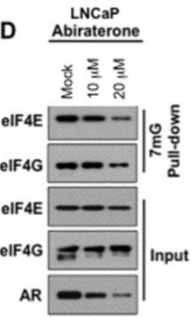
| Methoden | Biomarker | Bilder | PMID |
|---|---|---|---|
| Western blot | eIF4E / eIF4G / eIF4E / eIF4G / AR p-4EBP1 / 4EBP1 |
|
22174412 |
Informationen zu klinischen Studien (Clinical Trial Information)
(Daten von https://clinicaltrials.gov, aktualisiert am 2026-08-19)
| NCT-Nummer | Rekrutierung | Bedingungen | Sponsor/Kollaboratoren | Startdatum | Phases |
|---|---|---|---|---|---|
| NCT07237269 | RECRUITING | Prostate Cancer |
University of Nebraska |
2026-10-15 | PHASE2 |
| NCT06952803 | RECRUITING | Prostate Cancer |
AstraZeneca |
2025-08-06 | PHASE3 |
| NCT07190300 | RECRUITING | Metastatic Hormone-Sensitive Prostate Cancer (mHSPC) |
Novartis Pharmaceuticals |
2026-01-13 | PHASE1; PHASE2 |
| NCT04175431 | RECRUITING | Prostate Adenocarcinoma |
University of Washington |
2020-09-30 | PHASE2 |
| NCT07005154 | RECRUITING | Prostate Cancer; Metastatic Castration-Resistant Prostate Cancer; Metastatic Hormone Sensitive Prostate Cancer |
Astellas Pharma Global Development, Inc. |
2025-08-19 | PHASE2 |
| NCT06991556 | ACTIVE_NOT_RECRUITING | Metastatic Hormone-sensitive Prostate Cancer |
Novartis Pharmaceuticals |
2025-07-07 | PHASE2 |

Die Produkte sind nur für Forschungszwecke bestimmt. Nicht zur Anwendung am Menschen. Kein Verkauf an Patienten.
©Copyright 2013 Selleck Chemicals. Alle Rechte vorbehalten.