
Nur für die Forschung bestimmt
Veliparib (ABT-888) PARP Inhibitor
Kat.-Nr.: S1004
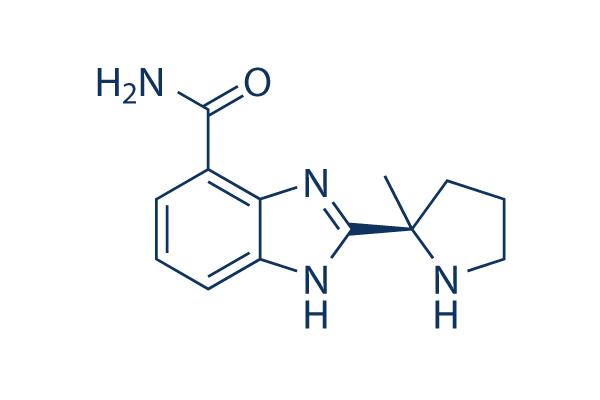
Chemische Struktur
Molekulargewicht: 244.29
Qualitätskontrolle (Quality Control)
| Verwandte Targets | HDAC ATM/ATR DNA-PK WRN DNA/RNA Synthesis Topoisomerase PPAR Sirtuin Casein Kinase eIF |
|---|---|
| Andere PARP Inhibitors | XAV-939 AZD5305 (Saruparib) PJ34 HCl AG-14361 Iniparib (BSI-201) G007-LK A-966492 UPF 1069 Pamiparib ME0328 |
Zellkultur, Behandlung & Arbeitskonzentration
(Cell Culture, Treatment & Working Concentration)
| Zelllinien | Assay-Typ | Konzentration | Inkubationszeit | Formulierung | Aktivitätsbeschreibung | PMID |
|---|---|---|---|---|---|---|
| A4-Fuk | Growth Inhibition Assay | IC50=43.5691 μM | SANGER | |||
| JVM-2 | Growth Inhibition Assay | IC50=42.9207 μM | SANGER | |||
| MOLT-4 | Growth Inhibition Assay | IC50=42.2538 μM | SANGER | |||
| KARPAS-45 | Growth Inhibition Assay | IC50=41.4818 μM | SANGER | |||
| HCC1187 | Growth Inhibition Assay | IC50=41.2771 μM | SANGER | |||
| NB14 | Growth Inhibition Assay | IC50=40.7031 μM | SANGER | |||
| SW982 | Growth Inhibition Assay | IC50=38.0998 μM | SANGER | |||
| IGROV-1 | Growth Inhibition Assay | IC50=39.3304 μM | SANGER | |||
| CAL-54 | Growth Inhibition Assay | IC50=37.966 μM | SANGER | |||
| T47D | Growth Inhibition Assay | IC50=37.7018 μM | SANGER | |||
| H4 | Growth Inhibition Assay | IC50=37.567 μM | SANGER | |||
| LAMA-84 | Growth Inhibition Assay | IC50=36.7345 μM | SANGER | |||
| MV-4-11 | Growth Inhibition Assay | IC50=35.8499 μM | SANGER | |||
| KG-1 | Growth Inhibition Assay | IC50=33.6001 μM | SANGER | |||
| JVM-3 | Growth Inhibition Assay | IC50=35.5868 μM | SANGER | |||
| MFE-280 | Growth Inhibition Assay | IC50=33.3889 μM | SANGER | |||
| KU812 | Growth Inhibition Assay | IC50=32.3642 μM | SANGER | |||
| COLO-684 | Growth Inhibition Assay | IC50=33.3599 μM | SANGER | |||
| A2780 | Growth Inhibition Assay | IC50=30.7457 μM | SANGER | |||
| RS4-11 | Growth Inhibition Assay | IC50=30.4241 μM | SANGER | |||
| EM-2 | Growth Inhibition Assay | IC50=29.4901 μM | SANGER | |||
| L-363 | Growth Inhibition Assay | IC50=29.4798 μM | SANGER | |||
| MOLT-13 | Growth Inhibition Assay | IC50=29.3814 μM | SANGER | |||
| EW-13 | Growth Inhibition Assay | IC50=29.3814 μM | SANGER | |||
| LU-139 | Growth Inhibition Assay | IC50=29.3748 μM | SANGER | |||
| 697 | Growth Inhibition Assay | IC50=29.0235 μM | SANGER | |||
| LB771 | Growth Inhibition Assay | IC50=28.8373 μM | SANGER | |||
| SK-MEL-1 | Growth Inhibition Assay | IC50=12.4663 μM | SANGER | |||
| CAL-33 | Growth Inhibition Assay | IC50=10.434 μM | SANGER | |||
| HAL-01 | Growth Inhibition Assay | IC50=9.8862 μM | SANGER | |||
| KASUMI-1 | Growth Inhibition Assay | IC50=8.89266 μM | SANGER | |||
| NCI-H720 | Growth Inhibition Assay | IC50=8.43603 μM | SANGER | |||
| C41 | Kinase Assay | 30 min | Inhibition of PARP1 with EC50 of 0.002 μM | 19888760 | ||
| Jurkat | Kinase Assay | 96 h | DMSO | Inhibition of PARP1 assessed as reduction of cell viability with EC50 of 3 μM | 23850199 | |
| Capan1 | Growth Inhibition Assay | 72 h | DMSO | Antiproliferative activity against BRCA2 gene mutated human Capan1 cells with IC50 of 39.7 μM | 24398383 | |
| ML-1 | Apoptotic Assay | 2.5 μM | 24 h | DMSO | Synergistically enhances TRAIL-induced apoptosis in ML-1 cells | 24895135 |
| HCT-116 | Kinase Assay | 0.5 μM | 24 h | PARP activity decreases | 23054213 | |
| UM-SCC1 | Cytotoxic Assay | 10 μM | 24 h | Reduces the cell viability | 21912620 | |
| FaDu | Cytotoxic Assay | 10 μM | 24 h | Reduces the cell viability | 21912620 | |
| LoVo | Function assay | 30 mins | Inhibition of PARP in human LoVo cells assessed as inhibition of poly(ADP)-ribose polymerization for 30 mins by fluorescence assay, EC50 = 0.00594 μM. | 26652717 | ||
| LoVo | Function assay | 30 mins | Inhibition of PARP in human LoVo cells assessed as inhibition of poly(ADP)-ribose polymerization for 30 mins by fluorescence assay, EC50 = 0.00594 μM. | 26652717 | ||
| LoVo | Function assay | 30 mins | Inhibition of PARP in human LoVo cells assessed as inhibition of poly(ADP)-ribose polymerization for 30 mins by fluorescence assay, EC50 = 0.00594 μM. | 26652717 | ||
| VC8 | Cytotoxicity assay | 3 days | Cytotoxicity against Chinese hamster VC8 cells harboring BRCA2 deficient after 3 days by CCK8 assay, CC50 = 2.344 μM. | 29335205 | ||
| LoVo | Cytotoxicity assay | 0.4 uM | 5 days | Potentiation of -induced cytotoxicity in human LoVo cells assessed as GI50 at 0.4 uM after 5 days by Celltiter-Glo assay, GI50 = 6.203 μM. | 26652717 | |
| Saos-2 | qHTS assay | qHTS of pediatric cancer cell lines to identify multiple opportunities for drug repurposing: Primary screen for Saos-2 cells | 29435139 | |||
| SK-N-SH | qHTS assay | qHTS of pediatric cancer cell lines to identify multiple opportunities for drug repurposing: Orthogonal 3D viability screen for SK-N-SH cells | 29435139 | |||
| TC32 | qHTS assay | qHTS of pediatric cancer cell lines to identify multiple opportunities for drug repurposing: Confirmatory screen for TC32 cells | 29435139 | |||
| T98G | Growth Inhibition Assay | IC50=44.8517 μM | SANGER | |||
| BALL-1 | Growth Inhibition Assay | IC50=43.9532 μM | SANGER | |||
| MDA-MB-361 | Growth Inhibition Assay | IC50=43.8414 μM | SANGER | |||
| SBC-1 | Growth Inhibition Assay | IC50=41.3063 μM | SANGER | |||
| MOLT-16 | Growth Inhibition Assay | IC50=36.952 μM | SANGER | |||
| BEN | Growth Inhibition Assay | IC50=27.9566 μM | SANGER | |||
| HCC70 | Growth Inhibition Assay | IC50=27.7246 μM | SANGER | |||
| NCI-H1693 | Growth Inhibition Assay | IC50=27.2898 μM | SANGER | |||
| HLE | Growth Inhibition Assay | IC50=27.054 μM | SANGER | |||
| NCI-H2029 | Growth Inhibition Assay | IC50=26.4238 μM | SANGER | |||
| CTV-1 | Growth Inhibition Assay | IC50=25.8969 μM | SANGER | |||
| TGBC11TKB | Growth Inhibition Assay | IC50=25.6863 μM | SANGER | |||
| HCC1937 | Growth Inhibition Assay | IC50=24.746 μM | SANGER | |||
| MHH-NB-11 | Growth Inhibition Assay | IC50=23.1363 μM | SANGER | |||
| A388 | Growth Inhibition Assay | IC50=21.9091 μM | SANGER | |||
| ECC10 | Growth Inhibition Assay | IC50=20.7455 μM | SANGER | |||
| Daoy | Growth Inhibition Assay | IC50=19.5649 μM | SANGER | |||
| KYSE-150 | Growth Inhibition Assay | IC50=18.9986 μM | SANGER | |||
| NKM-1 | Growth Inhibition Assay | IC50=18.5119 μM | SANGER | |||
| H9 | Growth Inhibition Assay | IC50=18.2833 μM | SANGER | |||
| COLO-668 | Growth Inhibition Assay | IC50=17.6294 μM | SANGER | |||
| GP5d | Growth Inhibition Assay | IC50=17.053 μM | SANGER | |||
| DEL | Growth Inhibition Assay | IC50=16.6717 μM | SANGER | |||
| ChaGo-K-1 | Growth Inhibition Assay | IC50=16.5325 μM | SANGER | |||
| RPMI-8226 | Growth Inhibition Assay | IC50=16.2042 μM | SANGER | |||
| OS-RC-2 | Growth Inhibition Assay | IC50=15.9589 μM | SANGER | |||
| EW-3 | Growth Inhibition Assay | IC50=14.5565 μM | SANGER | |||
| DU-145 | Growth Inhibition Assay | IC50=13.9053 μM | SANGER | |||
| MN-60 | Growth Inhibition Assay | IC50=13.5389 μM | SANGER | |||
| SK-NEP-1 | Growth Inhibition Assay | IC50=13.166 μM | SANGER | |||
| HEC-1 | Growth Inhibition Assay | IC50=12.9196 μM | SANGER | |||
| KY821 | Growth Inhibition Assay | IC50=12.485 μM | SANGER | |||
| Ramos-2G6-4C10 | Growth Inhibition Assay | IC50=12.4752 μM | SANGER | |||
| DT40 | Cytotoxic Assay | 72 h | DMSO | Cytotoxicity against chicken BRCA2-deficient DT40 cells | 24922587 | |
| PC-3 | Growth Inhibition Assay | 10 μM | Induces a significant inhibition in colony formation | 21571912 | ||
| C41 | Function assay | Inhibition of PARP1 in human C41 cells, EC50 = 0.002 μM. | 19143569 | |||
| A673 | qHTS assay | qHTS of pediatric cancer cell lines to identify multiple opportunities for drug repurposing: Primary screen for A673 cells | 29435139 | |||
| NB1643 | qHTS assay | qHTS of pediatric cancer cell lines to identify multiple opportunities for drug repurposing: Primary screen for NB1643 cells | 29435139 | |||
| SK-N-MC | qHTS assay | qHTS of pediatric cancer cell lines to identify multiple opportunities for drug repurposing: Primary screen for SK-N-MC cells | 29435139 | |||
| SJ-GBM2 | qHTS assay | qHTS of pediatric cancer cell lines to identify multiple opportunities for drug repurposing: Orthogonal 3D viability screen for SJ-GBM2 cells | 29435139 | |||
| EoL-1-cell | Growth Inhibition Assay | IC50=1.0798 μM | SANGER | |||
| NCI-SNU-5 | Growth Inhibition Assay | IC50=3.12841 μM | SANGER | |||
| BV-173 | Growth Inhibition Assay | IC50=5.45409 μM | SANGER | |||
| HCC1806 | Growth Inhibition Assay | IC50=5.75173 μM | SANGER | |||
| COLO-680 | Growth Inhibition Assay | IC50=6.21406 μM | SANGER | |||
| HCC2218 | Growth Inhibition Assay | IC50=7.79704 μM | SANGER | |||
| SK-MEL-24 | Growth Inhibition Assay | IC50=7.81924 μM | SANGER | |||
| Mo-T | Growth Inhibition Assay | IC50=45.6389 μM | SANGER | |||
| MHH-PREB-1 | Growth Inhibition Assay | IC50=45.7585 μM | SANGER | |||
| ALL-PO | Growth Inhibition Assay | IC50=47.3791 μM | SANGER | |||
| NCI-H510A | Growth Inhibition Assay | IC50=47.9034 μM | SANGER | |||
| ML-2 | Growth Inhibition Assay | IC50=49.7856 μM | SANGER | |||
| Klicken Sie hier, um weitere experimentelle Zellliniendaten anzuzeigen | ||||||
Chemische Informationen, Lagerung & Stabilität (Chemical Information, Storage & Stability)
| Molekulargewicht | 244.29 | Formel | C13H16N4O |
Lagerung (Ab Erhaltdatum) | |
|---|---|---|---|---|---|
| CAS-Nr. | 912444-00-9 | SDF herunterladen | Lagerung von Stammlösungen |
|
|
| Synonyme | NSC 737664 | Smiles | CC1(CCCN1)C2=NC3=C(C=CC=C3N2)C(=O)N | ||
Löslichkeit (Solubility)
|
In vitro |
DMSO
: 49 mg/mL
(200.58 mM)
Water : Insoluble Ethanol : Insoluble |
Molaritätsrechner
|
In vivo |
|||||
In-vivo-Formulierungsrechner (Klare Lösung)
Schritt 1: Geben Sie unten die Informationen ein (Empfohlen: Ein zusätzliches Tier einplanen, um Verluste während des Experiments auszugleichen)
Schritt 2: Geben Sie die In-vivo-Formulierung ein (Dies ist nur der Rechner, nicht die Formulierung. Bitte kontaktieren Sie uns zuerst, wenn im Abschnitt Löslichkeit keine In-vivo-Formulierung angegeben ist.)
Berechnungsergebnisse:
Arbeitskonzentration: mg/ml;
Methode zur Herstellung der DMSO-Stammflüssigkeit: mg Wirkstoff voraufgelöst in μL DMSO ( Konzentration der Stammflüssigkeit mg/mL, Bitte kontaktieren Sie uns zuerst, wenn die Konzentration die DMSO-Löslichkeit der jeweiligen Wirkstoffcharge überschreitet. )
Methode zur Herstellung der In-vivo-Formulierung: Nehmen Sie μL DMSO Stammflüssigkeit, fügen Sie als Nächstes hinzuμL PEG300, mischen und aufklären, fügen Sie als Nächstes hinzuμL Tween 80, mischen und aufklären, fügen Sie als Nächstes hinzu μL ddH2O, mischen und aufklären.
Methode zur Herstellung der In-vivo-Formulierung: Nehmen Sie μL DMSO Stammflüssigkeit, fügen Sie als Nächstes hinzu μL Maisöl, mischen und aufklären.
Hinweis: 1. Bitte stellen Sie sicher, dass die Flüssigkeit klar ist, bevor Sie das nächste Lösungsmittel hinzufügen.
2. Achten Sie darauf, die Lösungsmittel in der richtigen Reihenfolge hinzuzufügen. Sie müssen sicherstellen, dass die im vorherigen Schritt erhaltene Lösung klar ist, bevor Sie das nächste Lösungsmittel hinzufügen. Physikalische Methoden wie Vortexen, Ultraschall oder ein warmes Wasserbad können zur Unterstützung des Lösungsvorgangs verwendet werden.
Wirkungsmechanismus (Mechanism of Action)
| Eigenschaften |
Increases the efficacy of common cancer therapies such as radiation and alkylating agents.
|
|---|---|
| Targets/IC50/Ki |
PARP2
(Cell-free assay) 2.9 nM(Ki)
PARP1
(Cell-free assay) 5.2 nM(Ki)
|
| In vitro |
Veliparib (ABT-888) is inactive to SIRT2 (>5 μM). It inhibits the PARP activity with EC50 of 2 nM in C41 cells. This compound could decrease the PAR levels in both irradiated and nonirradiated H460 cells. It also reduces clonogenic survival and inhibits DNA repair by PARP-1 inhibition in H460 cells. When combined with radiation, it increases apoptosis and autophagy in H460 cells. It also inhibits PARP activity in H1299, DU145 and 22RV1 cells and the inhibition is independent of p53 function. At 10 μM, it suppresses the surviving fraction (SF) by 43% in the clonogenic H1299 cells. It shows effective radiosensitivity in oxic H1299 cells. Furthermore, it could attenuate the SF of hypoxic-irradiated cells including H1299, DU145 and 22RV1. |
| Kinase-Assay |
In-vitro-PARP-Assays
|
|
PARP-Assays für Veliparib (ABT-888) werden in einem Puffer durchgeführt, der 50 mM Tris (pH 8,0), 1 mM DTT, 1,5 μM [3H]NAD+ (1,6 μCi/mmol), 200 nM biotinyliertes Histon H1, 200 nM slDNA und 1 nM PARP-1- oder 4 nM PARP-2-Enzym enthält. Die Reaktionen werden mit 1,5 mM Benzamid beendet, auf Streptavidin-Flash-Platten übertragen und mit einem TopCount-Mikrotiterplatten-Szintillationszähler gezählt.
|
|
| In vivo |
Veliparib (ABT-888) has an oral bioavailability of 56%-92% in mice, Sprague-Dawley rats, beagle dogs, and cynomolgus monkeys after oral administration. This compound (25 mg/kg i.p.) could improve tumor growth delay in a NCI-H460 xenograft model with well tolerated. Combination with radiation, it decreases the tumor vessel formation. It reduces intratumor PAR levels by more than 95% at a dose of 3 and 12.5 mg/kg in A375 and Colo829 xenograft models and the suppression could be maintained over time. |
Referenzen |
|
Anwendungen (Applications)
| Methoden | Biomarker | Bilder | PMID |
|---|---|---|---|
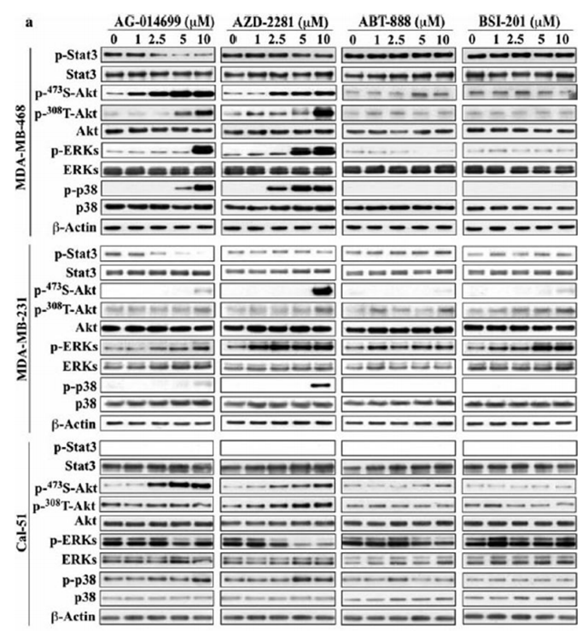
| Western blot | p-STAT3 / STAT3 / p-AKT(S473) / p-AKT(T308) / p-ERK / p-p38 |
|
22678161 |
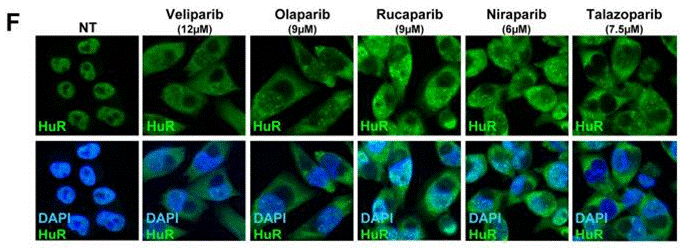
| Immunofluorescence | HuR BRCA1 |
|
28687616 |
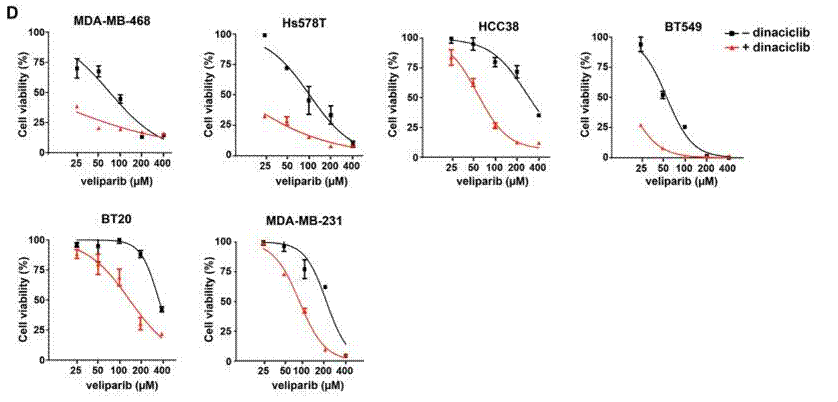
| Growth inhibition assay | Cell viability (TNBC cell lines) Cell viability (melanoma cells) |
|
27880910 |
Informationen zu klinischen Studien (Clinical Trial Information)
(Daten von https://clinicaltrials.gov, aktualisiert am 2026-05-06)
| NCT-Nummer | Rekrutierung | Bedingungen | Sponsor/Kollaboratoren | Startdatum | Phases |
|---|---|---|---|---|---|
| NCT01042379 | RECRUITING | Breast Neoplasms; Breast Cancer; Breast Tumors; Angiosarcoma; TNBC - Triple-Negative Breast Cancer; HER2-positive Breast Cancer; HER2-negative Breast Cancer; Hormone Receptor Positive Tumor; Hormone Receptor Negative Tumor; Early-stage Breast Cancer; Locally Advanced Breast Cancer |
QuantumLeap Healthcare Collaborative |
2010-03-01 | PHASE2 |
| NCT02595905 | COMPLETED | Metastatic BRCA Hereditary Breast Carcinoma; Metastatic Breast Carcinoma; Metastatic Malignant Neoplasm in the Brain; Metastatic Triple-Negative Breast Carcinoma; Recurrent Breast Carcinoma; Stage IV Breast Cancer AJCC v6 and v7 |
National Cancer Institute (NCI) |
2016-09-15 | PHASE2 |
| NCT01585805 | ACTIVE_NOT_RECRUITING | Locally Advanced Pancreatic Adenocarcinoma; Metastatic Pancreatic Adenocarcinoma; Stage III Pancreatic Cancer AJCC v8; Stage IV Pancreatic Cancer AJCC v8 |
National Cancer Institute (NCI) |
2012-05-15 | PHASE2 |
| NCT01251874 | ACTIVE_NOT_RECRUITING | Recurrent Breast Carcinoma; Stage IIIB Breast Cancer AJCC v7; Stage IIIC Breast Cancer AJCC v7; Stage IV Breast Cancer AJCC v6 and v7; Triple-Negative Breast Carcinoma |
National Cancer Institute (NCI) |
2010-11-22 | PHASE1 |
| NCT01149083 | COMPLETED | Anatomic Stage III Breast Cancer AJCC v8; Anatomic Stage IV Breast Cancer AJCC v8; Locally Advanced Breast Carcinoma; Metastatic Breast Carcinoma; Unresectable Breast Carcinoma |
National Cancer Institute (NCI) |
2010-06-30 | PHASE2 |
| NCT01618357 | COMPLETED | Breast Cancer |
Richard Zellars |
2013-07-22 | PHASE1 |

Die Produkte sind nur für Forschungszwecke bestimmt. Nicht zur Anwendung am Menschen. Kein Verkauf an Patienten.
©Copyright 2013 Selleck Chemicals. Alle Rechte vorbehalten.