
Nur für die Forschung bestimmt
YK-4-279 DNA/RNA Synthesis Inhibitor
Kat.-Nr.: S7679
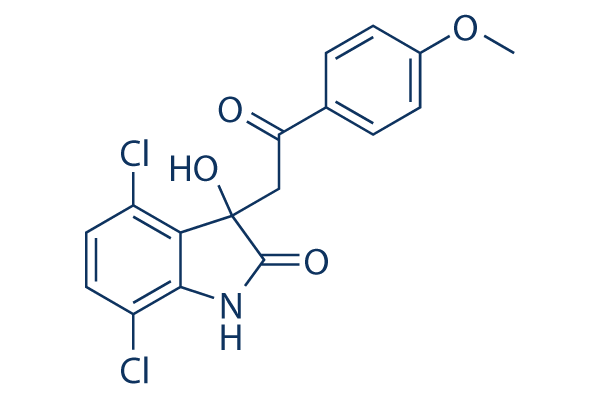
Chemische Struktur
Molekulargewicht: 366.20
Qualitätskontrolle (Quality Control)
| Verwandte Targets | CDK HSP PD-1/PD-L1 ROCK Wee1 Microtubule Associated Ras KRas Aurora Kinase Casein Kinase |
|---|---|
| Andere DNA/RNA Synthesis Inhibitors | CX-5461 (Pidnarulex) SCR7 Favipiravir (T-705) RK-33 EED226 BMH-21 Carmofur Triapine (3-AP) Halofuginone Tegafur (FT-207) |
Zellkultur, Behandlung & Arbeitskonzentration
(Cell Culture, Treatment & Working Concentration)
| Zelllinien | Assay-Typ | Konzentration | Inkubationszeit | Formulierung | Aktivitätsbeschreibung | PMID |
|---|---|---|---|---|---|---|
| COS7 | Function assay | Inhibition of transcriptional activity of full-length EWS-FLI1 (unknown origin) expressed in COS7 cells by NR0B1-luciferase reporter gene assay, IC50=0.35μM | 25432018 | |||
| TC71 | Growth inhibition assay | 3 days | Growth inhibition of human TC71 cells harboring EWS-FLI1 fusion protein after 3 days by WST1 assay, GI50=0.92μM | 25432018 | ||
| TC32 | Growth inhibition assay | 3 days | Growth inhibition of human TC32 cells harboring EWS-FLI1 fusion protein after 3 days by WST1 assay, GI50=0.94μM | 25432018 | ||
| TC32 | qHTS assay | qHTS of pediatric cancer cell lines to identify multiple opportunities for drug repurposing: Primary screen for TC32 cells | 29435139 | |||
| DAOY | qHTS assay | qHTS of pediatric cancer cell lines to identify multiple opportunities for drug repurposing: Primary screen for DAOY cells | 29435139 | |||
| SJ-GBM2 | qHTS assay | qHTS of pediatric cancer cell lines to identify multiple opportunities for drug repurposing: Primary screen for SJ-GBM2 cells | 29435139 | |||
| A673 | qHTS assay | qHTS of pediatric cancer cell lines to identify multiple opportunities for drug repurposing: Primary screen for A673 cells | 29435139 | |||
| SK-N-MC | qHTS assay | qHTS of pediatric cancer cell lines to identify multiple opportunities for drug repurposing: Primary screen for SK-N-MC cells | 29435139 | |||
| NB-EBc1 | qHTS assay | qHTS of pediatric cancer cell lines to identify multiple opportunities for drug repurposing: Primary screen for NB-EBc1 cells | 29435139 | |||
| Saos-2 | qHTS assay | qHTS of pediatric cancer cell lines to identify multiple opportunities for drug repurposing: Primary screen for Saos-2 cells | 29435139 | |||
| LAN-5 | qHTS assay | qHTS of pediatric cancer cell lines to identify multiple opportunities for drug repurposing: Primary screen for LAN-5 cells | 29435139 | |||
| BT-12 | qHTS assay | qHTS of pediatric cancer cell lines to identify multiple opportunities for drug repurposing: Primary screen for BT-12 cells | 29435139 | |||
| OHS-50 | qHTS assay | qHTS of pediatric cancer cell lines to identify multiple opportunities for drug repurposing: Primary screen for OHS-50 cells | 29435139 | |||
| RD | qHTS assay | qHTS of pediatric cancer cell lines to identify multiple opportunities for drug repurposing: Primary screen for RD cells | 29435139 | |||
| MG 63 (6-TG R) | qHTS assay | qHTS of pediatric cancer cell lines to identify multiple opportunities for drug repurposing: Primary screen for MG 63 (6-TG R) cells | 29435139 | |||
| Rh41 | qHTS assay | qHTS of pediatric cancer cell lines to identify multiple opportunities for drug repurposing: Primary screen for Rh41 cells | 29435139 | |||
| Klicken Sie hier, um weitere experimentelle Zellliniendaten anzuzeigen | ||||||
Chemische Informationen, Lagerung & Stabilität (Chemical Information, Storage & Stability)
| Molekulargewicht | 366.20 | Formel | C17H13Cl2NO4 |
Lagerung (Ab Erhaltdatum) | |
|---|---|---|---|---|---|
| CAS-Nr. | 1037184-44-3 | SDF herunterladen | Lagerung von Stammlösungen |
|
|
| Synonyme | N/A | Smiles | COC1=CC=C(C=C1)C(=O)CC2(C3=C(C=CC(=C3NC2=O)Cl)Cl)O | ||
Löslichkeit (Solubility)
|
In vitro |
DMSO
: 73 mg/mL
(199.34 mM)
Ethanol : 73 mg/mL Water : Insoluble |
Molaritätsrechner
|
In vivo |
|||||
In-vivo-Formulierungsrechner (Klare Lösung)
Schritt 1: Geben Sie unten die Informationen ein (Empfohlen: Ein zusätzliches Tier einplanen, um Verluste während des Experiments auszugleichen)
Schritt 2: Geben Sie die In-vivo-Formulierung ein (Dies ist nur der Rechner, nicht die Formulierung. Bitte kontaktieren Sie uns zuerst, wenn im Abschnitt Löslichkeit keine In-vivo-Formulierung angegeben ist.)
Berechnungsergebnisse:
Arbeitskonzentration: mg/ml;
Methode zur Herstellung der DMSO-Stammflüssigkeit: mg Wirkstoff voraufgelöst in μL DMSO ( Konzentration der Stammflüssigkeit mg/mL, Bitte kontaktieren Sie uns zuerst, wenn die Konzentration die DMSO-Löslichkeit der jeweiligen Wirkstoffcharge überschreitet. )
Methode zur Herstellung der In-vivo-Formulierung: Nehmen Sie μL DMSO Stammflüssigkeit, fügen Sie als Nächstes hinzuμL PEG300, mischen und aufklären, fügen Sie als Nächstes hinzuμL Tween 80, mischen und aufklären, fügen Sie als Nächstes hinzu μL ddH2O, mischen und aufklären.
Methode zur Herstellung der In-vivo-Formulierung: Nehmen Sie μL DMSO Stammflüssigkeit, fügen Sie als Nächstes hinzu μL Maisöl, mischen und aufklären.
Hinweis: 1. Bitte stellen Sie sicher, dass die Flüssigkeit klar ist, bevor Sie das nächste Lösungsmittel hinzufügen.
2. Achten Sie darauf, die Lösungsmittel in der richtigen Reihenfolge hinzuzufügen. Sie müssen sicherstellen, dass die im vorherigen Schritt erhaltene Lösung klar ist, bevor Sie das nächste Lösungsmittel hinzufügen. Physikalische Methoden wie Vortexen, Ultraschall oder ein warmes Wasserbad können zur Unterstützung des Lösungsvorgangs verwendet werden.
Wirkungsmechanismus (Mechanism of Action)
| Targets/IC50/Ki |
RHA
|
|---|---|
| In vitro |
YK-4-279 eliminates cyclin D levels by blocking the interaction of EWS-FLI1 with RHA in EWS-FLI1-containing TC32 cells. This compound also specifically inhibits ESFT cell growth and induces apoptosis. It also inhibits ERG and ETV1 biological activity in fusion-positive prostate cancer cells, and further decreases cell motility and invasion.
|
| In vivo |
In vivo, YK-4-279 (1.5 mg/dose i.p.) inhibits the growth of ESFT xenograft tumors. In mouse model, this compound selectively prevents prostate cancer growth and metastasis in fusion-positive LNCaP-luc-M6 tumors.
|
Referenzen |
|
Anwendungen (Applications)
| Methoden | Biomarker | Bilder | PMID |
|---|---|---|---|
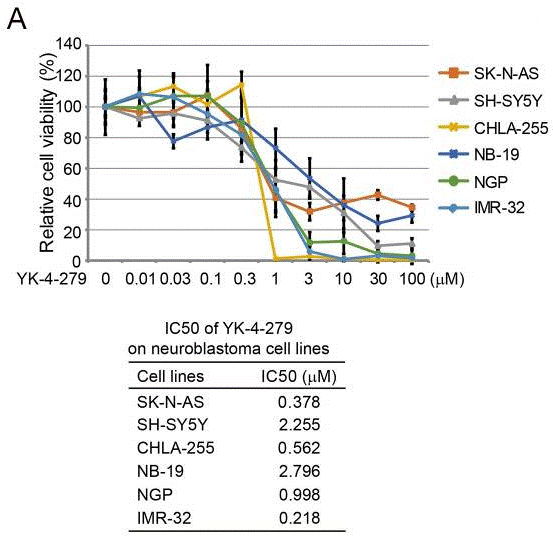
| Growth inhibition assay | Cell viability |
|
29212266 |
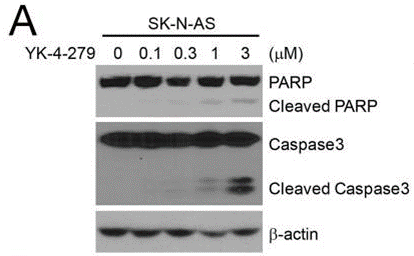
| Western blot | PARP / Cleaved PARP / Caspase 3 / Cleaved Caspase 3 p-HH3(Ser10) / Histone H3 / p-Aurora A (T288) / Aurora A / Aurora B / Cyclin B / p53 / p21 |
|
29212266 |
Häufig gestellte Fragen (FAQ) (Frequently Asked Questions)
Frage 1:
I would like to know whether it is the racemate version, or whether it is the + R-enantiomer or the – S-enantiomer of this compound?
Antwort:
For our S7679, it is a recemate.

Die Produkte sind nur für Forschungszwecke bestimmt. Nicht zur Anwendung am Menschen. Kein Verkauf an Patienten.
©Copyright 2013 Selleck Chemicals. Alle Rechte vorbehalten.