
Nur für die Forschung bestimmt
R788 (Fostamatinib) Disodium Syk Inhibitor
Kat.-Nr.: S2206
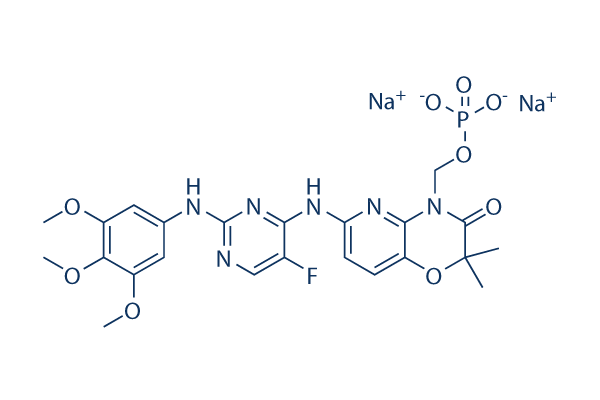
Chemische Struktur
Molekulargewicht: 624.42
Qualitätskontrolle (Quality Control)
| Verwandte Targets | EGFR VEGFR JAK FGFR PDGFR Src HIF FLT3 HER2 FLT |
|---|---|
| Andere Syk Inhibitors | R406 R406 (free base) PRT062607 (P505-15) HCl Entospletinib (GS-9973) Piceatannol BAY 61-3606 dihydrochloride PRT-060318 2HCl TAK-659 Hydrochloride Lanraplenib (GS-SYK) RO9021 |
Zellkultur, Behandlung & Arbeitskonzentration
(Cell Culture, Treatment & Working Concentration)
| Zelllinien | Assay-Typ | Konzentration | Inkubationszeit | Formulierung | Aktivitätsbeschreibung | PMID |
|---|---|---|---|---|---|---|
| Ramos | Function assay | Inhibition of SYK in human Ramos cells, IC50 = 0.267 μM. | 23350847 | |||
| SJ-GBM2 | qHTS assay | qHTS of pediatric cancer cell lines to identify multiple opportunities for drug repurposing: Primary screen for SJ-GBM2 cells | 29435139 | |||
| A673 | qHTS assay | qHTS of pediatric cancer cell lines to identify multiple opportunities for drug repurposing: Primary screen for A673 cells | 29435139 | |||
| SK-N-MC | qHTS assay | qHTS of pediatric cancer cell lines to identify multiple opportunities for drug repurposing: Primary screen for SK-N-MC cells | 29435139 | |||
| NB-EBc1 | qHTS assay | qHTS of pediatric cancer cell lines to identify multiple opportunities for drug repurposing: Primary screen for NB-EBc1 cells | 29435139 | |||
| U-2 OS | qHTS assay | qHTS of pediatric cancer cell lines to identify multiple opportunities for drug repurposing: Primary screen for U-2 OS cells | 29435139 | |||
| Saos-2 | qHTS assay | qHTS of pediatric cancer cell lines to identify multiple opportunities for drug repurposing: Primary screen for Saos-2 cells | 29435139 | |||
| SK-N-SH | qHTS assay | qHTS of pediatric cancer cell lines to identify multiple opportunities for drug repurposing: Primary screen for SK-N-SH cells | 29435139 | |||
| NB1643 | qHTS assay | qHTS of pediatric cancer cell lines to identify multiple opportunities for drug repurposing: Primary screen for NB1643 cells | 29435139 | |||
| LAN-5 | qHTS assay | qHTS of pediatric cancer cell lines to identify multiple opportunities for drug repurposing: Primary screen for LAN-5 cells | 29435139 | |||
| Rh18 | qHTS assay | qHTS of pediatric cancer cell lines to identify multiple opportunities for drug repurposing: Primary screen for Rh18 cells | 29435139 | |||
| OHS-50 | qHTS assay | qHTS of pediatric cancer cell lines to identify multiple opportunities for drug repurposing: Primary screen for OHS-50 cells | 29435139 | |||
| RD | qHTS assay | qHTS of pediatric cancer cell lines to identify multiple opportunities for drug repurposing: Primary screen for RD cells | 29435139 | |||
| MG 63 (6-TG R) | qHTS assay | qHTS of pediatric cancer cell lines to identify multiple opportunities for drug repurposing: Primary screen for MG 63 (6-TG R) cells | 29435139 | |||
| Rh41 | qHTS assay | qHTS of pediatric cancer cell lines to identify multiple opportunities for drug repurposing: Primary screen for Rh41 cells | 29435139 | |||
| NB1643 | qHTS assay | qHTS of pediatric cancer cell lines to identify multiple opportunities for drug repurposing: Confirmatory screen for NB1643 cells | 29435139 | |||
| A673 | qHTS assay | qHTS of pediatric cancer cell lines to identify multiple opportunities for drug repurposing: Confirmatory screen for A673 cells) | 29435139 | |||
| SK-N-MC | qHTS assay | qHTS of pediatric cancer cell lines to identify multiple opportunities for drug repurposing: Confirmatory screen for SK-N-MC cells | 29435139 | |||
| LAN-5 | qHTS assay | qHTS of pediatric cancer cell lines to identify multiple opportunities for drug repurposing: Confirmatory screen for LAN-5 cells | 29435139 | |||
| DAOY | qHTS assay | qHTS of pediatric cancer cell lines to identify multiple opportunities for drug repurposing: Confirmatory screen for DAOY cells | 29435139 | |||
| BT-37 | qHTS assay | qHTS of pediatric cancer cell lines to identify multiple opportunities for drug repurposing: Confirmatory screen for BT-37 cells | 29435139 | |||
| TC32 | qHTS assay | qHTS of pediatric cancer cell lines to identify multiple opportunities for drug repurposing: Confirmatory screen for TC32 cells | 29435139 | |||
| MG 63 (6-TG R) | qHTS assay | qHTS of pediatric cancer cell lines to identify multiple opportunities for drug repurposing: Confirmatory screen for MG 63 (6-TG R) cells | 29435139 | |||
| U-2 OS | qHTS assay | qHTS of pediatric cancer cell lines to identify multiple opportunities for drug repurposing: Confirmatory screen for U-2 OS cells | 29435139 | |||
| Rh41 | qHTS assay | qHTS of pediatric cancer cell lines to identify multiple opportunities for drug repurposing: Confirmatory screen for Rh41 cells | 29435139 | |||
| RD | qHTS assay | qHTS of pediatric cancer cell lines to identify multiple opportunities for drug repurposing: Confirmatory screen for RD cells | 29435139 | |||
| Rh30 | qHTS assay | qHTS of pediatric cancer cell lines to identify multiple opportunities for drug repurposing: Confirmatory screen for Rh30 cells | 29435139 | |||
| Saos-2 | qHTS assay | qHTS of pediatric cancer cell lines to identify multiple opportunities for drug repurposing: Confirmatory screen for Saos-2 cells | 29435139 | |||
| OHS-50 | qHTS assay | qHTS of pediatric cancer cell lines to identify multiple opportunities for drug repurposing: Confirmatory screen for OHS-50 cells | 29435139 | |||
| SK-N-SH | qHTS assay | qHTS of pediatric cancer cell lines to identify multiple opportunities for drug repurposing: Confirmatory screen for SK-N-SH cells | 29435139 | |||
| Klicken Sie hier, um weitere experimentelle Zellliniendaten anzuzeigen | ||||||
Chemische Informationen, Lagerung & Stabilität (Chemical Information, Storage & Stability)
| Molekulargewicht | 624.42 | Formel | C23H24FN6O9P.2Na |
Lagerung (Ab Erhaltdatum) | |
|---|---|---|---|---|---|
| CAS-Nr. | 1025687-58-4 | SDF herunterladen | Lagerung von Stammlösungen |
|
|
| Synonyme | Tamatinib Fosdium | Smiles | CC1(C(=O)N(C2=C(O1)C=CC(=N2)NC3=NC(=NC=C3F)NC4=CC(=C(C(=C4)OC)OC)OC)COP(=O)([O-])[O-])C.[Na+].[Na+] | ||
Löslichkeit (Solubility)
|
In vitro |
DMSO
: 12 mg/mL
(19.21 mM)
Water : Insoluble Ethanol : Insoluble |
Molaritätsrechner
|
In vivo |
|||||
In-vivo-Formulierungsrechner (Klare Lösung)
Schritt 1: Geben Sie unten die Informationen ein (Empfohlen: Ein zusätzliches Tier einplanen, um Verluste während des Experiments auszugleichen)
Schritt 2: Geben Sie die In-vivo-Formulierung ein (Dies ist nur der Rechner, nicht die Formulierung. Bitte kontaktieren Sie uns zuerst, wenn im Abschnitt Löslichkeit keine In-vivo-Formulierung angegeben ist.)
Berechnungsergebnisse:
Arbeitskonzentration: mg/ml;
Methode zur Herstellung der DMSO-Stammflüssigkeit: mg Wirkstoff voraufgelöst in μL DMSO ( Konzentration der Stammflüssigkeit mg/mL, Bitte kontaktieren Sie uns zuerst, wenn die Konzentration die DMSO-Löslichkeit der jeweiligen Wirkstoffcharge überschreitet. )
Methode zur Herstellung der In-vivo-Formulierung: Nehmen Sie μL DMSO Stammflüssigkeit, fügen Sie als Nächstes hinzuμL PEG300, mischen und aufklären, fügen Sie als Nächstes hinzuμL Tween 80, mischen und aufklären, fügen Sie als Nächstes hinzu μL ddH2O, mischen und aufklären.
Methode zur Herstellung der In-vivo-Formulierung: Nehmen Sie μL DMSO Stammflüssigkeit, fügen Sie als Nächstes hinzu μL Maisöl, mischen und aufklären.
Hinweis: 1. Bitte stellen Sie sicher, dass die Flüssigkeit klar ist, bevor Sie das nächste Lösungsmittel hinzufügen.
2. Achten Sie darauf, die Lösungsmittel in der richtigen Reihenfolge hinzuzufügen. Sie müssen sicherstellen, dass die im vorherigen Schritt erhaltene Lösung klar ist, bevor Sie das nächste Lösungsmittel hinzufügen. Physikalische Methoden wie Vortexen, Ultraschall oder ein warmes Wasserbad können zur Unterstützung des Lösungsvorgangs verwendet werden.
Wirkungsmechanismus (Mechanism of Action)
| Eigenschaften |
Clinically used oral formulation of R406.
|
|---|---|
| Targets/IC50/Ki |
Syk
(Cell-free assay) 41 nM
|
| In vitro |
R935788 is a methylene phosphate prodrug of R406, which can be rapidly converted to R406 in vivo. R406 (in vitro active form of R935788) selectively inhibits Syk-dependent signaling with EC50 values ranging from 33 nM to 171 nM, more potently than Syk-independent pathways in different cells. R406 inhibits cellular proliferation of a variety of diffuse large B-cell lymphoma (DLBCL) cell lines with EC50 values ranging from 0.8 μM to 8.1 μM. R406 treatment reduces basal phosphorylation of BLNK, Akt, glycogen synthase kinase-3 (GSK-3), forkhead box O (FOXO) and ERK not only in cells with high (TCL-002) but also in cells with low levels of phosphorylated Syk (TCL1-551). In addition, R406 completely inhibits the anti-IgM induced Bcr signal in TCL1 leukemias. Despite the higher levels of constitutively active Syk in TCL1 leukemias, R406 is not selectively cytotoxic to the leukemic cells.
|
| Kinase-Assay |
In-vitro-Fluoreszenzpolarisations-Kinase-Assays
|
|
R406 (in vitro aktive Form von R935788) wird in DMSO seriell verdünnt und dann auf 1% DMSO in Kinasepuffer (20 mM HEPES, pH 7,4, 5 mM MgCl2, 2 mM MnCl2, 1 mM DTT, 0,1 mg/mL acetyliertes BGG) verdünnt. ATP und Substrat in Kinasepuffer werden bei Raumtemperatur zugegeben, was zu einer finalen DMSO-Konzentration von 0,2% führt. Die Kinase-Reaktionen werden in einem Endvolumen von 20 μL durchgeführt, das 5 μM HS1-Peptidsubstrat und 4 μM ATP enthält, und durch Zugabe von 0,125 ng Syk in Kinasepuffer gestartet. Die Reaktion wird 40 Minuten bei Raumtemperatur ablaufen gelassen. Die Reaktion wird durch Zugabe von 20 μL PTK-Quench-Mix gestoppt, der EDTA/Anti-Phosphotyrosin-Antikörper (1× final)/fluoreszierenden Phosphopeptid-Tracer (0,5× final) in FP-Dilutionspuffer verdünnt enthält. Die Platte wird 30 Minuten im Dunkeln bei Raumtemperatur inkubiert und dann auf einem Polarion-Fluoreszenzpolarisations-Plattenlesegerät abgelesen. Die Daten werden umgewandelt, um die Menge des vorhandenen Phosphopeptids unter Verwendung einer Kalibrierungskurve zu bestimmen, die durch Konkurrenz mit dem im Tyrosinkinase-Assay-Kit bereitgestellten Phosphopeptid-Kompetitor erzeugt wurde. Zur IC50-Bestimmung wird R406 in elf Konzentrationen in Duplikaten getestet, und die Kurvenanpassung wird durch nichtlineare Regressionsanalyse unter Verwendung der Prism GraphPad Software durchgeführt.
|
|
| In vivo |
Given that plasma half-life of R406 in mice is less than 2 hours, R935788 is administered in 3 divided doses at 3-hour intervals to provide continuous Syk inhibition during each day of treatment, mimicking the longer plasma half-life in humans (15 hours). Despite the relatively modest cytotoxic effect in vitro, R935788 significantly inhibits the proliferation and survival of leukemic cell in vivo, which is associated with the blocking of antigen-dependent B-cell receptor (Bcr) signaling rather than inhibition of constitutive Syk activity. R935788 treatment at 80 mg/kg/day for 18-21 days potently inhibits tumor growth of TCL1-002, TCL1-551 and TCL1-870 in mice with undetectable leukemic CD5+/B220+ cells at the last day of treatment, significantly prolongs the survival of the treated mice with median survival increased from 45/46 days to 170/172 days, and completely eradicates the malignant cells in a substantial proportion of mice after a 6-month follow-up period without affecting the production of normal B lymphocytes. R935788 treatment also induces an early and transient migration of both normal and malignant B cells from spleen and lymph nodes to peripheral blood, which is subsequently followed by selective growth inhibition of the malignant B-cell population. In addition, R935788 is also effective against spontaneously developing TCL1 leukemias in Eμ-TCL1 transgenic mice.
|
Referenzen |
|
Anwendungen (Applications)
| Methoden | Biomarker | Bilder | PMID |
|---|---|---|---|
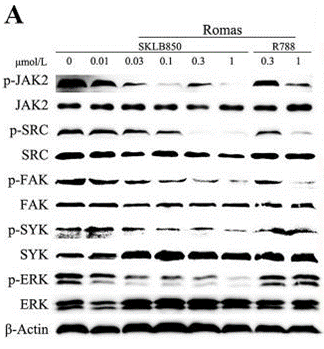
| Western blot | p-JAK2 / JAK2 / p-SRC / SRC / p-FAK / FAK / p-SYK / SYK / p-ERK / ERK p-SYK(525-526) / t-SYK / p-SYK(323) / p-BTK / t-BTK p-MEK / MEK / p-ERK / ERK / p-AKT / AKT |
|
29340070 |
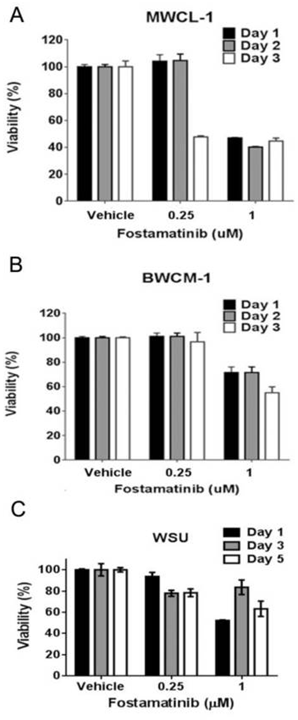
| Growth inhibition assay | Cell viability |
|
25748087 |
Informationen zu klinischen Studien (Clinical Trial Information)
(Daten von https://clinicaltrials.gov, aktualisiert am 2026-01-22)
| NCT-Nummer | Rekrutierung | Bedingungen | Sponsor/Kollaboratoren | Startdatum | Phases |
|---|---|---|---|---|---|
| NCT06233110 | RECRUITING | Chronic Graft Versus Host Disease |
Stefanie Sarantopoulos, MD, PhD. |
2025-10-29 | PHASE1 |
| NCT06948097 | RECRUITING | Lung Transplantation |
National Heart, Lung, and Blood Institute (NHLBI) |
2026-09-09 | PHASE1 |
| NCT06639724 | RECRUITING | Pancreatic Ductal Adenocarcinoma (PDAC) |
University of California, San Diego |
2024-12-05 | PHASE1 |
| NCT06564207 | NOT_YET_RECRUITING | Acute Respiratory Distress Syndrome; ARDS |
Inova Health Care Services |
2026-08-30 | PHASE2 |
| NCT05904093 | RECRUITING | Sickle Cell Disease; Hb-SS Disease; Hemoglobin S; Disease Sickle Cell Anemia; Sickle Cell Disorders; Hemoglobin Beta Thalassemia Disease |
National Heart, Lung, and Blood Institute (NHLBI) |
2024-12-18 | PHASE1 |
| NCT05509582 | WITHDRAWN | Immune Mediated Anemia; Immune Mediated Thrombocytopenia; Chronic GVHD |
National Heart, Lung, and Blood Institute (NHLBI) |
2025-11-07 | PHASE2 |
Häufig gestellte Fragen (FAQ) (Frequently Asked Questions)
Frage 1:
What’s the difference between S2625 and S2206?
Antwort:
The differences between S2625 and S2206: 1. S2206 is more stable than S2625; 2. The water solubility of S2206 is better than S2625; 3. The absorption of S2206 is harder than S2625, so you need to test the suitable dosage if you use it in animal assays; 4. The potency of S2206 and S2625 is similar.

Die Produkte sind nur für Forschungszwecke bestimmt. Nicht zur Anwendung am Menschen. Kein Verkauf an Patienten.
©Copyright 2013 Selleck Chemicals. Alle Rechte vorbehalten.