
Nur für die Forschung bestimmt
Rociletinib (CO-1686) EGFR Inhibitor
Kat.-Nr.: S7284
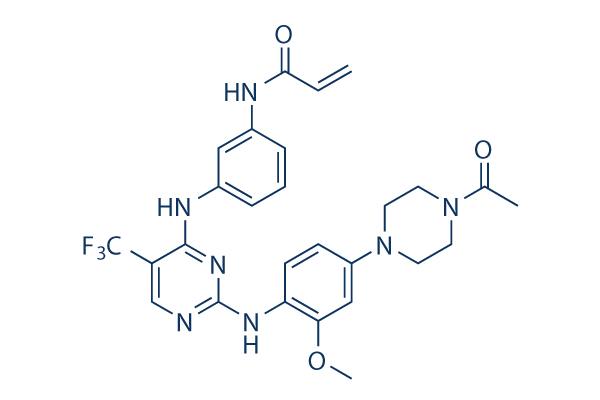
Chemische Struktur
Molekulargewicht: 555.55
Qualitätskontrolle (Quality Control)
| Verwandte Targets | VEGFR FGFR PDGFR c-Met Src MEK CSF-1R FLT3 HER2 c-Kit |
|---|---|
| Andere EGFR Inhibitors | Lazertinib (YH25448) Icotinib Hydrochloride Sunvozertinib AG-490 AG-1478 Canertinib (CI-1033) Genistein Poziotinib (NOV120101, HM781-36B) WZ4002 PD153035 HCl |
Zellkultur, Behandlung & Arbeitskonzentration
(Cell Culture, Treatment & Working Concentration)
| Zelllinien | Assay-Typ | Konzentration | Inkubationszeit | Formulierung | Aktivitätsbeschreibung | PMID |
|---|---|---|---|---|---|---|
| NCI-H1975 | Kinase assay | ~5 μM | DMSO | inhibits pEGFR with IC50 of 62 nM | ||
| HCC827 | Kinase assay | ~5 μM | DMSO | inhibits pEGFR with IC50 of 187 nM | ||
| HCC827-EPR | Kinase assay | ~5 μM | DMSO | inhibits pEGFR with IC50 of 180 nM | ||
| PC9 | Kinase assay | ~5 μM | DMSO | inhibits pEGFR with IC50 of 211 nM | ||
| A431 | Kinase assay | ~5 μM | DMSO | inhibits pEGFR with IC50 of >4331 nM | ||
| NCI-H1299 | Kinase assay | ~5 μM | DMSO | inhibits pEGFR with IC50 of >2000 nM | ||
| NCI-H358 | Kinase assay | ~5 μM | DMSO | inhibits pEGFR with IC50 of >2000 nM | ||
| NCI-H1975 | Growth inhibitory assay | ~5 μM | DMSO | GI50=32 nM | ||
| HCC827 | Growth inhibitory assay | ~5 μM | DMSO | GI50=7 nM | ||
| HCC827-EPR | Growth inhibitory assay | ~5 μM | DMSO | GI50=20 nM | ||
| PC9 | Growth inhibitory assay | ~5 μM | DMSO | GI50=26 nM | ||
| A431 | Growth inhibitory assay | ~5 μM | DMSO | GI50=547 nM | ||
| NCI-H1299 | Growth inhibitory assay | ~5 μM | DMSO | GI50=4275 nM | ||
| NCI-H358 | Growth inhibitory assay | ~5 μM | DMSO | GI50=1806 nM | ||
| PC-9 (exon 19del) | Growth inhibitory assay | ~10 μM | DMSO | IC50=84 nM | ||
| H3255 (L858R) | Growth inhibitory assay | ~10 μM | DMSO | IC50=35 nM | ||
| PC-9ER (exon 19del+T790M) | Growth inhibitory assay | ~10 μM | DMSO | IC50=37 nM | ||
| H1975 (L858R+T790M) | Growth inhibitory assay | ~10 μM | DMSO | IC50=23 nM | ||
| BID007 (A763_Y764insFQEA) | Growth inhibitory assay | ~10 μM | DMSO | IC50=1278 nM | ||
| Ba/F3 (FQEA) | Growth inhibitory assay | ~10 μM | DMSO | IC50=673 nM | ||
| Ba/F3 (HH) | Growth inhibitory assay | ~10 μM | DMSO | IC50=1730 nM | ||
| Ba/F3 (ASV) | Growth inhibitory assay | ~10 μM | DMSO | IC50=5290 nM | ||
| Ba/F3 (FQEA) | Growth inhibitory assay | ~10 μM | DMSO | IC50=262 nM | ||
| Klicken Sie hier, um weitere experimentelle Zellliniendaten anzuzeigen | ||||||
Chemische Informationen, Lagerung & Stabilität (Chemical Information, Storage & Stability)
| Molekulargewicht | 555.55 | Formel | C27H28F3N7O3 |
Lagerung (Ab Erhaltdatum) | |
|---|---|---|---|---|---|
| CAS-Nr. | 1374640-70-6 | SDF herunterladen | Lagerung von Stammlösungen |
|
|
| Synonyme | AVL-301 | Smiles | CC(=O)N1CCN(CC1)C2=CC(=C(C=C2)NC3=NC=C(C(=N3)NC4=CC(=CC=C4)NC(=O)C=C)C(F)(F)F)OC | ||
Löslichkeit (Solubility)
|
In vitro |
DMSO
: 100 mg/mL
(180.0 mM)
Water : Insoluble Ethanol : Insoluble |
Molaritätsrechner
|
In vivo |
|||||
In-vivo-Formulierungsrechner (Klare Lösung)
Schritt 1: Geben Sie unten die Informationen ein (Empfohlen: Ein zusätzliches Tier einplanen, um Verluste während des Experiments auszugleichen)
Schritt 2: Geben Sie die In-vivo-Formulierung ein (Dies ist nur der Rechner, nicht die Formulierung. Bitte kontaktieren Sie uns zuerst, wenn im Abschnitt Löslichkeit keine In-vivo-Formulierung angegeben ist.)
Berechnungsergebnisse:
Arbeitskonzentration: mg/ml;
Methode zur Herstellung der DMSO-Stammflüssigkeit: mg Wirkstoff voraufgelöst in μL DMSO ( Konzentration der Stammflüssigkeit mg/mL, Bitte kontaktieren Sie uns zuerst, wenn die Konzentration die DMSO-Löslichkeit der jeweiligen Wirkstoffcharge überschreitet. )
Methode zur Herstellung der In-vivo-Formulierung: Nehmen Sie μL DMSO Stammflüssigkeit, fügen Sie als Nächstes hinzuμL PEG300, mischen und aufklären, fügen Sie als Nächstes hinzuμL Tween 80, mischen und aufklären, fügen Sie als Nächstes hinzu μL ddH2O, mischen und aufklären.
Methode zur Herstellung der In-vivo-Formulierung: Nehmen Sie μL DMSO Stammflüssigkeit, fügen Sie als Nächstes hinzu μL Maisöl, mischen und aufklären.
Hinweis: 1. Bitte stellen Sie sicher, dass die Flüssigkeit klar ist, bevor Sie das nächste Lösungsmittel hinzufügen.
2. Achten Sie darauf, die Lösungsmittel in der richtigen Reihenfolge hinzuzufügen. Sie müssen sicherstellen, dass die im vorherigen Schritt erhaltene Lösung klar ist, bevor Sie das nächste Lösungsmittel hinzufügen. Physikalische Methoden wie Vortexen, Ultraschall oder ein warmes Wasserbad können zur Unterstützung des Lösungsvorgangs verwendet werden.
Wirkungsmechanismus (Mechanism of Action)
| Targets/IC50/Ki |
EGFR (L858R/T790M)
(Cell-free assay) 21.5 nM(Ki)
EGFR (wt)
(Cell-free assay) 303.3 nM(Ki)
|
|---|---|
| In vitro |
Rociletinib (CO-1686) inhibits p-EGFR with IC50 ranging from 62 to 187 nM in mutant EGFR–expressing cells, while it inhibits EGFR phosphorylation with IC50 of > 2,000 nM in the three WT EGFR–expressing cells. This compound selectively inhibits growth of NSCLC cells expressing mutant EGFR with GI50 ranging from 7 to 32 nM, and induces apoptosis. CO-1686–resistant NSCLC cell lines exhibit signs of epithelial-mesenchymal transition and increased sensitivity to AKT inhibitors.
|
| Kinase-Assay |
Studien zur Hemmkinetik
|
|
Rekombinante humane Wildtyp- und T790M/L858R-Doppelmutanten-EGFR, beide N-terminal GST-markiert, werden im Assay für Rociletinib (CO-1686) verwendet. Der Omnia Continuous-Read-Assay wird wie vom Anbieter beschrieben durchgeführt.
|
|
| In vivo |
Rociletinib (CO-1686) causes dose-dependent and significant tumor growth inhibition in all EGFR-mutant models as well as human EGFRL858R- and EGFRL858R/T790M-expressing transgenic mice.
|
Referenzen |
Informationen zu klinischen Studien (Clinical Trial Information)
(Daten von https://clinicaltrials.gov, aktualisiert am 2016-05-17)
| NCT-Nummer | Rekrutierung | Bedingungen | Sponsor/Kollaboratoren | Startdatum | Phases |
|---|---|---|---|---|---|
| NCT02705339 | WITHDRAWN | Carcinoma, Non-Small-Cell Lung; Non-Small Cell Lung Cancer; Nonsmall Cell Lung Cancer |
Washington University School of Medicine |
2016-05 | PHASE2 |
| NCT02147990 | TERMINATED | Non-small Cell Lung Cancer |
Clovis Oncology, Inc. |
2014-06-16 | PHASE2 |
| NCT01526928 | TERMINATED | Locally Advanced or Metastatic Non Small Cell Lung Cancer |
Clovis Oncology, Inc. |
2012-03-27 | PHASE1; PHASE2 |
| NCT02322281 | TERMINATED | Non-small Cell Lung Cancer |
Clovis Oncology, Inc. |
2015-02 | PHASE3 |
| NCT02630186 | TERMINATED | Non-small Cell Lung Cancer |
Clovis Oncology, Inc. |
2016-02-24 | PHASE1; PHASE2 |
| NCT02186301 | TERMINATED | Non-Small Cell Lung Cancer |
Clovis Oncology, Inc. |
2014-11 | PHASE2; PHASE3 |

Die Produkte sind nur für Forschungszwecke bestimmt. Nicht zur Anwendung am Menschen. Kein Verkauf an Patienten.
©Copyright 2013 Selleck Chemicals. Alle Rechte vorbehalten.