
Nur für die Forschung bestimmt
Benzbromarone P450 (e.g. CYP17) Hemmer
Kat.-Nr.: S4221
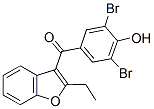
Chemische Struktur
Molekulargewicht: 424.08
Qualitätskontrolle (Quality Control)
| Verwandte Targets | Dehydrogenase HSP Transferase PDE phosphatase PPAR Vitamin Carbohydrate Metabolism Mitochondrial Metabolism Casein Kinase |
|---|---|
| Andere P450 (e.g. CYP17) Inhibitors | Apigenin Baicalein Naringenin Diosmetin Alizarin Orteronel Sodium Danshensu Naringin Piperine Danshensu |
Chemische Informationen, Lagerung & Stabilität (Chemical Information, Storage & Stability)
| Molekulargewicht | 424.08 | Formel | C17H12Br2O3 |
Lagerung (Ab Erhaltdatum) | |
|---|---|---|---|---|---|
| CAS-Nr. | 3562-84-3 | SDF herunterladen | Lagerung von Stammlösungen |
|
|
| Synonyme | Desuric | Smiles | CCC1=C(C2=CC=CC=C2O1)C(=O)C3=CC(=C(C(=C3)Br)O)Br | ||
Löslichkeit (Solubility)
|
In vitro |
DMSO
: 85 mg/mL
(200.43 mM)
Ethanol : 15 mg/mL Water : Insoluble |
Molaritätsrechner
|
In vivo |
|||||
In-vivo-Formulierungsrechner (Klare Lösung)
Schritt 1: Geben Sie unten die Informationen ein (Empfohlen: Ein zusätzliches Tier einplanen, um Verluste während des Experiments auszugleichen)
Schritt 2: Geben Sie die In-vivo-Formulierung ein (Dies ist nur der Rechner, nicht die Formulierung. Bitte kontaktieren Sie uns zuerst, wenn im Abschnitt Löslichkeit keine In-vivo-Formulierung angegeben ist.)
Berechnungsergebnisse:
Arbeitskonzentration: mg/ml;
Methode zur Herstellung der DMSO-Stammflüssigkeit: mg Wirkstoff voraufgelöst in μL DMSO ( Konzentration der Stammflüssigkeit mg/mL, Bitte kontaktieren Sie uns zuerst, wenn die Konzentration die DMSO-Löslichkeit der jeweiligen Wirkstoffcharge überschreitet. )
Methode zur Herstellung der In-vivo-Formulierung: Nehmen Sie μL DMSO Stammflüssigkeit, fügen Sie als Nächstes hinzuμL PEG300, mischen und aufklären, fügen Sie als Nächstes hinzuμL Tween 80, mischen und aufklären, fügen Sie als Nächstes hinzu μL ddH2O, mischen und aufklären.
Methode zur Herstellung der In-vivo-Formulierung: Nehmen Sie μL DMSO Stammflüssigkeit, fügen Sie als Nächstes hinzu μL Maisöl, mischen und aufklären.
Hinweis: 1. Bitte stellen Sie sicher, dass die Flüssigkeit klar ist, bevor Sie das nächste Lösungsmittel hinzufügen.
2. Achten Sie darauf, die Lösungsmittel in der richtigen Reihenfolge hinzuzufügen. Sie müssen sicherstellen, dass die im vorherigen Schritt erhaltene Lösung klar ist, bevor Sie das nächste Lösungsmittel hinzufügen. Physikalische Methoden wie Vortexen, Ultraschall oder ein warmes Wasserbad können zur Unterstützung des Lösungsvorgangs verwendet werden.
Wirkungsmechanismus (Mechanism of Action)
| Targets/IC50/Ki |
CYP2C9
19.3 nM(Ki)
|
|---|---|
| In vitro |
Benzbromarone (20 μM) decreases mitochondrial membrane potential by 81% in isolated rat hepatocytes. This compound decreases state 3 oxidation and respiratory control ratios for L-glutamate with IC50 < 1 μM in isolated rat liver mitochondria. It (50 μM) uncouples oxidative phosphorylation and increases oxygen consumption by hepatocytes starting at 10 μM in isolated rat hepatocytes. This chemical also inhibits the formation of acid-soluble β-oxidation products in a dose-dependent manner with IC50 of 2 μM. It (100 μM) inhibits the electron transport chain and are uncouplers of oxidative phosphorylation in isolated rat liver mitochondria. This compound (1 μM) leads to concentration-dependent increasion of ROS production in HepG2 cells. It (100 μM) leads to a significant increase in mitochondrial size of isolated rat liver mitochondria. This chemical is associated with leakage of cytochrome c into the cytoplasm of HepG2 cells. It (100 μM) results in the proportion of apoptotic cells of 11% in rat hepatocytes. This compound significantly reduces the oxypurinol uptake at a concentration as low as 10 nM and completely blocks it at 1 μM. It (1 μM) uptakes the typical substrate of OCTN1 (tetraethylammonium) and OCTN2 (carnitine) in the HEK293 cells expressed with human OCTN1 by 96.7% and 111% of control, respectively. This chemical completely inhibits urate uptake at 50 μM in URAT1-expressing oocytes, with IC50 of less than 0.1 μM. It activates through sequential hydroxylation of the benzofuran ring to a catechol, which can then be further oxidized to a reactive quinone intermediate capable of adducting protein. |
Referenzen |
|
Informationen zu klinischen Studien (Clinical Trial Information)
(Daten von https://clinicaltrials.gov, aktualisiert am 2024-10-15)
| NCT-Nummer | Rekrutierung | Bedingungen | Sponsor/Kollaboratoren | Startdatum | Phases |
|---|---|---|---|---|---|
| NCT05504083 | COMPLETED | Hyperuricemia |
InventisBio Co., Ltd |
2022-09-28 | PHASE2 |
| NCT03534037 | UNKNOWN | Hyperuricemia; Metabolic Syndrome; Left Ventricular Diastolic Dysfunction |
National Defense Medical Center, Taiwan |
2020-02-01 | PHASE4 |
| NCT05210517 | COMPLETED | Type 2 Diabetes |
Amsterdam UMC, location VUmc |
2020-10-01 | PHASE4 |
| NCT02944214 | UNKNOWN | Chronic Kidney Disease; Hyperuricemia; Abnormal Renal Function |
Shanghai 10th People's Hospital |
2016-10 | |
| NCT02338323 | COMPLETED | Chronic Kidney Disease; Hyperuricemia; Abnormal Renal Function |
Shanghai 10th People's Hospital |
2015-01 | |
| NCT03185793 | COMPLETED | Hyperuricemia |
Jiangsu HengRui Medicine Co., Ltd. |
2017-07-20 | PHASE2 |

Die Produkte sind nur für Forschungszwecke bestimmt. Nicht zur Anwendung am Menschen. Kein Verkauf an Patienten.
©Copyright 2013 Selleck Chemicals. Alle Rechte vorbehalten.