
Technische Daten
| Formel | C20H28O2 |
||||||||||
| Molekulargewicht | 300.4 | CAS-Nr. | 302-79-4 | ||||||||
| Löslichkeit (25°C)* | In vitro | DMSO | 60 mg/mL (199.73 mM) | ||||||||
| Ethanol | 4 mg/mL (13.31 mM) | ||||||||||
| Water | Insoluble | ||||||||||
| In vivo (Lösungsmittel dem Produkt einzeln und nacheinander hinzufügen.) |
|
||||||||||
|
* <1 mg/ml bedeutet schwer löslich oder unlöslich. * Bitte beachten Sie, dass Selleck die Löslichkeit aller Verbindungen intern testet und die tatsächliche Löslichkeit geringfügig von den veröffentlichten Werten abweichen kann. Dies ist normal und auf leichte Abweichungen zwischen den Chargen zurückzuführen. * Versand bei Raumtemperatur (Stabilitätstests zeigen, dass dieses Produkt ohne Kühlmassnahmen versendet werden kann.) |
|||||||||||
Herstellung von Stammlösungen
Biologische Aktivität
| Beschreibung | Retinoic acid (Tretinoin, Vitamin A acid) ist ein Ligand sowohl für den Retinoid Receptor (RAR) als auch für den Retinoid X Receptor (RXR) und kann die granulozytische Differenzierung und Apoptose in Zellen der akuten promyelozytären Leukämie (APL) induzieren. Tretinoin (NSC 122758) kann zur Induktion von Tiermodellen der Osteoporose verwendet werden. | ||
|---|---|---|---|
| Targets |
|
||
| In vitro | Retinoic acid (Tretinoin, Vitamin A acid) prevents the cytotoxicity of H2O2 in cultured human mesangial cells by increasing both the catalase activity and the reduced glutathione content, which are dose- and time-dependent changes. Its incubation leads to increased levels of catalase mRNA and gamma-glutamyl-cysteine synthetase (catalytic subunit) mRNA, the latter being the rate-limiting step in de novo reduced glutathione synthesis. This compound also upregulates matrix metalloproteinase-13 and matrix metalloproteinase-8 in human keloid-derived fibroblasts. |
||
| In vivo | Retinoic acid (Tretinoin, Vitamin A acid) has been shown to reduce renal cortex protein content by 30% in treated old male Fischer 344 rats compared to controls, an effect potentially mediated through inhibition of tumor necrosis factor-beta1 and osteopontin expression. It also prevents major steroid-induced biomechanical changes in hairless mouse dermal connective tissue that contribute to atrophy. When combined with imiquimod, this compound leads to tattoo fading and moderate pigment clearance on histopathology in guinea pigs. Additionally, it increases fibroblastic proliferation in skin incisions made in CD-1 mice, though collagen production is diminished. |
Protokoll (aus Referenz)
| Zell-Assay: |
|
|---|---|
| Tierstudie: |
|
Referenzen
|
Produktvalidierung durch den Kunden
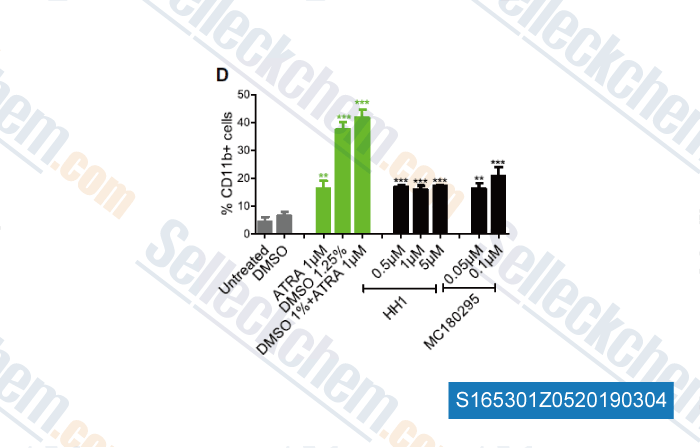
-
Daten von [ , , Cell, 2018, 175(5):1244-1258 ]
Sellecks Retinoic acid (Tretinoin, Vitamin A acid) Wurde zitiert von 43 Publikationen
| Retinoic acid rewires the adrenergic core regulatory circuitry of childhood neuroblastoma [ Science Advances, October 20, 2021, eabe0834] | PubMed: 34669465 |
| The Effect of Retinoic Acid on Arsenite-Transformed Malignant UROtsa Bladder Cancer Cells: In Vitro Model of Basal Muscle-Invasive Bladder Cancer [ Cancers, March 17, 2024, 1178] | PubMed: 38539513 |
| Pre-adaptation of stem cell-derived islet organoids to hypoxia via zinc transportation inhibition drives angiogenesis [ Cell Stem Cell, 2026, 33(4):676-694.e10] | PubMed: 41932324 |
| CPSF6-RARγ interacts with histone deacetylase 3 to promote myeloid transformation in RARG-fusion acute myeloid leukemia [ Nat Commun, 2025, 16(1):616] | PubMed: 39805830 |
| LDH nanoparticles-doped cellulose nanofiber scaffolds with aligned microchannels direct high-efficiency neural regeneration and organized neural circuit remodeling through RhoA/Rock/Myosin II pathway [ Biomaterials, 2025, 314:122873] | PubMed: 39369670 |
| Construction of human pluripotent stem cell-derived testicular organoids and their use as humanized testis models for evaluating the effects of semaglutide [ Theranostics, 2025, 15(6):2597-2623] | PubMed: 39990223 |
| Extracellular lactate improves neurogenesis by modulating H3K9 lactylation and SnoN expression under hypoxic conditions [ Stem Cell Res Ther, 2025, 16(1):462] | PubMed: 40866997 |
| Human epicardial organoids from pluripotent stem cells resemble fetal stage with potential cardiomyocyte- transdifferentiation [ Cell Biosci, 2025, 15(1):4] | PubMed: 39825425 |
| Study of Retinoic Acid-Induced Osteoarthritis: Integrating RNA-Sequencing, Network Pharmacology, Molecular Docking, and Experimental Validation [ Int J Mol Sci, 2025, 26(12)5519] | PubMed: 40564983 |
| Potassium Iodide Induces Apoptosis in Salivary Gland Cancer Cells [ Int J Mol Sci, 2025, 26(11)5199] | PubMed: 40508009 |
RÜCKGABERICHTLINIE
Die bedingungslose Rückgaberichtlinie von Selleck Chemicals sorgt für ein reibungsloses Online-Einkaufserlebnis unserer Kunden. Wenn Sie mit Ihrem Kauf in irgendeiner Weise unzufrieden sind, können Sie jeden Artikel innerhalb von 7 Tagen nach Erhalt zurücksenden. Im Falle von Produktqualitätsproblemen, seien sie protokoll- oder produktbedingt, können Sie jeden Artikel innerhalb von 365 Tagen ab dem ursprünglichen Kaufdatum zurücksenden. Bitte befolgen Sie bei der Rücksendung von Produkten die nachstehenden Anweisungen.
VERSAND UND LAGERUNG
Selleck-Produkte werden bei Raumtemperatur transportiert. Wenn Sie das Produkt bei Raumtemperatur erhalten, seien Sie unbesorgt; die Qualitätsprüfungsabteilung von Selleck hat durch Experimente nachgewiesen, dass eine Lagerung bei normaler Temperatur von einem Monat die biologische Aktivität von Pulverprodukten nicht beeinträchtigt. Nach Erhalt lagern Sie das Produkt bitte gemäss den im Datenblatt beschriebenen Anforderungen. Die meisten Selleck-Produkte sind unter den empfohlenen Bedingungen stabil.
NICHT FÜR DIE ANWENDUNG AN MENSCHEN, IN DER VETERINÄRDIAGNOSTIK ODER ZU THERAPEUTISCHEN ZWECKEN BESTIMMT.