
Technische Daten
| Formel | C13H13N3O3 |
||||||||||
| Molekulargewicht | 259.26 | CAS-Nr. | 191732-72-6 | ||||||||
| Löslichkeit (25°C)* | In vitro | DMSO | 51 mg/mL (196.71 mM) | ||||||||
| Water | Insoluble | ||||||||||
| Ethanol | Insoluble | ||||||||||
| In vivo (Lösungsmittel dem Produkt einzeln und nacheinander hinzufügen.) |
|
||||||||||
|
* <1 mg/ml bedeutet schwer löslich oder unlöslich. * Bitte beachten Sie, dass Selleck die Löslichkeit aller Verbindungen intern testet und die tatsächliche Löslichkeit geringfügig von den veröffentlichten Werten abweichen kann. Dies ist normal und auf leichte Abweichungen zwischen den Chargen zurückzuführen. * Versand bei Raumtemperatur (Stabilitätstests zeigen, dass dieses Produkt ohne Kühlmassnahmen versendet werden kann.) |
|||||||||||
Herstellung von Stammlösungen
Biologische Aktivität
| Beschreibung | Lenalidomid ist ein TNF-α-Sekretionshemmer mit einer IC50 von 13 nM in PBMCs. Lenalidomid (CC-5013) ist ein Ligand der Ubiquitin-E3-Ligase Cereblon (CRBN) und verursacht die selektive Ubiquitinierung und den Abbau zweier lymphoider Transkriptionsfaktoren, IKZF1 und IKZF3, durch die CRBN-CRL4-Ubiquitinligase. Lenalidomid fördert die Expression von gespaltener Caspase-3 und hemmt die VEGF-Expression und induziert die Apoptose. | ||||||
|---|---|---|---|---|---|---|---|
| Targets |
|
||||||
| In vitro | Lenalidomide strongly induces IL-2 and sIL-2R production. This compound-induced tyrosine phosphorylation of CD28 on T cells is followed by a down-stream activation of NF-κB. This compound and pomalidomide inhibits autoubiquitination of CRBN in HEK293 T cells expressing thalidomide-binding competent wild-type CRBN, but not thalidomide-binding defective CRBN(YW/AA). Overexpression of CRBN wild-type protein, but not CRBN(YW/AA) mutant protein, in KMS12 myeloma cells, amplifies pomalidomide-mediated reductions in c-myc and IRF4 expression and increases in p21(WAF-1) expression. Long-term selection for this compound resistance in H929 myeloma cell lines is accompanied by a reduction in CRBN, while in DF15R myeloma cells resistant to both pomalidomide and this chemical, CRBN protein is undetectable. This chemical prevents induction of defects by down-regulating tumor cell inhibitory molecule expression. It prevents induction of tumor-induced T cell lytic synapse dysfunction. This compound treatment blocks CLL cell-induced T cell actin synapse dysfunction, mimicks antibody blockade, and down-regulates expression of CLL inhibitory ligands and their receptors on T cells. This treatment prevents tumor-induced immune suppression in FL, DLBCL, HL, MM, SCC, and OC and down-regulates immunosuppressive ligand expression on all tumor cells examined. CTL killing function significantly increases following antibody blockade of CLL inhibitory ligands or this chemical treatment compared to control treatments. Treatment of autologous CLL-T cell co-cultures with this agent reverses impaired CD8+ T cell lytic synapse formation and granzyme B trafficking. |
||||||
| In vivo | The induction of angiogenesis by bFGF is significantly inhibited by oral treatment of Lenalidomide in a dose-dependent manner. This compound significantly decreases the percentage of vascularized area from 5.16% (control group) to 2.58% (50 mg/kg). It significantly reduces the calculated total MVL from 21.07 (control) to 8.11 (50 mg/kg). This chemical significantly inhibites HUVEC migration through the fibronectin-coated membranes towards 0.1 ng/mL of bFGF at 100 μM, 1 ng/mL of VEGF at concentrations of 10 μM and 100 μM. |
Protokoll (aus Referenz)
| Kinase-Assay: |
|
|---|---|
| Tierstudie: |
|
Referenzen
|
Produktvalidierung durch den Kunden
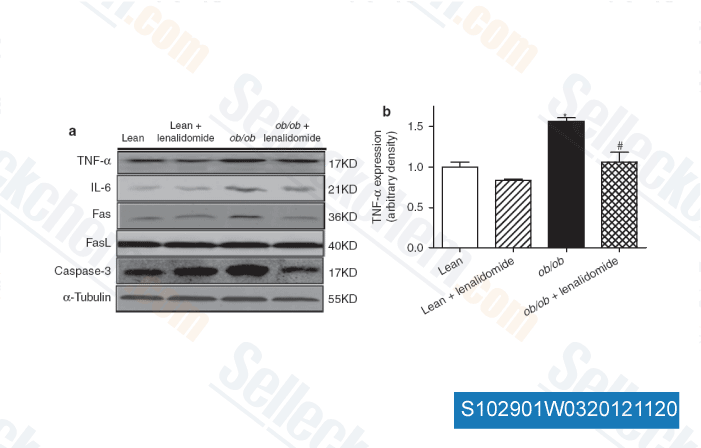
-
Daten von [ Obesity , 2012 , 20, 2174-85 ]

-
, , Harvard Medical School

-
, , Harvard Medical School

-
Daten von [ , , Clin Cancer Res, 2011, 17(10): 3259–71 ]
Sellecks CC-5013 (Lenalidomide) Wurde zitiert von 190 Publikationen
| Dual targeting PD-L1 and 4-1BB to overcome dendritic cell-mediated lenalidomide resistance in follicular lymphoma [ Signal Transduct Target Ther, 2025, 10(1):29] | PubMed: 39828715 |
| IKAROS levels are associated with antigen escape in CD19- and CD22-targeted therapies for B-cell malignancies [ Nat Commun, 2025, 16(1):3800] | PubMed: 40268897 |
| A patient-derived T cell lymphoma biorepository uncovers pathogenetic mechanisms and host-related therapeutic vulnerabilities [ Cell Rep Med, 2025, S2666-3791(25)00102-8] | PubMed: 40147445 |
| Haploinsufficiency of miR-143 and miR-145 reveal targetable dependencies in resistant del(5q) myelodysplastic neoplasm [ Leukemia, 2025, 39(4):917-928] | PubMed: 40000845 |
| The Prolonged Half-Life of the p53 Missense Variant R248Q Promotes Accumulation and Heterotetramer Formation with Wild-Type p53 to Exert the Dominant-Negative Effect [ Cancer Research, 2025, 1978-1996] | PubMed: 40163352 |
| The Prolonged Half-Life of the p53 Missense Variant R248Q Promotes Accumulation and Heterotetramer Formation with Wildtype p53 to Exert the Dominant-Negative Effect [ Cancer Res, 2025, 10.1158/0008-5472.CAN-24-1136] | PubMed: 40163352 |
| Enhancing T cell cytotoxicity in multiple myeloma with bispecific αPD-L1 × αCD3 T cell engager-armed T cells and low-dose bortezomib therapy [ Biomed Pharmacother, 2025, 184:117878] | PubMed: 39891948 |
| Rapid and high-throughput screening of proteolysis targeting chimeras using a dual-reporter system expressing fluorescence protein and luciferase [ BMC Biol, 2025, 23(1):51] | PubMed: 39985000 |
| KAT/3BP: A Metabolism-Targeting Agent with Single and Combination Activity in Aggressive B-Cell Lymphomas [ Cancers (Basel), 2025, 17(12)2034] | PubMed: 40563683 |
| Reposition of lenalidomide as a radiation protector based on LINCS gene expression signatures and its preclinical validation [ Sci Rep, 2025, 15(1):12955] | PubMed: 40234645 |
RÜCKGABERICHTLINIE
Die bedingungslose Rückgaberichtlinie von Selleck Chemicals sorgt für ein reibungsloses Online-Einkaufserlebnis unserer Kunden. Wenn Sie mit Ihrem Kauf in irgendeiner Weise unzufrieden sind, können Sie jeden Artikel innerhalb von 7 Tagen nach Erhalt zurücksenden. Im Falle von Produktqualitätsproblemen, seien sie protokoll- oder produktbedingt, können Sie jeden Artikel innerhalb von 365 Tagen ab dem ursprünglichen Kaufdatum zurücksenden. Bitte befolgen Sie bei der Rücksendung von Produkten die nachstehenden Anweisungen.
VERSAND UND LAGERUNG
Selleck-Produkte werden bei Raumtemperatur transportiert. Wenn Sie das Produkt bei Raumtemperatur erhalten, seien Sie unbesorgt; die Qualitätsprüfungsabteilung von Selleck hat durch Experimente nachgewiesen, dass eine Lagerung bei normaler Temperatur von einem Monat die biologische Aktivität von Pulverprodukten nicht beeinträchtigt. Nach Erhalt lagern Sie das Produkt bitte gemäss den im Datenblatt beschriebenen Anforderungen. Die meisten Selleck-Produkte sind unter den empfohlenen Bedingungen stabil.
NICHT FÜR DIE ANWENDUNG AN MENSCHEN, IN DER VETERINÄRDIAGNOSTIK ODER ZU THERAPEUTISCHEN ZWECKEN BESTIMMT.