
Technische Daten
| Formel | C22H18Cl2N8 |
||||||
| Molekulargewicht | 465.34 | CAS-Nr. | 252917-06-9 | ||||
| Löslichkeit (25°C)* | In vitro | DMSO | 93 mg/mL (199.85 mM) | ||||
| Water | Insoluble | ||||||
| Ethanol | Insoluble | ||||||
| In vivo (Lösungsmittel dem Produkt einzeln und nacheinander hinzufügen.) |
|
||||||
|
* <1 mg/ml bedeutet schwer löslich oder unlöslich. * Bitte beachten Sie, dass Selleck die Löslichkeit aller Verbindungen intern testet und die tatsächliche Löslichkeit geringfügig von den veröffentlichten Werten abweichen kann. Dies ist normal und auf leichte Abweichungen zwischen den Chargen zurückzuführen. * Versand bei Raumtemperatur (Stabilitätstests zeigen, dass dieses Produkt ohne Kühlmassnahmen versendet werden kann.) |
|||||||
Herstellung von Stammlösungen
Biologische Aktivität
| Beschreibung | Laduviglusib (CHIR-99021, CT99021) ist ein GSK-3α- und GSK-3β-Inhibitor mit IC50-Werten von 10 nM bzw. 6,7 nM. Es zeigt keine Kreuzreaktivität gegen Cyclin-abhängige Kinasen (CDKs) und eine 350-fache Selektivität gegenüber GSK-3β im Vergleich zu CDKs. Diese Verbindung fungiert als Wnt/β-catenin-Aktivator und induziert Autophagy. | ||||
|---|---|---|---|---|---|
| Targets |
|
||||
| In vitro | CHIR-99021 (Laduviglusib) shows greater than 500-fold selectivity for GSK-3 versus its closest homologs CDC2 and ERK2, as well as other protein kinases. Furthermore, it shows only weak binding to a panel of 22 pharmacologically relevant receptors and little inhibitory activity against a panel of 23 nonkinase enzymes. This compound induces the activation of glycogen synthase (GS) in insulin receptor-expressing CHO-IR cells with EC50 of 0.763 μM. | ||||
| In vivo | Oral administration of CHIR-99021 (Laduviglusib) at 30 mg/kg enhances glucose metabolism in a rodent model of type 2 diabetes, with a maximal plasma glucose reduction of nearly 150 mg/dl 3-4 hours after administration, while plasma insulin remains at or below control levels. When given orally at 16 or 48 mg/kg 1 hour before oral glucose challenges in ZDF rats, this compound significantly improves glucose tolerance with 14% and 33% reduction in plasma glucose at 16 mg/kg and 48 mg/kg, respectively; the higher dose also reduces hyperglycemia before the oral glucose challenge. |
Protokoll (aus Referenz)
| Zell-Assay: |
|
|---|---|
| Tierstudie: |
|
Referenzen
|
Produktvalidierung durch den Kunden
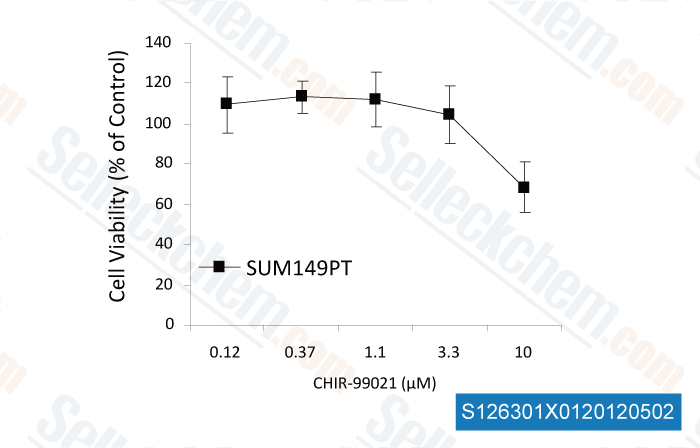
-
, , Dr. Yong-Weon Yi from Georgetown University Medical Center
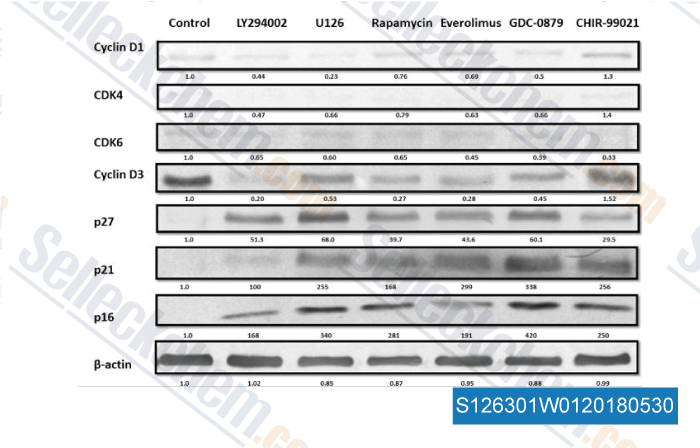
-
Daten von [ , , Med Oncol, 2017, 35(1):7 ]
Sellecks CHIR-99021 (Laduviglusib) Wurde zitiert von 1086 Publikationen
| GLIS2 Promotes Epithelial-Mesenchymal Transition and Gastric Cancer Progression by Regulating BGN to Activate the Wnt/β-Catenin Pathway [ The Kaohsiung Journal of Medical Sciences, September 12, 2025, e70103] | |
| Rapamycin and CHIR99021 Coordinate Robust Cardiomyocyte Differentiation From Human Pluripotent Stem Cells Via Reducing p53-Dependent Apoptosis [ Journal of the American Heart Association, October 2, 2017, e005295] | PubMed: 28971953 |
| The Glycogen Synthase Kinase-3 Inhibitor CHIR99021 Reduces Fatty Infiltration and Muscle Atrophy After Rotator Cuff Tears: An In Vitro Experiment and In Vivo Mouse Model [ The American Journal of Sports Medicine, February 24, 2025, 1184-1194] | |
| Pre-adaptation of stem cell-derived islet organoids to hypoxia via zinc transportation inhibition drives angiogenesis [ Cell Stem Cell, 2026, 33(4):676-694.e10] | PubMed: 41932324 |
| Histone H3.3 phosphorylation facilitates H3K9me3-heterochromatin formation during retrotransposon silencing and X-chromosome inactivation via H3.3K27me3-CBX7-KAP1 axis [ Sci Bull (Beijing), 2026, 71(4):820-837] | PubMed: 41582043 |
| Neural crest cell-derived DKK1 and NEDD4 modulate Wnt signalling in the second heart field to orchestrate outflow tract development [ Nat Commun, 2026, 17(1):1751] | PubMed: 41571667 |
| Epitranscriptomic regulation of mRNA stability in pivotal transcription factors modulates the second cell fate decision [ Nat Commun, 2026, 17(1):5800] | PubMed: 42045194 |
| Modeling early human heart development using an iPSC-based 3D bioprinted model of embryonic heart tube [ Nat Commun, 2026, 17(1):5689] | PubMed: 42031752 |
| Unbalanced chromatin binding of Polycomb complexes drives neurodevelopmental disorders [ Mol Cell, 2026, 86(4):604-624.e16] | PubMed: 41653922 |
| Endogenous retroviral elements LTR8B and MER65 rewire PSG9 regulation to control trophoblast syncytialization and pre-eclampsia risk [ Genome Biol, 2026, 27(1)73] | PubMed: 41796334 |
RÜCKGABERICHTLINIE
Die bedingungslose Rückgaberichtlinie von Selleck Chemicals sorgt für ein reibungsloses Online-Einkaufserlebnis unserer Kunden. Wenn Sie mit Ihrem Kauf in irgendeiner Weise unzufrieden sind, können Sie jeden Artikel innerhalb von 7 Tagen nach Erhalt zurücksenden. Im Falle von Produktqualitätsproblemen, seien sie protokoll- oder produktbedingt, können Sie jeden Artikel innerhalb von 365 Tagen ab dem ursprünglichen Kaufdatum zurücksenden. Bitte befolgen Sie bei der Rücksendung von Produkten die nachstehenden Anweisungen.
VERSAND UND LAGERUNG
Selleck-Produkte werden bei Raumtemperatur transportiert. Wenn Sie das Produkt bei Raumtemperatur erhalten, seien Sie unbesorgt; die Qualitätsprüfungsabteilung von Selleck hat durch Experimente nachgewiesen, dass eine Lagerung bei normaler Temperatur von einem Monat die biologische Aktivität von Pulverprodukten nicht beeinträchtigt. Nach Erhalt lagern Sie das Produkt bitte gemäss den im Datenblatt beschriebenen Anforderungen. Die meisten Selleck-Produkte sind unter den empfohlenen Bedingungen stabil.
NICHT FÜR DIE ANWENDUNG AN MENSCHEN, IN DER VETERINÄRDIAGNOSTIK ODER ZU THERAPEUTISCHEN ZWECKEN BESTIMMT.