
Technische Daten
| Formel | C20H22F3N5O |
||||||
| Molekulargewicht | 405.42 | CAS-Nr. | 1025065-69-3 | ||||
| Löslichkeit (25°C)* | In vitro | DMSO | 81 mg/mL (199.79 mM) | ||||
| Ethanol | 81 mg/mL (199.79 mM) | ||||||
| Water | Insoluble | ||||||
| In vivo (Lösungsmittel dem Produkt einzeln und nacheinander hinzufügen.) |
|
||||||
|
* <1 mg/ml bedeutet schwer löslich oder unlöslich. * Bitte beachten Sie, dass Selleck die Löslichkeit aller Verbindungen intern testet und die tatsächliche Löslichkeit geringfügig von den veröffentlichten Werten abweichen kann. Dies ist normal und auf leichte Abweichungen zwischen den Chargen zurückzuführen. * Versand bei Raumtemperatur (Stabilitätstests zeigen, dass dieses Produkt ohne Kühlmassnahmen versendet werden kann.) |
|||||||
Herstellung von Stammlösungen
Biologische Aktivität
| Beschreibung | SGI-1776 free base ist ein neuartiger ATP-kompetitiver Inhibitor von Pim1 mit einer IC50 von 7 nM in einem zellfreien Assay, 50- und 10-fach selektiver gegenüber Pim2 und Pim3, auch wirksam gegen Flt3 und Haspin. SGI-1776 induziert Apoptose und Autophagy. | ||||||||
|---|---|---|---|---|---|---|---|---|---|
| Targets |
|
||||||||
| In vitro | In addition to Pim, SGI-1776 also potently targets FLT3 (IC50 = 44nM). Treatment of AML cells with SGI-1776 results in a concentration-dependent induction of apoptosis. Importantly, SGI-1776 is also cytotoxic in AML primary cells, irrespective of FLT3 mutation status and results in Mcl-1 protein decline. Treatment of CLL cells with SGI-1776 results in a concentration-dependent induction of apoptosis. SGI-1776 induces apoptosis in CLL and that the mechanism involves Mcl-1 reduction. Apoptosis induction coupled with the inhibition of RNA synthesis is observed in CLL cells treated with SGI-1776. SGI-1776 exhibites cytotoxic activity in vitro with a median relative IC50 of 3.1 mM. SGI-1776 induces tumor growth inhibition meeting criteria for intermediate EFS T/C activity in 1 of 39 evaluable models. In contrast, SGI-1776 induces complete responses of subcutaneous MV4;11. |
||||||||
| In vivo | Consistent with cell line data, xenograft model studies with mice bearing MV-4-11 tumors shows efficacy with SGI-1776. SGI-1776 has shown preclinical activity against leukemia and solid tumor cell line models with IC50 values of 0.005–11.68 mM. SGI-1776 induces significant differences in EFS distribution in vivo in 9 of 31 solid tumor xenografts and in 1 of 8 of the evaluable ALL xenografts. |
Protokoll (aus Referenz)
| Kinase-Assay: |
|
|---|---|
| Zell-Assay: |
|
| Tierstudie: |
|
Referenzen
|
Produktvalidierung durch den Kunden
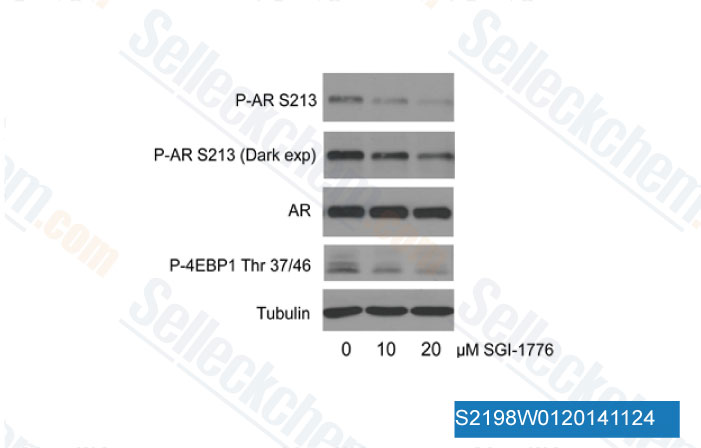
-
Daten von [ Oncogene , 2013 , 32(34), 3992-4000 ]
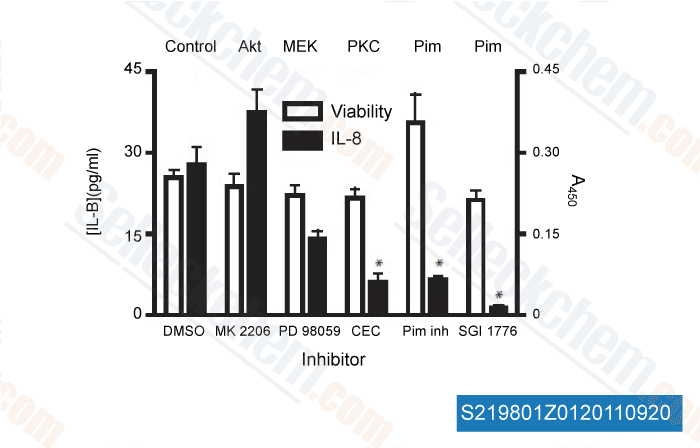
-
Daten von [ Sci Signal , 2011 , 4, rs9 ]
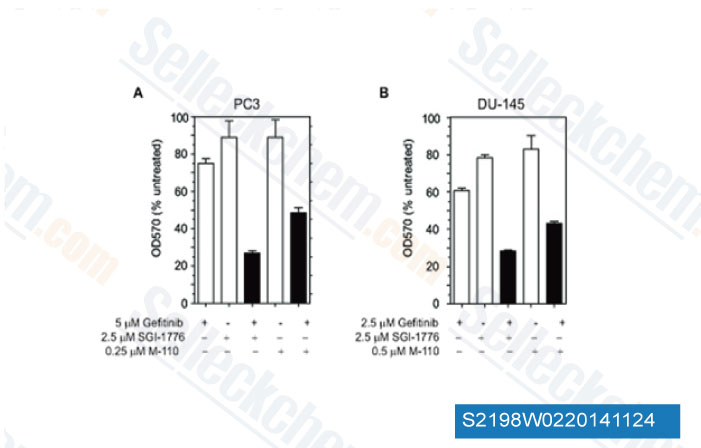
-
Daten von [ Oncotarget , 2011 , 2(12), 1134-44 ]
Sellecks SGI-1776 free base Wurde zitiert von 43 Publikationen
| PIM1 kinase promotes EMT-associated osimertinib resistance via regulating GSK3β signaling pathway in EGFR-mutant non-small cell lung cancer [ Cell Death Dis, 2024, 15(9):644] | PubMed: 39227379 |
| New Fusarochromanone Derivatives from the Marine Fungus Fusarium equiseti UBOCC-A-117302 [ Mar Drugs, 2024, 22(10)444] | PubMed: 39452852 |
| CDK9 inhibition induces epigenetic reprogramming revealing strategies to circumvent resistance in lymphoma [ Mol Cancer, 2023, 22(1):64] | PubMed: 36998071 |
| Neoprzewaquinone A Inhibits Breast Cancer Cell Migration and Promotes Smooth Muscle Relaxation by Targeting PIM1 to Block ROCK2/STAT3 Pathway [ Int J Mol Sci, 2023, 24(6)5464] | PubMed: 36982538 |
| Structure Activity Relationship Studies around DB18, a Potent and Selective Inhibitor of CLK Kinases [ Molecules, 2022, 27(19)6149] | PubMed: 36234686 |
| Targeting Echinococcus multilocularis PIM kinase for improving anti-parasitic chemotherapy [ PLoS Negl Trop Dis, 2022, 16(10):e0010483] | PubMed: 36190997 |
| Preclinical Immunopharmacologic Assessment of KPL-404, a Novel, Humanized, Non-Depleting Antagonistic Anti-CD40 Monoclonal Antibody [ Int J Gynecol Pathol, 2022, 10.1097/PGP.0000000000000882] | PubMed: 35443252 |
| Inhibition of PIM Kinases in DLBCL Targets MYC Transcriptional Program and Augments the Efficacy of Anti-CD20 Antibodies [ Cancer Res, 2021, 81(23):6029-6043] | PubMed: 34625423 |
| Inhibition of PIM Kinases in DLBCL Targets MYC Transcriptional Program and Augments the Efficacy of Anti-CD20 Antibodies [ Cancer Res, 2021, canres.1023.2021] | PubMed: 34625423 |
| PIM1 phosphorylation of the androgen receptor and 14-3-3 ζ regulates gene transcription in prostate cancer [ Commun Biol, 2021, 4(1):1221] | PubMed: 34697370 |
RÜCKGABERICHTLINIE
Die bedingungslose Rückgaberichtlinie von Selleck Chemicals sorgt für ein reibungsloses Online-Einkaufserlebnis unserer Kunden. Wenn Sie mit Ihrem Kauf in irgendeiner Weise unzufrieden sind, können Sie jeden Artikel innerhalb von 7 Tagen nach Erhalt zurücksenden. Im Falle von Produktqualitätsproblemen, seien sie protokoll- oder produktbedingt, können Sie jeden Artikel innerhalb von 365 Tagen ab dem ursprünglichen Kaufdatum zurücksenden. Bitte befolgen Sie bei der Rücksendung von Produkten die nachstehenden Anweisungen.
VERSAND UND LAGERUNG
Selleck-Produkte werden bei Raumtemperatur transportiert. Wenn Sie das Produkt bei Raumtemperatur erhalten, seien Sie unbesorgt; die Qualitätsprüfungsabteilung von Selleck hat durch Experimente nachgewiesen, dass eine Lagerung bei normaler Temperatur von einem Monat die biologische Aktivität von Pulverprodukten nicht beeinträchtigt. Nach Erhalt lagern Sie das Produkt bitte gemäss den im Datenblatt beschriebenen Anforderungen. Die meisten Selleck-Produkte sind unter den empfohlenen Bedingungen stabil.
NICHT FÜR DIE ANWENDUNG AN MENSCHEN, IN DER VETERINÄRDIAGNOSTIK ODER ZU THERAPEUTISCHEN ZWECKEN BESTIMMT.