
Technische Daten
| Formel | C17H15FN2O3 |
||||||
| Molekulargewicht | 314.31 | CAS-Nr. | 852475-26-4 | ||||
| Löslichkeit (25°C)* | In vitro | DMSO | 13 mg/mL (41.36 mM) | ||||
| Water | Insoluble | ||||||
| Ethanol | Insoluble | ||||||
| In vivo (Lösungsmittel dem Produkt einzeln und nacheinander hinzufügen.) |
|
||||||
|
* <1 mg/ml bedeutet schwer löslich oder unlöslich. * Bitte beachten Sie, dass Selleck die Löslichkeit aller Verbindungen intern testet und die tatsächliche Löslichkeit geringfügig von den veröffentlichten Werten abweichen kann. Dies ist normal und auf leichte Abweichungen zwischen den Chargen zurückzuführen. * Versand bei Raumtemperatur (Stabilitätstests zeigen, dass dieses Produkt ohne Kühlmassnahmen versendet werden kann.) |
|||||||
Herstellung von Stammlösungen
Biologische Aktivität
| Beschreibung | MC1568 ist ein selektiver HDAC-Inhibitor für Mais-HD1-A mit einem IC50-Wert von 100 nM in einem zellfreien Assay. Er ist 34-fach selektiver für HD1-A als für HD1-B. | ||||
|---|---|---|---|---|---|
| Targets |
|
||||
| In vitro | MC1568 is a selective class II (IIa) histone deacetylas (HDAC II) inhibitor with IC50 of 220 nM and 176-fold class II selectivity (against class I). In human breast cancer ZR-75.1 cell lysates, this compound (5 μM) shows no inhibitory activity against HDAC1 but is able to inhibit HDAC4. In MCF-7 cells, this compound (20 μM) increases the accumulation of acetylated H3 and H4 histones, as well as the levels of acetyl-tubulin, which indicates a inhibitory effect of this chemical on HDAC6. In C2C12 cells, this compound (5 μM) arrests myogenesis by decreasing myocyte enhancer factor 2D (MEF2D) expression, stabilizing the HDAC4-HDAC3-MEF2D complex, and by inhibiting differentiation-induced MEF2D acetylation. This compound (5 or 10 μM) interferes with the RAR- and PPARγ-mediated differentiation-inducing signaling pathways. In F9 cells, this chemical specifically blocks endodermal differentiation despite not affecting retinoic acid-induced maturation of promyelocytic NB4 cells. In 3T3-L1 cells, this compound attenuates PPARγ-induced adipogenesis. |
||||
| In vivo | In mice, MC1568 (50 mg/kg) shows an apparent tissue-selective HDAC inhibition. In skeletal muscle and heart, this compound inhibits the activity of HDAC4 and HDAC5 without affecting HDAC3 activity, thereby leaving MEF2-HDAC complexes in a repressed state. In reporting PPRE-Luc mice, it impairs PPARγ signaling mostly in the heart and adipose tissues. In a recent study of pancreatic explants, this chemical enhances expression of Pax4, a key factor required for proper β-and δ-cell differentiation and amplifies endocrine β- and δ-cells. |
Protokoll (aus Referenz)
| Kinase-Assay: |
|
|---|---|
| Zell-Assay: |
|
| Tierstudie: |
|
Referenzen
|
Produktvalidierung durch den Kunden

-
Daten von [ Proc Natl Acad Sci U S A , 2012 , 109(34) ]
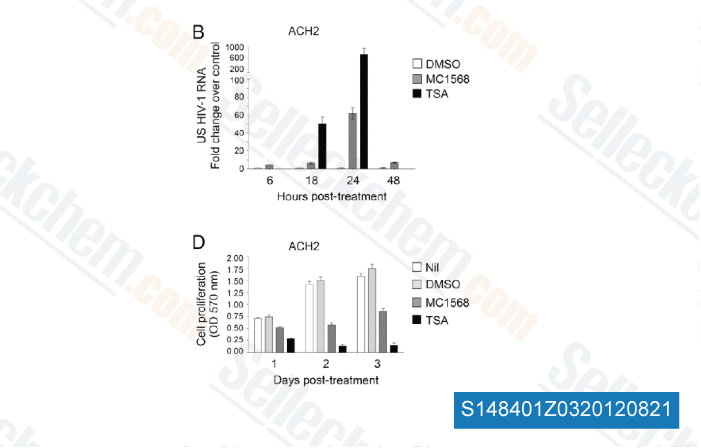
-
Daten von [ Proc Natl Acad Sci U S A , 2012 , 109(34) ]
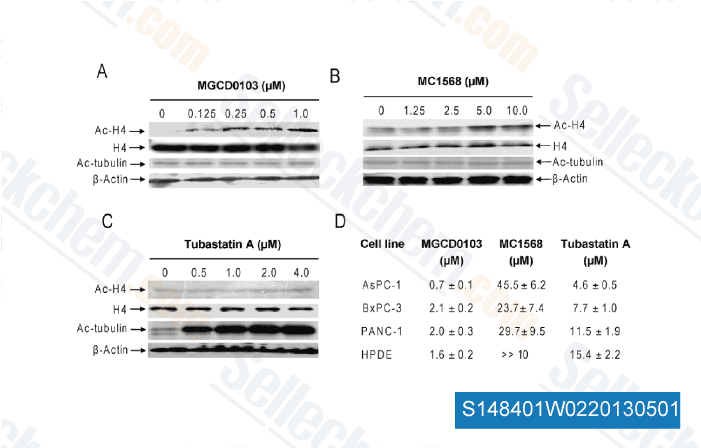
-
Daten von [ PLoS One , 2012 , 7(12), e52095 ]
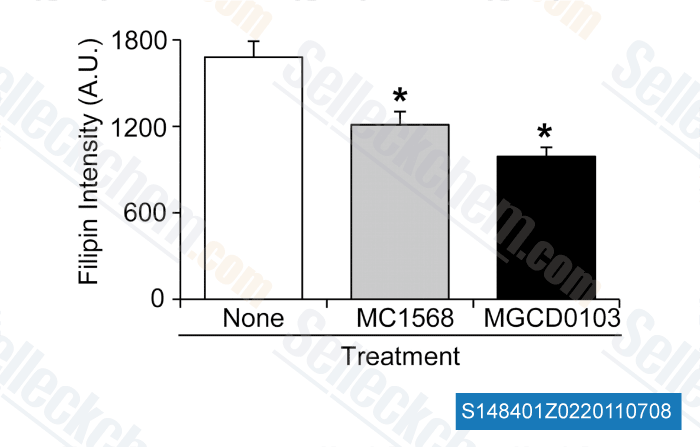
-
Daten von [ J Biol Chem , 2011 , 286, 23842–23851 ]
Sellecks MC1568 Wurde zitiert von 51 Publikationen
| HSD17B4 deficiency causes dysregulation of primary cilia and is alleviated by acetyl-CoA [ Nat Commun, 2025, 16(1):2663] | PubMed: 40102401 |
| Key epigenetic and signaling factors in the formation and maintenance of the blood-brain barrier [ Elife, 2024, 12RP86978] | PubMed: 39670988 |
| Global isonicotinylome analysis identified SMAD3 isonicotinylation promotes liver cancer cell epithelial-mesenchymal transition and invasion [ iScience, 2024, 27(9):110775] | PubMed: 39286495 |
| Selective Inhibition of Histone Deacetylase Class IIa With MC1568 Ameliorates Podocyte Injury [ Front Med (Lausanne), 2022, 9:848938] | PubMed: 35492337 |
| HBV covalently closed circular DNA minichromosomes in distinct epigenetic transcriptional states differ in their vulnerability to damage [ Hepatology, 2021, 10.1002/hep.32245] | PubMed: 34779008 |
| Butyrate and Class I Histone Deacetylase Inhibitors Promote Differentiation of Neonatal Porcine Islet Cells into Beta Cells [ Cells, 2021, 10(11)3249] | PubMed: 34831471 |
| Epigenetic Repression of Chloride Channel Accessory 2 Transcription in Cardiac Fibroblast: Implication in Cardiac Fibrosis [ Front Cell Dev Biol, 2021, 9:771466] | PubMed: 34869368 |
| HDAC8 cooperates with SMAD3/4 complex to suppress SIRT7 and promote cell survival and migration. [ Nucleic Acids Res, 2020, 6;48(6):2912-2923] | PubMed: 31970414 |
| Valproate reverses mania-like behaviors in mice via preferential targeting of HDAC2 [ Mol Psychiatry, 2020, 10.1038/s41380-020-00958-2] | PubMed: 33235333 |
| Valproic acid upregulates the expression of the p75NTR/sortilin receptor complex to induce neuronal apoptosis [ Apoptosis, 2020, 10.1007/s10495-020-01626-0] | PubMed: 32712736 |
RÜCKGABERICHTLINIE
Die bedingungslose Rückgaberichtlinie von Selleck Chemicals sorgt für ein reibungsloses Online-Einkaufserlebnis unserer Kunden. Wenn Sie mit Ihrem Kauf in irgendeiner Weise unzufrieden sind, können Sie jeden Artikel innerhalb von 7 Tagen nach Erhalt zurücksenden. Im Falle von Produktqualitätsproblemen, seien sie protokoll- oder produktbedingt, können Sie jeden Artikel innerhalb von 365 Tagen ab dem ursprünglichen Kaufdatum zurücksenden. Bitte befolgen Sie bei der Rücksendung von Produkten die nachstehenden Anweisungen.
VERSAND UND LAGERUNG
Selleck-Produkte werden bei Raumtemperatur transportiert. Wenn Sie das Produkt bei Raumtemperatur erhalten, seien Sie unbesorgt; die Qualitätsprüfungsabteilung von Selleck hat durch Experimente nachgewiesen, dass eine Lagerung bei normaler Temperatur von einem Monat die biologische Aktivität von Pulverprodukten nicht beeinträchtigt. Nach Erhalt lagern Sie das Produkt bitte gemäss den im Datenblatt beschriebenen Anforderungen. Die meisten Selleck-Produkte sind unter den empfohlenen Bedingungen stabil.
NICHT FÜR DIE ANWENDUNG AN MENSCHEN, IN DER VETERINÄRDIAGNOSTIK ODER ZU THERAPEUTISCHEN ZWECKEN BESTIMMT.